Automotive Industry
Mercedes-Benz Opens Test Facility for Headlights
The center enables detailed testing of headlights under constant, reproducible conditions.
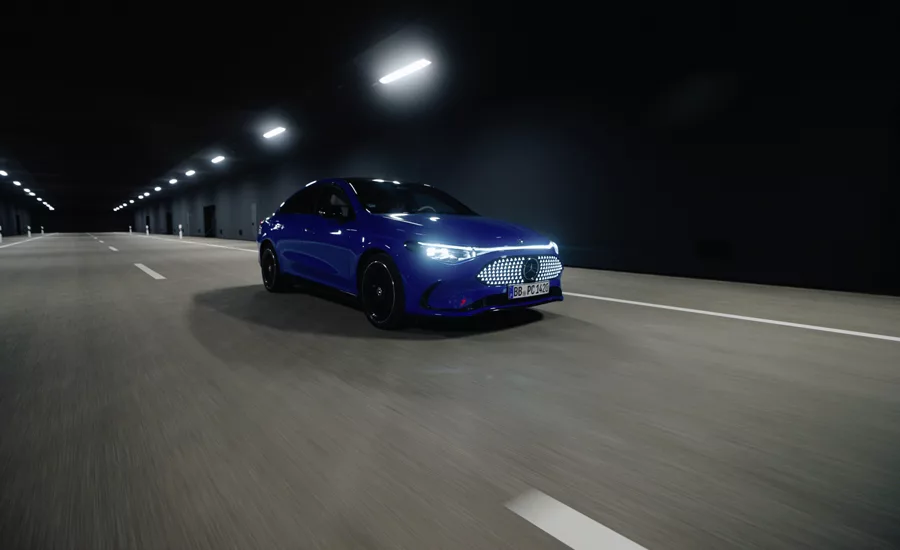
Mercedes-Benz has opened a new, state-of-the-art facility for testing automotive lighting at its Global Proving Ground. Photo courtesy of Mercedes-Benz
IMMENDINGEN, Germany—Mercedes-Benz has opened a new, state-of-the-art facility for testing automotive lighting at its Global Proving Ground here.
At 443 feet long and 26.2 feet high, the light testing center ranks among the largest of its kind in the automotive industry. It enables detailed testing of headlight systems under constant, reproducible conditions, independent of time of day, weather or environmental influences.
The center cost 10.5 million euros and took two years to construct. It authentically recreates a country road. The asphalt mixture of the road surface was specially developed to replicate the reflective properties of an aged road as closely as possible. Up to five cars can be tested in parallel, including the simulation of oncoming traffic or vehicles ahead. Reflector posts can be deployed at the sides of the road in 65-foot increments and pedestrian dummies can also be flexibly integrated.
Durability Testing Without Drivers
Among other tasks, the proving ground is used for durability testing of vehicles. Robots steer test vehicles completely autonomously along a rough-road track. The track’s potholes, bumps and cobblestones strenuously test the chassis and body of vehicles. Automating the process increases the precision of driving maneuvers, reduces strain on test drivers, and enables 24/7 operation, which significantly accelerates testing.
Depending on the vehicle, test cars must complete up to 3,728 miles on the circuit, which is equivalent to 186,411 miles of real-world driving.
Like all test areas at the proving ground, the durability circuit has a digital twin. The proving ground is digitally mapped down to the submillimeter level, and vehicles and loads are digitally mirrored. This data is used in preliminary simulations, serves as load spectra for test benches, and enables test results to be quickly fed back to the development departments.
Looking for quick answers on assembly and manufacturing topics? Try Ask ASM, our new smart AI search tool. Ask ASM
Digital testing is so precise that often many thousands of miles are driven digitally before the first physical test miles are driven on the test site. For example, when tuning chassis for each new model, more than 100 different variations are tested digitally. The most suitable variants are then installed on a prototype vehicle and tested physically at Immendingen.
53 Miles of Road
Mercedes initially spent 200 million euros on the proving ground, which is built on the site of a former military base. Since it opened in 2015, the automaker has spent additional 200 million euros to expand the site.
Spanning 1,285 acres, the proving ground has more than 30 test modules, 53 miles of road-simulating tracks, and 256 junctions. The grounds depict real-world driving environments in many ways: from complex city intersections to mountain passes with nearly 591 feet of elevation change. Some routes replicate road conditions and markings in Europe, while others copy roads from the U.S., China and Japan. Up to 400 vehicles can be on the roads at the same time in various test programs.
To test how vehicle sensors behave under low sun or particularly bright light sources, Immendingen features a so-called artificial sun. These high-performance mobile lights are otherwise used on arctic ships for iceberg detection. In addition, heavy rain and spray can also be simulated using special systems.
One of the greatest advantages of the proving ground is that nearly all test requirements for real-world testing—apart from snow, ice and extreme heat—are consolidated at a single location. Approximately 80 percent of test drives previously carried out on public roads have now been relocated to the site.
Over the past decade, approximately 30,000 test vehicles have covered more than 62 million miles at the proving ground, the equivalent of circling the Earth 2,500 times.Looking for a reprint of this article?
From high-res PDFs to custom plaques, order your copy today!