Three Ways Leaders Can Counteract Supply Chain Cost Increases
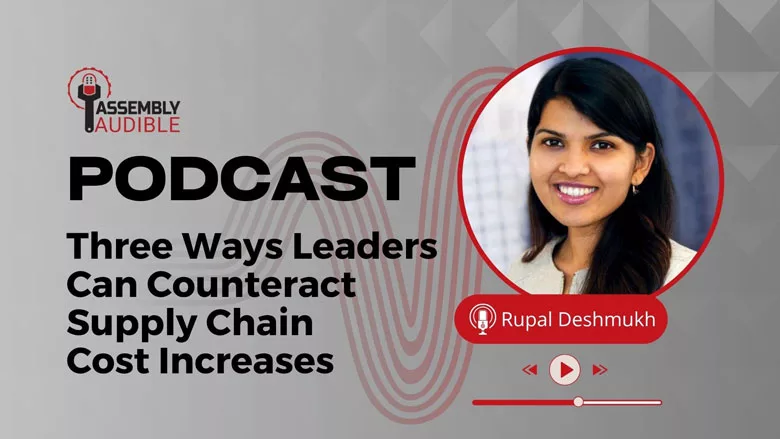
Kearney’s recent Supply Chain Navigator projects that global supply chain costs will rise to 7 percent above inflation by the end of this year. The study aims to provide a clear view of what executives should be most concerned about and what they should focus on to become more stable. We spoke with Rupal Deshmukh, partner for supply chain and strategic operations at Kearney, to learn more about the report’s findings and how operational leaders can navigate these challenges.
Q: Tell me about your work. What do you do with Kearney as a partner?
Deshmukh: I specialize in supply chain transformations, which means I work on end-to-end supply chain topics, ranging from how you buy your raw materials to how you manufacture and distribute them, as well as how you meet your customers’ needs in the most efficient way possible. Over the last 15 years, I’ve worked across a range of continents and industries, helping some of the world’s largest companies redesign their networks, unlock double-digit cost improvements, and future-proof against volatility.
My passion is about turning complexity into clarity. That’s what I enjoy doing most, whether it’s working with Fortune 500 manufacturers to save hundreds of millions of dollars by optimizing their networks, or even guiding retailers in using AI for planning.
The study we’re discussing today is from the Kearney Supply Chain Institute. We have over 60 partners who work on creating sites and reports to navigate supply chain complexity. The Kearney Supply Chain Navigator is one of those reports. The report intends to provide clarity on the cost and volatility outlook at a global level.
About Kearney’s Supply Chain Navigator
Q: How was the Supply Chain Navigator conducted?
Deshmukh: There are so many metrics that can be used to determine the health of a supply chain.
You could look at global inventory levels and see whether they’re trending high or low. You could look at manufacturing cost and distribution cost. There’s at least 30 indicators, not even counting the minutiae. We intended to develop a stock-based view of seeing where costs are likely to be and where we see them trending.
And there are three groupings of data sets we use. We use supply chain fundamentals—everything from inventory, labor and freight costs. We use sentiment, including consumer sentiment on the health of the economy. We also use supply chain professional sentiment to track cost trends. And finally, we use risk and resilience indicators.
Looking for quick answers on assembly and manufacturing topics? Try Ask ASM, our new smart AI search tool. Ask ASM
These indicators help us determine things like, what are the levels of geopolitical risk today? And then there’s a regression model and an engine that analyzes the outlook. We’ve been doing this for the last two years now. Originally we looked at every quarter, but then we eventually realized that every half-year outlook is far stronger. We found it to be accurate within 90 to 95 percent of the actuals.
The Three Primary Factors Contributing to Increased Supply Chain Costs
Q: The study indicates that global supply chain costs are projected to outpace inflation by up to 7 percent by Q4 2025. That’s up from 2 percent last year.
Can you discuss some of the factors contributing to the increase in supply chain costs in 2025?
Deshmukh: I’m going to divide it up into what’s driving the cost increase and what we expect to see as stable. So, there are three major factors that are driving cost increases globally.
- There is the impact of tariffs. So, what we’re finding is that, across sectors and because of the policy change, there’s been a relative increase of about 30 percent in the rate of data. So that’s a massive increase in the cost of goods that are being moved globally.
- The second factor is the cost of goods sold. And one could argue that they’re correlated. But because of the rate and tariff increases, the cost of goods sold, which obviously includes manufacturing and distribution, has risen by 6 percent.
- And the third factor in the mix is that post-COVID, many companies began building redundancy into their supply chains, which showed up in a couple of ways. They changed where they sourced, or the number of countries they sourced from. So instead of just going to a low-cost supplier, you’re now going to work with three different suppliers, and you’ll have different cost variants.
In addition, many companies are changing the footprint of their manufacturing and distribution networks. Billions of dollars in investment in factories being put in the U.S. as an example. So, a combination of these has led to an increase in the overall fixed-cost investment. What you have is that, in today’s environment, demand is soft, but you’ve already made commitments to invest in factories.
And that’s leading to an overall rise in the cost base required to run a supply chain.
Manufacturing and Labor Costs are Remaining Stable
The good news is that what is staying stable are manufacturing costs and labor costs. They’ve had a rise of 2 percent, which is well in line with inflation, which is great. Transportation is still, more or less, at an all-time low since the peak that we had in COVID, which is good. Those two being flat is relatively good news at this stage.
Three Tips: What Leaders Can Do with The Information from the Study
Q: What do people do with this information?
Deshmukh: A consumer goods company is likely to see cost increases in what they’re buying from raw materials providers. They’re likely going to see some open questions around tariffs as well. So a lot of volatility is what you would expect to see. And the cost of goods sold-based. And we are seeing that thematically across companies.
There are really three big recommendations or factors that we’re seeing leaders working on to counteract supply chain cost increases.
- One is building systems that flex. And what I mean by that is truly planning that is flexible.
- Number two is about having a very tight-knit ecosystem. Not thinking about competition as an enterprise but really thinking about how you work with your customers and suppliers to compete against other ecosystems.
- And the third factor is AI-led business re-engineering.
What do I mean by each of those? When we’re thinking about planning that is flexible, we’re not just thinking about the regular integrated business planning process. We’re also thinking about scenario planning. In this environment, where volatility is almost structural, the excuse of having a disruption that led to cost increases is not going to play well in the stock market.
Leaders are designing their internal playbooks in collaboration with their suppliers and customers to determine what their response plan might look like. That’s factor No. 1: Creating an internal planning capability that allows you to rapidly respond to major scenarios that could go wrong.
The second thing is building a tighter ecosystem. [Companies are rethinking how they are working with their suppliers.]
Take the example of a major medical products distribution company. They look at their top 50 suppliers and engage in joint business planning with them. That is a practical way to ensure you’re working in a very tight-knit fashion with the people and the ecosystem that matters most.
And the last one is AI-led business re-engineering. Our finding is that, instead of just going after the use cases for which suppliers are reaching out to you, a number of startups and innovative companies are working in the realm of AI. It’s taking an outcomes-backed approach. How do you reimagine or re-engineer your major processes to either drive growth for your business or drive the highest operational efficiency?
Instead of going after little point solutions and trying to go after the biggest buyers, think about how AI could drive a meaningful change in efficiency or growth.
Defining Disruption-led Cost Inflation
Q: What is disruption-led cost inflation?
Deshmukh: We’re seeing disruption stemming from two things. One is related to the tariff environment. And second is around the geopolitical landscape.
In the tariff environment today, despite almost six months of talks around tariffs, there are still a number of open questions: Where will the China tariffs finally land? Will India really see a 50 percent tariff applied to many of the goods brought into the U.S.? Will Brazil also have a 50 percent tariff increase? So that is one true source of disruption that is very likely to lead to additional cost inflation.
And the other one is related to geopolitical risk. One thing I track is the Oxford Economics geopolitical risk indicator. To give you a couple of numbers, in the first two decades of the century, that risk indicator was at a level two. It spiked up to five as soon as Russia invaded Ukraine in early 2022. It came down, but it’s now back up to 3.8, which suggests that, compared to the first two decades of the century, we’re still in a fairly fragile geopolitical environment.
And practically, what that does to supply chains is that, as soon as you have a conflict, if it occurs at a critical flow location, you have to move your shipments to a completely different direction.
Q: In the study, you’re quoted as saying, "Supply chains that thrive won’t be those that resist disruption best but those designed to expect it." Can you talk about supply chain design and some of the latest tools or technologies being used in manufacturing supply chain planning?
Deshmukh: If you want to thrive in this environment, you need to be able to respond with a structured approach whenever a new disruption arises. It goes back to those three factors that I talked about. Supply chains that flex. Working in a tight-knit way with your ecosystem, and then having AI drive business process re-engineering.
We are seeing a number of advancements in the planning space. A lot of companies are using things like demand sensing, especially retailers, where they look at macro indicators that could be. For example, if Texas is going to see 100-degree temperatures in the summer, you would expect to see a see a spike in demand for ice cream, right?
We’re finding that AI toolkits that allow you to harness those macroeconomic factors.
The other one is around technology that allows you to do predictive maintenance. There are several platforms that allow you to track when systems and machines go down and what factors impact them, and using that data to define your predictive maintenance plan better is another use case we’re finding great value in.
Q: How does AI factor into all of this?
Deshmukh: We are finding that AI is being used to do three things. It’s being used to automate your processes fully, which is the most advanced way. Or you have AI-assisted tasks where a human handles some portion of it. And finally you can use AI as an assistant, which is the easiest form.
That’s what a lot of us do. We are doing our day-to-day jobs and then going into AI to look at one or two things. In the world of supply chain, there are a number of use cases where we have to do all three.
Companies are most likely to start at the level of using AI as AI systems. So instead of manually processing invoices—which a lot of companies shouldn’t be doing—you can use AI to help the invoicing team automate invoice validation.
Then you have the most advanced state. Walmart has a very public example. It uses Factum AI to automate negotiations with almost 70 percent of its peers and suppliers, which is a beautiful use case because it has changed a process that was extremely manual and still is for a lot of companies. Instead of a human going through thousands of suppliers and sending them emails to negotiate contracts, AI can do that in a far more structured fashion.
And the fun tidbit through that is that apparently a lot of suppliers prefer negotiating with AI rather than humans, because it actually allows you to reach an agreed product price much faster.
Supply Chain Resilience vs. Absorption
Q: I read in the study that supply chain leadership isn’t about resilience, it’s about absorption. What does that mean?
Deshmukh: Resilience is a huge factor that has been worked upon in supply chains over the last couple of years. Building redundancy through your network, so that you can respond quickly to disruption. What we’re increasingly finding is that supply chain leaders are using disruptions to a much stronger extent, and absorption is about that.
It’s about taking that disruption, figuring out what works, and then creating a competitive market advantage. So that’s how I think about resilience vs. absorption. I’ll take the example of an automotive distributor. They had tariffs increase costs by about 15 percent. They used that opportunity to elevate the conversation of commercial agreements that they have with their customers. They went back to their customers and said, "Based on these increases, what can we do to partner better to help you grow?" They used it as a great opportunity to increase their scope of business. And they went back to their suppliers and said, “What can we do to better take costs out of our work together?” Can we help improve things by giving you better visibility into our demand? Can we help by giving you fewer skills to work with?
Download the survey here.
Looking for a reprint of this article?
From high-res PDFs to custom plaques, order your copy today!