Assembly Lines
AI Remains the Hottest Trend in Robotics
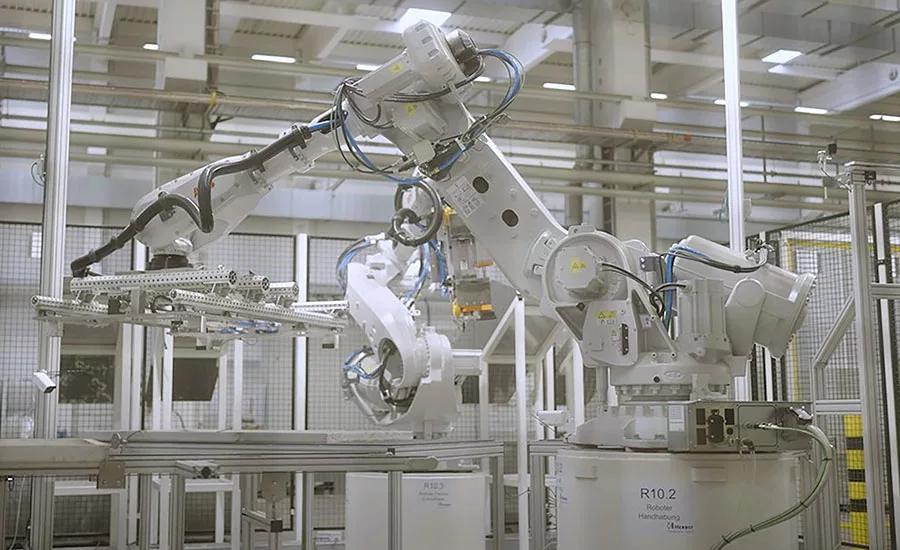
Artificial intelligence is the No 1 automation trend affecting manufacturers today.
FRANKFURT—According to the International Federation of Robotics (IFR), artificial intelligence remains the top automation trend affecting manufacturers today. AI enables robots to work independently and tackle more applications.
Analytical AI helps machines process large datasets, detect patterns and provides actionable insights. This enables them to autonomously anticipate failures before they occur in smart factories.
Generative AI, on the other hand, marks a shift from rule-based automation to intelligent, self-evolving systems. GenAI creates new outputs and enables robots to learn new tasks autonomously and generate training data through simulation. This also allows a new kind of human–robot interaction with natural language and vision-based commands.
Agentic AI technology combines analytical AI for structured decision-making, and generative AI for adaptability. The hybrid approach enables robots to work independently in complex, real-world environments.
The IFR claims that demand for versatile robots is accelerating. This directly reflects a market push toward a convergence of information technology (IT) and operational technology (OT). The merge of IT’s data-processing power and OT’s physical control capabilities enhance robotics versatility through real-time data exchange, automation and advanced analytics.
This integration is a foundational element of the digital enterprise and Industry 4.0. The IT/OT convergence breaks down these silos, creating a seamless flow of data between the digital and physical worlds, which significantly enhances the capabilities and versatility of robots.
The field of humanoid robotics is also expanding rapidly. The next-generation machines are a promising technology where flexibility is required, typically in environments designed for humans.
Today, companies are moving beyond prototypes to deploy humanoids in real life. Reliability and efficiency are key to success: In competing with traditional automation, humanoid robots need to match high industrial requirements toward cycle times, energy consumption and maintenance costs.
Looking for quick answers on assembly and manufacturing topics? Try Ask ASM, our new smart AI search tool. Ask ASM
Industry standards also define safety levels, durability criteria and consistent performance of humanoid robots needed on the factory floor. According to IFR, humanoids intended to fill labor gaps need to achieve human-level dexterity and productivity, key measures to prove real-world efficiency.
As robots increasingly operate alongside humans in factories, safety is more important than ever. AI-driven autonomy fundamentally changes the safety landscape, which makes testing, validation and human oversight much more complex. Robotic systems need to be designed and certified in line with ISO safety standards and clearly defined liability frameworks.
In the context of AI in robotics and the convergence of IT and OT, a spectrum of safety and security concerns arise that demand robust governance and clear assignment of liability.
In addition, the rapid expansion of robotics systems into cloud-connected and AI-driven environments is exposing industrial production to a growing array of cybersecurity threats. As robots become more integrated into workplaces, concerns are mounting over the sensitive data they collect, including audio, video and sensor streams.
The legal and ethical ambiguity surrounding liability has prompted calls for clear frameworks to govern AI deployment.Looking for a reprint of this article?
From high-res PDFs to custom plaques, order your copy today!