Assembly Lines
3D-Printing Platform Rapidly Produces Electric Motors
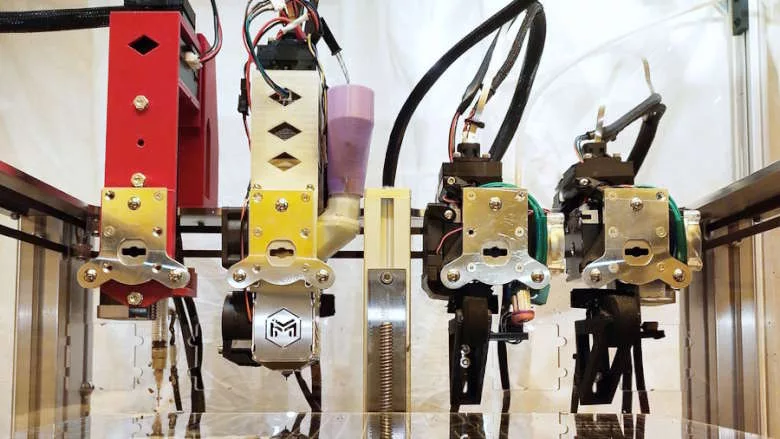
A new multimaterial additive manufacturing platform can be used to fully print electric machines in a single step.
CAMBRIDGE, MA—Engineers at the Massachusetts Institute of Technology (MIT) have developed a multimaterial additive manufacturing platform that can be used to print electric machines in a single step. It can process multiple functional materials, including electrically conductive and magnetic materials, using four extrusion tools.
The printer switches between extruders, which deposit material by squeezing it through a nozzle as it fabricates a device one layer at a time.
The engineers recently used the system to print an electric linear motor in just a few hours using five materials. They only needed to perform one post-processing step for the motor to be fully functional.
“A broken motor in an automated machine can bring production on a busy factory floor to a halt,” says Luis Fernando Velásquez-García, Ph.D., a principal research scientist in MIT’s Microsystems Technology Laboratories who worked on the R&D project. “If engineers can’t find a replacement part, they may have to order one from a distributor hundreds of miles away, leading to costly production delays.
“It would be easier, faster and cheaper to make a new motor onsite, but fabricating electric machines typically requires specialized equipment and complicated processes, which restricts production to a few manufacturing centers,” explains Velásquez-García.
“In the long run, this 3D printing platform could be used to rapidly fabricate customizable electronic components for robots, vehicles or medical equipment with much less waste,” claims Velásquez-García.
The MIT engineers focused on extrusion printing, a tried-and-true additive manufacturing method that involves squirting material through a nozzle to fabricate an object one layer at a time.
Looking for quick answers on assembly and manufacturing topics? Try Ask ASM, our new smart AI search tool. Ask ASM
To fabricate an electrical device, they needed to be able to switch between multiple materials that offer different functionalities. For instance, the device needed an electrically conductive material to carry electric current and hard magnetic materials to generate magnetic fields for efficient energy conversion.
Velásquez-García and his colleagues carefully designed each extruder to balance the requirements and limitations of the material. “There were significant engineering challenges,” he points out. “We had to figure out how to marry together many different expressions of the same printing method—extrusion—seamlessly into one platform.”
The engineers used strategically placed sensors and a novel control framework so each tool is picked up and put down consistently by the platform’s robotic arms. Each nozzle moves precisely and predictably, which ensures that each layer of material lines up properly.
The linear motor was fabricated in 3 hours. The researchers only needed to magnetize the hard magnetic materials after printing to enable full functionality. According to Velásquez-García, it performed “as well or better than similar motors that require more complex fabrication methods or additional post-processing steps.”
In the future, the engineers plan to integrate the magnetization step into the multimaterial extrusion process and print a rotary electrical motor, in addition to more complex electronic devices.
Looking for a reprint of this article?
From high-res PDFs to custom plaques, order your copy today!