Assembly Magazine logo
search
Ask ASSEMBLY AI
cart
facebook twitter linkedin youtube
  • Sign In
  • Create Account
  • Sign Out
  • My Account
Assembly Magazine logo
  • TRENDS
    • Ask ASSEMBLY AI
    • Trends
    • News
    • New Products
  • INDUSTRIES
    • Aerospace
    • Appliance
    • DFMA Assembly
    • Medical Devices
    • Green Manufacturing
    • Lean Manufacturing
    • Machinery Assembly
    • Electronics Assembly
    • Automotive
  • TECHNOLOGIES
    • Adhesives & Dispensing
    • Assembly Presses
    • Automated Assembly Systems
    • Manufacturing Management
    • Manufacturing Software
    • Motion Control
    • Screwdriving & Riveting
    • Robotics
    • Test & Inspection
    • Plastics & Metal Welding
    • Wire Processing
    • Workstations
  • AUTONOMOUS & ELECTRIC MOBILITY
    • AEM Magazine Archives
    • Autonomy
    • Electrification
    • Mobility Services
    • Assembly & Testing
    • AV/EM News
  • MEDIA
    • Ask ASSEMBLY AI
    • Podcasts
    • Assembly News Now
    • Assembly TV
    • Webinars
    • eBooks
  • EVENTS
    • Calendar
    • The ASSEMBLY Show
  • MORE
    • Exclusives >
      • Plant of the Year
      • Capital Spending
    • Buyers Guide >
      • Supplier Insights
    • Classifieds
    • Featured Products
    • Newsletters
    • Store
    • White Papers
    • Columns
    • Sponsor Insights
  • INFOCENTER
    • Assembly & Test Solutions
  • EMAGAZINE
    • eMagazine
    • Archive Issues
    • Advertise
    • Contact Us
    • Sign Up
TechnologiesRobotics Assembly

Assembly Lines

Humanoid Robot Market to Grow Quickly Over the Next Decade
By Austin Weber
humanoid robots
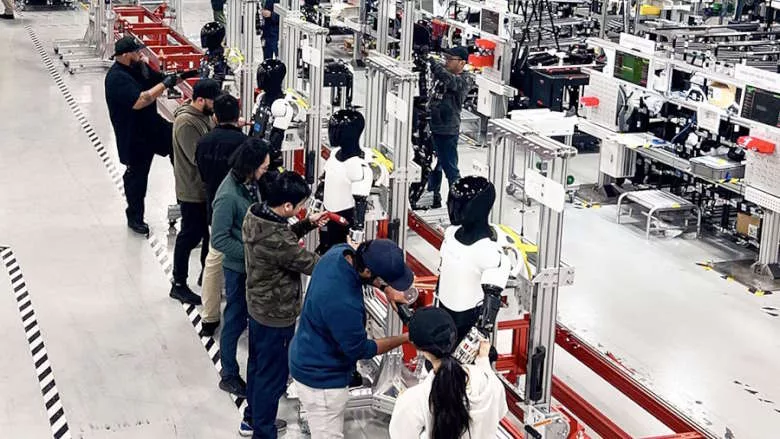
Photo courtesy Tesla Inc.

The global market for humanoid robots is predicted to reach $30 billion by 2036.

April 2, 2026

CAMBRIDGE, England—The humanoid robot industry is entering an early commercialization phase, with adoption expected to scale first in industrial environments before expanding into broader commercial and consumer markets.

According to a new report by IDTechEx, the global market for humanoids will reach $30 billion by 2036, driven by increasing deployments in automotive manufacturing and logistics, alongside ongoing progress in component scaling and platform reliability.

“Humanoid robots are increasingly viewed less as futuristic prototypes and more as a practical route to bring artificial intelligence into human-designed environments,” says Shihao Fu, technology analyst at IDTechEx. “Over the last 12 months, market activity has shifted from trade show demonstrations toward structured pilot deployments on production sites, supported by larger and more deliberate investment from both start-ups and established OEMs.

“With component supply chains gradually stabilizing and early cost reductions emerging, [companies] are now using real-world deployment data to define which humanoid use cases are commercially viable in the near term, and which remain longer-term opportunities,” explains Fu.

According to Fu, automotive manufacturing will be the first commercial sector where humanoid robots scale in meaningful volumes. Indeed, automakers such as BMW, Hyundai, Mercedes-Benz and Tesla have already deployed bipedal machines in their factories.

“Compared with open-world environments, automotive plants offer controlled operating conditions, structured workflow and clearer ROI justification for repetitive labor-intensive tasks,” says Fu. “Early deployments are focused on relatively simple, but scalable tasks such as material handling, inspection support, intra-factory transport and basic assembly assistance.

“As the market transitions beyond proof-of-concept demonstrations, commercialization is increasingly being defined less by ‘general-purpose capability’ and more by reliability, safety validation, maintainability and predictable uptime,” Fu points out.

Looking for quick answers on assembly and manufacturing topics? Try Ask ASM, our new smart AI search tool. Ask ASM →

A key reason why automotive manufacturing is emerging as the first scalable deployment market is that many of the most active investors and strategic backers are automotive OEMs themselves. Unlike traditional industrial automation buyers, they have both the capital base and long-term incentive to accelerate humanoid development, particularly as they face rising labor costs, tightening workforce availability and increasing pressure to improve manufacturing flexibility.

“OEM-backed investment also provides immediate access to controlled production environments, engineering validation resources and real operational datasets that are difficult for start-ups to obtain independently,” notes Fu. “In practice, this allows humanoid platforms to iterate faster through reliability testing, safety validation workflows and maintainability optimization.

“OEM involvement also increases the likelihood of scaled procurement once a platform meets minimum performance thresholds, reducing go-to-market uncertainty and accelerating supply chain readiness,” adds Fu.

Logistics and warehousing applications are expected to become the second big market for humanoids. However, growth in this segment will be affected by competition from existing automation technologies such as autonomous mobile robots, automated guided vehicles, cobots and traditional six-axis robots.

“Despite this, humanoid robots are increasingly positioned as a flexible automation alternative where mixed and unpredictable tasks must be completed in facilities designed around human workers,” says Fu. “As hardware cost declines and task performance improves, humanoids may become commercially attractive for workflows such as pick-and-place, parcel handling and repetitive sorting operations, particularly in environments where deploying fixed automation would require high capital investment and major infrastructure redesign.”

But, humanoid robots still face major engineering and manufacturing constraints, such as component-level bottlenecks.

“Battery energy density and thermal management remain major limitations, restricting operating time and increasing downtime,” warns Fu. “At the same time, scaling high-precision components, such as screws, bearings and high-performance actuators, remains challenging, as supply chains are not yet optimized for high-volume humanoid production.

“Dexterous hands and tactile sensing also remain critical hurdles for expanding humanoid task capability beyond basic industrial operations,” claims Fu. “In many current deployments, humanoids remain best suited to tasks that do not require advanced manipulation, fine grip control or human-level perception of contact forces.”

KEYWORDS: advanced manufacturing humanoid robot

Share This Story

Looking for a reprint of this article?
From high-res PDFs to custom plaques, order your copy today!

Austinweber headshot
Austin has been senior editor for ASSEMBLY Magazine since September 1999. He has more than 21 years of b-to-b publishing experience and has written about a wide variety of manufacturing and engineering topics. Austin is a graduate of the University of Michigan.

Recommended Content

JOIN TODAY
To unlock your recommendations.

Already have an account? Sign In

  • Made in the U.S.A.

    Consumer Products Manufacturing: Made in the USA

    Supply chain lessons learned during the coronavirus...
    Automated Assembly Systems
    By: Austin Weber
  • Best Practices for Press-Fit Assembly

    Best Practices for Press-Fit Assembly

    In manufacturing, ironclad formulas for success are hard...
    Assembly Presses
    By: Jim Camillo
  • aem0523leader-tesla1.jpg

    Tesla Rethinks the Assembly Line

    Engineers at Tesla Inc. have developed a new process that...
    Industries
    By: Austin Weber
Manage My Account
  • eMagazine Subscription
  • Assembly Newsletters
  • Online Registration
  • Subscription Customer Service
  • Manage My Preferences

More Videos

Sponsored Content

Sponsored Content is a special paid section where industry companies provide high quality, objective, non-commercial content around topics of interest to the ASSEMBLY audience. All Sponsored Content is supplied by the advertising company and any opinions expressed in this article are those of the author and not necessarily reflect the views of ASSEMBLY or its parent company, BNP Media. Interested in participating in our Sponsored Content section? Contact your local rep!

close
  • ultrasonic welding
    Sponsored bySonobond Ultrasonics

    Engineering Efficiency in High-Performance Assembly: How Ultrasonic Welding Enhances Throughput, Reliability and Quality

  • UV curing system
    Sponsored byDymax

    Why UV Intensity Alone Doesn’t Define Curing Performance

  • wooden pallets
    Sponsored byLEAN Manufacturing Products

    Eliminating Waste on the Shop Floor: Applying Lean Principles to Improve Manufacturing Efficiency

Popular Stories

ASSEMBLY News Now, episode-30: Volvo Redesigns EV Manufacturing

Volvo Redesigns EV Manufacturing

Boeing CEO Kelly Ortberg announces 1 billion investment

Boeing Plans $1 Billion Wichita Investment, Workforce Training Center

GE Appliances Worker on Line

GE Appliances Expands Factory AI With 800 Gemini Enterprise Agents

Watch the latest episode of ANN now!

Events

July 24, 2025

From Shop Floor to CFO: How Manufacturers Are Closing the Loop Between Operations and Finance

On Demand Learn how manufacturers are bridging the gap between the shop floor and ERP systems to gain real-time visibility, streamline operations, and kick-start digital transformation—without waiting years.

Sponsored by:

PicoStratusGreen
July 30, 2025

Buffer Analysis and Design Fundamentals for Manufacturing Excellence

On Demand In this presentation, Dr. Herman Tang shares practical insights from his industry experience and research on buffer management in manufacturing operations.

View All Submit An Event

Poll

Difficult Assembly Processes

Which assembly process gives you the most difficulty?
View Results Poll Archive

Products

Manufacturing Cost Policy Deployment (MCPD) Profitability Scenarios: Systematic and Systemic Improvement of Manufacturing Costs

Manufacturing Cost Policy Deployment (MCPD) Profitability Scenarios: Systematic and Systemic Improvement of Manufacturing Costs

See More Products
Register for webinar - Modernizing Automotive Assembly: Why Upgrading Legacy MES is a Business Imperative

Related Articles

  • Exoskeleton Market To Grow Over Next Decade

    Exoskeleton Market To Grow Over Next Decade

    See More
  • automotive manufacturing

    Auto Suppliers Need to Shift Focus to Survive the Next Decade

    See More
  • Will the Next Decade Bring a Worker Shortage?

    See More

Related Products

See More Products
  • history.jpg

    Faster, Better, Cheaper in the History of Manufacturing: From the Stone Age to Lean Manufacturing and Beyond

  • value stream.jpg

    Using Hoshin Kanri to Improve the Value Stream

  • leaner

    Leaner Manufacturing: How to Make the Lean Production Process Easier, Faster, and More Cost-Effective

See More Products

Related Directories

  • HowToRobot

×

Never miss the latest news and trends driving the manufacturing industry

Stay in the know on the latest assembly trends.

JOIN TODAY!
  • RESOURCES
    • Advertise
    • Contact Us
    • Directories
    • Manufacturing Division
    • Store
    • Want More?
  • SIGN UP TODAY
    • Create Account
    • eMagazine
    • Newsletters
    • Customer Service
    • Manage Preferences
  • SERVICES
    • Marketing Services
    • Reprints
    • Market Research
    • List Rental
    • Survey/Respondent Access
  • STAY CONNECTED
    • LinkedIn
    • Facebook
    • Instagram
    • YouTube
    • X (Twitter)
  • PRIVACY
    • PRIVACY POLICY
    • TERMS & CONDITIONS
    • DO NOT SELL MY PERSONAL INFORMATION
    • PRIVACY REQUEST
    • ACCESSIBILITY

Copyright ©2026. All Rights Reserved BNP Media, Inc. and BNP Media II, LLC.

Design, CMS, Hosting & Web Development :: ePublishing