ASSEMBLY Audible
Greg Dyer on Manufacturing Hiring, Workforce Flexibility and the Future of Factory Talent
From ASSEMBLY Magazine headquarters in Birmingham, Michigan, this is Assembly Audible where we connect great ideas in product assembly to you. I'm your host, JJ.
Today we're talking about one of the biggest challenges facing manufacturers right now: finding and developing the workforce needed to keep production moving. As reshoring accelerates, automation and AI expand across the factory floor, and experienced workers retire in large numbers, manufacturers are being forced to rethink how they recruit, train and retain talent.
My guest today is Greg Dyer, Chief Commercial Officer at Randstad USA. Randstad is one of the world's largest workforce solutions providers, helping companies connect with talent across manufacturing, logistics and industrial operations. In our conversation, Greg shares what the current labor market looks like for manufacturers, why reshoring is creating new workforce pressures and how companies can rethink recruiting to meet today's hiring challenges.
We also talk about the so-called silver tsunami of retiring workers, the growing importance of flexibility for younger employees and how automation and AI are changing frontline manufacturing jobs.
If you're a manufacturer struggling to fill roles, develop skilled workers or prepare your workforce for the next generation of factory technology, this conversation offers valuable perspective. So let’s dive right in.
ASSEMBLY:
Thanks for being here, Greg. First, tell me a little bit about Randstad. What do you folks do?
GREG DYER:
Yeah, so Randstad is a global workforce solutions organization. We pride ourselves on being a partner for talent. And that's not only for the talent that we put to work each and every day—almost 700,000 employees worldwide. Here in the U.S., we're close to 100,000 employees. So it's a big number across all of our different client engagements. But what we do, and a big part of our business, of course, is the frontline workers in industrial manufacturing and logistics work. So we're partnering with clients to scale up, whether that's a few resources or thousands of resources that they might need to meet their demand, get their production out, keep their clients happy and create value. So yeah, we certainly welcome the opportunity to do that in a bigger way.
ASSEMBLY:
So, paint a picture for me of the current labor market in the United States for manufacturing.
Looking for quick answers on assembly and manufacturing topics? Try Ask ASM, our new smart AI search tool. Ask ASM
GREG DYER:
Well, certainly it's still a strong market in terms of there being many job seekers in the market who are looking for the next role. And of course, companies are also hiring. It's a bit of, do we have the right numbers in the right locations with the right skills? I think that's a piece of it for sure. But I think it's also about how you're attracting talent. How are you reaching out to them? Who are you partnering with in some cases to help with those endeavors? So there's definitely talent available. I think it comes down to how you are positioned to take advantage of that talent.
ASSEMBLY:
So, talking about manufacturing hiring, we've got AI, automation, all sorts of things going on in the industry, reshoring too. What do you think is having the biggest impact on manufacturing hiring right now, in this moment?
GREG DYER:
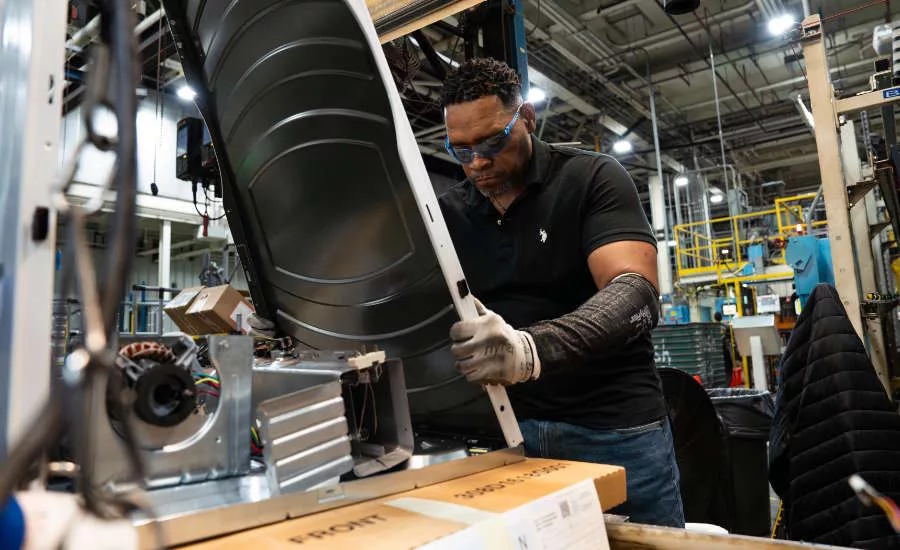
Yeah, it is a massive convergence in terms of all of these things having an impact. But I would say reshoring is more of the headline right now. We're seeing a shift toward being closer to the customer, and that's becoming one of the most valuable propositions compared to offshore labor and those types of things. Take GE Appliances, for example. They've successfully moved some operations back to the U.S. They realize that zero distance to the buyer is a growth engine for them.
But for the average manufacturer, it has hit a bit of a wall. We had a survey last year where we surveyed more than 700 leaders, including 306 in manufacturing and logistics. Seventy-seven percent were optimistic, yet, as you pointed out earlier, 23 percent are struggling with the ability to execute. So what is the gap? It's the squeeze there. It's not just an HR problem. It's really a supply chain problem, and it puts risk throughout the operation.
What we're seeing, of course, is a number of very experienced people leaving organizations—this exodus of expertise, if you will. More than 80 percent of workers who left recently did so to retire. So you've got these experienced workers leaving who really know the game. And you can't just get that experience to come in right away with more entry-level workers. So you've got to stop just hunting for talent and start building it. And how do you build those workforces? That's a big shift. Companies have been thinking about that for a long time. But it's not just apprenticeships or building connections with local universities. There's got to be something more, and it's something that is a bit more tech-enabled from our view in terms of how you get talent.
ASSEMBLY:
You mentioned GE Appliances. We just spoke with the vice president of manufacturing over there, Bill Good, about the company's reshoring efforts. Why do you think companies like GE Appliances are having success with reshoring, and why do you think other companies may be struggling? What's the differentiating factor between the two?
GREG DYER:
Well, I think part of it is how much operation they already have here in the U.S. How quickly can they scale existing facilities? For some companies it's a matter of, if we have to start from the ground up, that's going to take some time. So that will be over a longer period.
But this issue of being able to get the right talent is a big part of it. I think that's driven more around strategies to get the talent as much as it is about how we onshore or reshore production that has been offshore in the past. So it's a bit of a mix there.
As I mentioned earlier, getting frontline workers and skilled workers is something that, now with technology, can be addressed differently. I'll mention briefly the Randstad talent platform, a two-sided marketplace. You have the ability to reach a much broader network of talent. With those candidates, you can assess for skills, readiness and more, and you're able to do that digitally. Traditional recruiting means one person can only do as much work as one person can do. So you've got to leverage technology differently than what we've done in the past to really bridge the gap in terms of how we get the right staff in place.
But in terms of the operations themselves, it comes down to what your path is. Are you starting from existing facilities, or do you need to build from the ground up, like some of these data centers that are being built today? That can be a much longer process.
ASSEMBLY:
So, give me a little insight into the impacts automation and AI are having on frontline manufacturing workers.
GREG DYER:
Yes. We see 2025 as the year of adopting AI. And 2026 is all about amplifying talent and enabling your workforce with AI, not replacing it.
As we see the rise of agenic AI systems that autonomously solve problems—for example, maintenance systems that can draft a repair plan—that could be one example. But for the employee, digital fluency becomes critical. Workers need to be able to oversee these systems and drive outcomes that are successful for the organization.
In a maintenance mechanic role, for example, it could go beyond being the reactive fixer. Now you're an uptime analyst using data to ensure you have plans in place to prevent failures. For a CNC machinist, programming is not new, but we're seeing more complex multi-axis setups. For picker-packers, we've seen a number of our customers using voice pick or pick-to-light systems to maintain 100 percent accuracy at high speed. You're not just depending on a human worker, but on a human worker enabled with technology to get a higher-quality output across the board.
So that's the opportunity. Technology handles more of the transactional work so humans can focus on the strategic judgment that keeps operations running smoothly and producing high-quality results.
ASSEMBLY:
We just spoke with an expert a few weeks ago who was talking about the silver tsunami—the large number of manufacturing workers who are retiring. Now we need to replace them. So how do you go about doing that? How do you fix the pipeline?
GREG DYER:
I think certainly there's a bit of work to do in killing the image of the dark and dirty factory floor. That perception still exists in some places. In reality, there's a lot of advanced manufacturing and clean manufacturing environments today. So to some extent we need to reshape what people picture in their minds.
This tech-driven, human-centric career option is part of that story. With only two in five organizations having a succession plan in place, there's a lot of opportunity. I also mentioned earlier the idea of reverse mentoring or mentorship between newer workers and veteran workers. That can help rebuild the pipeline.
But starting earlier and having a plan for where you need those workers will be key. Bridging the knowledge gap and making sure you have long-term, sustainable talent is critical.
ASSEMBLY:
There's AI deployment going on across every industry. I don't think there's any sector it's not touching right now. Manufacturing AI looks a little different from how it looks in an office job, though. You've got highly capable robots, machine vision and all sorts of amazing technology. Do you think the technology angle could be a good hook to attract people to the manufacturing workforce?
GREG DYER:
I think you're onto something there. There's no doubt. It continues to develop at a fast pace, and in every type of role, especially in manufacturing. In office work, it's easy to see how AI can help with research or preparation tasks. In manufacturing, it's more about monitoring, maintenance and preventative opportunities.
That's going to continue to be an area that is wide open.
ASSEMBLY:
What are some of the most common mistakes manufacturing companies are making when they're trying to recruit in today's labor market?
GREG DYER:
There are a couple. Number one, some companies assume that because of the name on the building, everybody should know them and want to work there. So first, there needs to be a bit of humility—looking in the mirror and asking how we really engage with talent and workers who may not even know our brand, even if we think it's well known.
Second is choice, control and flexibility. How do you match that need in a way that works for your organization? If you can do that, you'll give manufacturing hiring a leg up because you'll be addressing a pain point workers are looking to solve.
Otherwise what happens is someone might say yes to working four 10-hour shifts or another schedule, but then they don't show up after a few days because that arrangement doesn't actually work for them. Understanding that flexibility is important will be key. If we think we've operated for 50 years with fixed schedules and fixed workers and that will continue forever, that mindset will create challenges for organizations trying to hire employees who are increasingly looking for flexibility.
ASSEMBLY:
I really like what you said there about having the company name on the building and assuming people should be thankful for the job they have posted. That's not really how newer generations of employees think about it. There's a cultural mindset shift in how younger generations view work. Tell me a little bit about that from your perspective.
GREG DYER:
I think people are looking for purpose. They're looking for impact. They want to understand more clearly what the employer is offering from a value proposition standpoint.
If we rethink that for a moment, how do we get people excited again about manufacturing? Anytime you go through a plant on a tour, you see amazing things happening. But we don't always tell that story externally. So how do we retell our story instead of assuming people already understand it?
Get people excited. Give them a sense of purpose. How things are made is really cool. We just need to think about how we get that story out to some of these newer generations who may not know those stories or haven't had the opportunity to see them.
In recent years we've had a lot of remote, a lot of digital environments and a lot of screen time. Many young people simply haven't been exposed to manufacturing environments.
ASSEMBLY:
Between automation, AI and all the other changes happening in manufacturing, it can be hard for new workers to keep up. When companies are hiring, what should manufacturers be looking for in the people they bring in?
GREG DYER:
We mentioned this earlier—learning agility and the ability to tap into the skills someone has and continue developing them over time. There are assessments that can help predict some of that. But getting to those people early and showing them a vision is important.
For example, years ago at a client facility we were installing robots on several production lines. These were very expensive systems. Instead of needing 20 people to run a line, we now only needed five. Part of that was driven by wage inflation and long-term cost considerations.
Leaders need to engage frontline workers and help them understand the future. Identify who has the learning agility to continue upskilling.
But the advice to the client was to bring the teams together and explain what was happening and what the path forward looked like. Show them how they could move into more skilled roles working with the technology. Get them excited about the plan rather than letting them see robotics installed without understanding what it meant for their jobs.
Bringing people along on the journey is really important. Leaders need to engage frontline workers and help them understand the future. Identify who has the learning agility to continue upskilling. And in some cases, you'll also need to bring in talent from outside the organization if those skills don't already exist internally.
ASSEMBLY:
What advice do you have for manufacturers who are struggling to fill roles right now? What are one or two changes they can make that will help?
GREG DYER:
A couple things. Number one, look at how you might partner to fill the flexibility gap that you have. That could be with us or with one of our competitors in the space. We're happy to work with companies to help solve that challenge.
And the second is looking at your employee value proposition and what you're offering. Fair wages are a great starting point. But flexibility, as I mentioned earlier, is really the key.
Looking for a reprint of this article?
From high-res PDFs to custom plaques, order your copy today!