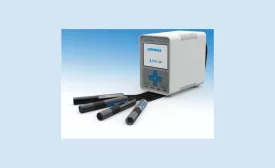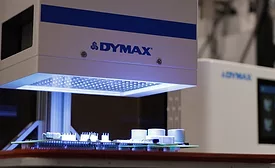
Published intensity values don’t always reflect real curing performance. Working distance, emitter design and uniformity can significantly influence results in production environments.
It may not be as “sexy” as a robot or a high-speed automated assembly system, but one of the most interesting new products introduced at the show last fall was actually an adhesive.
Worldwide, sales of smart phones and tablet computers have skyrocketed. A report by Credit Suisse predicts annual sales of smart phones will cross the 1 billion mark in 2014, driven by the launch of lower-end handsets and increasing demand from China. Tablet computers are also experiencing rapid growth. Forrester Research projects sales of tablet computers to grow from 56 million in 2011 to 375 million in 2017, a compound annual growth rate of 46 percent.
Fabricating and testing optical components is a very detailed process. It begins by grinding a spherical glass blank using ring tools to create a semifinished lens. Next, the lens’ rough surface is rotated and rubbed against a tool having the desired surface shape.
TOKYO—Researchers at Japan’s National Institute of Advanced Industrial Science and Technology have developed an organic material that can be liquefied or hardened by shining different types of light on it. The result is an adhesive that can be used over and over again.