Assembly Magazine logo
search
Ask ASSEMBLY AI
cart
facebook twitter linkedin youtube
  • Sign In
  • Create Account
  • Sign Out
  • My Account
Assembly Magazine logo
  • TRENDS
    • Ask ASSEMBLY AI
    • Trends
    • News
    • New Products
  • INDUSTRIES
    • Aerospace
    • Appliance
    • DFMA Assembly
    • Medical Devices
    • Green Manufacturing
    • Lean Manufacturing
    • Machinery Assembly
    • Electronics Assembly
    • Automotive
  • TECHNOLOGIES
    • Adhesives & Dispensing
    • Assembly Presses
    • Automated Assembly Systems
    • Manufacturing Management
    • Manufacturing Software
    • Motion Control
    • Screwdriving & Riveting
    • Robotics
    • Test & Inspection
    • Plastics & Metal Welding
    • Wire Processing
    • Workstations
  • AUTONOMOUS & ELECTRIC MOBILITY
    • AEM Magazine Archives
    • Autonomy
    • Electrification
    • Mobility Services
    • Assembly & Testing
    • AV/EM News
  • MEDIA
    • Ask ASSEMBLY AI
    • Podcasts
    • Assembly News Now
    • Assembly TV
    • Webinars
    • eBooks
  • EVENTS
    • Calendar
    • The ASSEMBLY Show
  • MORE
    • Exclusives >
      • Plant of the Year
      • Capital Spending
    • Buyers Guide >
      • Supplier Insights
    • Classifieds
    • Featured Products
    • Newsletters
    • Store
    • White Papers
    • Columns
    • Sponsor Insights
  • INFOCENTER
    • Assembly & Test Solutions
  • EMAGAZINE
    • eMagazine
    • Archive Issues
    • Advertise
    • Contact Us
    • Sign Up
Electronics AssemblyAdhesives & Dispensing Assembly

Boost Productivity With UV-Curing Adhesives

Because they polymerize quickly on-demand, UV-curing adhesives are ideal for automated assembly processes.

By Torsten Uske, Martin Kluke
August 9, 2013

For mass-production on assembly lines, UV- and light-curing adhesives offer significant advantages over other joining methods.

They are generally solvent-free and one-component materials, so they can be integrated into continuous manufacturing processes safely and easily. Because they polymerize in seconds when exposed to ultraviolet or visible light, they won’t compromise cycle time in automated assembly processes. Curing with light is much less energy-intensive than curing with heat.

Curing occurs with deliberate exposure to light of a certain wavelength, not just any light, so components can be positioned precisely before the adhesive hardens. The adhesives can bond components that are too small to be screwed together. And finally, they have outstanding optical qualities. When bonding layers in a touch screen, they can reduce reflections and improve readability, even in direct sunlight.

There are two main types of UV-curing adhesives. Radically initiated adhesives are usually based on an acrylate matrix, while cationically initiated adhesives are based on epoxy resins. These one-component adhesives are simple to process. No mixing is required. In addition, both types of adhesive are available in dual-curing formulations. These materials usually cure with a combination of light and heat or humidity. This ensures that the adhesive will cure in areas that cannot be directly illuminated by light.

For both chemistries, it’s essential to match the wavelength of the UV light source with the trigger of the photoinitiator to ensure an effective curing reaction. Light sources based on LEDs are favored, because their peak emission spectra match the wavelengths needed to activate the photoinitiators. LED lamps are available with different wavelengths to suit a range of adhesives and photoinitiators.

Bonding Automotive Switches

Light-curing adhesives are particularly well-suited for high-volume assembly processes, where rapid curing and high reliability are essential. The following examples illustrate the range of applications for UV-curing acrylate- and epoxy-based adhesives.

In the automotive industry, process reliability is important for assembling safety-critical devices, such as air bag deactivation switches and seatbelt monitoring switches. Because these devices are produced in the millions on high-speed automated assembly lines, they require an adhesive that is easy to dispense and fast-curing. Process control is essential. Because they are more cost-effective and reliable, light-curing adhesives are increasingly being used in place of two-component or heat-curing adhesives and casting compounds.

Looking for quick answers on assembly and manufacturing topics? Try Ask ASM, our new smart AI search tool. Ask ASM →

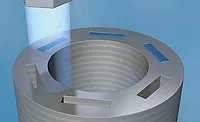
When assembling these snap-action switches, hermetical sealing of the housings and connectors is essential for withstanding environmental conditions during vehicle operation. It’s often necessary to bond the housing and seal the connector pins in a single step, a process known as seal bonding.

Two-component or heat-curing adhesives and encapsulants are neither particularly reliable nor cost-effective for such applications. The complex and high-maintenance equipment for processing two-component adhesives work only when large amounts (more than 100 milligrams) are dispensed.

In contrast, UV- and light-curing adhesives are optimized for bonding auto parts and sealing them against fluctuating temperatures, humidity, contaminants, pressure and shocks. (Light-curing adhesives for such applications remain flexible over a temperature range of -40 to 176 F.) The operating costs of curing lamps are much lower than those of heat-curing ovens. Light-curing adhesives are easy to dispense in high-volume automated assembly lines. Their constant viscosity and unchanging flow properties facilitate complete wetting of the parts, which leads to a
reliable seal. The adhesives cure within seconds—much faster than thermal curing—and the bond holds up exceptionally well through years of use.

In addition, 100 percent in-line control of seal tightness is possible, since acrylate-based, UV-curing adhesives achieve final strength immediately after irradiation. Fully automated camera inspection of the bond can be done in-line by using colorants or fluorescent agents in the adhesive, ensuring detection of insufficient adhesive or possible contaminations at the connector pins.

Smart Phone Assembly

Light-curing adhesives have played an important role in the rapid improvement of smart phone technology, having met the demand for a fast, easily automated joining method for assembling displays, speakers and other components.

These adhesives enable tension-free, direct bonding of the cover glass to the LCD module (display bonding) and to the touch panel (touch-to-lens bonding) with high optical transparency. To minimize tension between substrates, which could cause display failures, these adhesives are soft and flexible—with a shear modulus around 30 times lower than a standard acrylate formulation.

Dual-curing adhesives are available for displays with shadowed areas (for example, black print edges). They cure with exposure to both light and moisture.

What applies to a smart phone’s display also applies to its speakers. They are getting smaller and must be produced at high volumes with high quality. Today’s mobile phones include high-performance mini-speakers, comprised of membranes, coils and covers—up to eight components—bonded together with a light-curing adhesives.

With light-curing adhesives, these tiny speakers can be mass-produced at rates of up to 6,000 per hour. Testing can be done immediately after curing, so OEMs do not need a buffer stock to ensure just-in-time delivery.

Billions of microchips are embedded in credit cards, bank cards and SIM cards for mobile phones. Production of these cards and microchips requires a fast and reliable encapsulation
process. Epoxy-based, light-curing adhesives offer an ideal solution. A high-viscous dam compound is quickly dispensed around the chip. Then the chip is encapsulated by a less-viscous fill compound. Curing both materials takes seconds. The flow properties of both encapsulants are particularly important, since the chip is placed in a cavity and a maximum cover height must not be exceeded. Light-curing adhesives maintain this tolerance exceptionally well.

For more information on UV-curing adhesives, call 978-254-5275 or visit www.delo-adhesives.com/us.


Comparing UV-Curing Chemistries

Acrylate-Based                           Epoxy-Based

Extremely fast curing                Thermal resistance

High-peel resistance                Chemical resistance

Optically clear                             Low outgassing

UV-stable                                    Optically clear

Universally good adhesion      Resists yellowing

High equalization of tensions  Dry-surface preactivation possible

 There are two main types of UV-curing adhesive. Radically initiated adhesives are usually based on an acrylate matrix, while cationically initiated adhesives are based on epoxy resins. Each chemistry has its benefits. 

KEYWORDS: display assembly electronics potting light-curing adhesive UV cure adhesives

Share This Story

Looking for a reprint of this article?
From high-res PDFs to custom plaques, order your copy today!

Torsten Uske is President of DELO Industrial Adhesives LLC, Sudbury, MA.
Martin Kluke is Product Manager at DELO Industrial Adhesives LLC, Sudbury, MA.

Recommended Content

JOIN TODAY
To unlock your recommendations.

Already have an account? Sign In

  • Made in the U.S.A.

    Consumer Products Manufacturing: Made in the USA

    Supply chain lessons learned during the coronavirus...
    Automated Assembly Systems
    By: Austin Weber
  • Best Practices for Press-Fit Assembly

    Best Practices for Press-Fit Assembly

    In manufacturing, ironclad formulas for success are hard...
    Assembly Presses
    By: Jim Camillo
  • aem0523leader-tesla1.jpg

    Tesla Rethinks the Assembly Line

    Engineers at Tesla Inc. have developed a new process that...
    Industries
    By: Austin Weber
Manage My Account
  • eMagazine Subscription
  • Assembly Newsletters
  • Online Registration
  • Subscription Customer Service
  • Manage My Preferences

More Videos

Sponsored Content

Sponsored Content is a special paid section where industry companies provide high quality, objective, non-commercial content around topics of interest to the ASSEMBLY audience. All Sponsored Content is supplied by the advertising company and any opinions expressed in this article are those of the author and not necessarily reflect the views of ASSEMBLY or its parent company, BNP Media. Interested in participating in our Sponsored Content section? Contact your local rep!

close
  • ultrasonic welding
    Sponsored bySonobond Ultrasonics

    Engineering Efficiency in High-Performance Assembly: How Ultrasonic Welding Enhances Throughput, Reliability and Quality

  • UV curing system
    Sponsored byDymax

    Why UV Intensity Alone Doesn’t Define Curing Performance

  • wooden pallets
    Sponsored byLEAN Manufacturing Products

    Eliminating Waste on the Shop Floor: Applying Lean Principles to Improve Manufacturing Efficiency

Popular Stories

ASSEMBLY News Now, episode-30: Volvo Redesigns EV Manufacturing

Volvo Redesigns EV Manufacturing

Boeing CEO Kelly Ortberg announces 1 billion investment

Boeing Plans $1 Billion Wichita Investment, Workforce Training Center

automated consumer goods assembly system

Best Practices for Cycle Time Optimization

Watch the latest episode of ANN now!

Events

July 24, 2025

From Shop Floor to CFO: How Manufacturers Are Closing the Loop Between Operations and Finance

On Demand Learn how manufacturers are bridging the gap between the shop floor and ERP systems to gain real-time visibility, streamline operations, and kick-start digital transformation—without waiting years.

Sponsored by:

PicoStratusGreen
July 30, 2025

Buffer Analysis and Design Fundamentals for Manufacturing Excellence

On Demand In this presentation, Dr. Herman Tang shares practical insights from his industry experience and research on buffer management in manufacturing operations.

View All Submit An Event

Poll

Difficult Assembly Processes

Which assembly process gives you the most difficulty?
View Results Poll Archive

Products

Manufacturing Cost Policy Deployment (MCPD) Profitability Scenarios: Systematic and Systemic Improvement of Manufacturing Costs

Manufacturing Cost Policy Deployment (MCPD) Profitability Scenarios: Systematic and Systemic Improvement of Manufacturing Costs

See More Products
Register for webinar - Modernizing Automotive Assembly: Why Upgrading Legacy MES is a Business Imperative

Related Articles

  • Alternative UV-Curing Adhesives

    Alternative UV-Curing Adhesives

    See More
  • Options for Curing UV Adhesives

    See More

Related Products

See More Products
  • 0001349.jpeg

    Adhesion and Adhesives Technology 4e

  • Designing with Plastics

  • reducing.jpg

    Reducing Process Costs with Lean, Six Sigma, and Value Engineering Techniques

See More Products

Events

View AllSubmit An Event
  • August 14, 2025

    Adhesives, Dispensing and Curing Technology Panel Discussion

    On Demand Get ready for The ASSEMBLY Show happening October 21 – 23 at the Donald E. Stephens Convention Center in Rosemont, Illinois. Join us for an exclusive pre-show webinar to learn about the pros and cons of major adhesive chemistries and how to choose the best dispensing method for your application.
View AllSubmit An Event

Related Directories

  • Shenzhen DeepMaterial Technologies Co. ltd.

    Deepmaterial is reactive hot melt pressure sensitive adhesive manufacturer and supplier, manufacturing epoxy adhesive glue,underfill epoxy,one component epoxy adhesives, hot melt adhesives glue, uv curing adhesives,high refractive index optical adhesive, magnet bonding adhesives, best top waterproof structural adhesive glue for plastic to metal and glass, electronic adhesives glue for electric motor and micro motors in home appliance.
  • Honle UV America Inc.

×

Never miss the latest news and trends driving the manufacturing industry

Stay in the know on the latest assembly trends.

JOIN TODAY!
  • RESOURCES
    • Advertise
    • Contact Us
    • Directories
    • Manufacturing Division
    • Store
    • Want More?
  • SIGN UP TODAY
    • Create Account
    • eMagazine
    • Newsletters
    • Customer Service
    • Manage Preferences
  • SERVICES
    • Marketing Services
    • Reprints
    • Market Research
    • List Rental
    • Survey/Respondent Access
  • STAY CONNECTED
    • LinkedIn
    • Facebook
    • Instagram
    • YouTube
    • X (Twitter)
  • PRIVACY
    • PRIVACY POLICY
    • TERMS & CONDITIONS
    • DO NOT SELL MY PERSONAL INFORMATION
    • PRIVACY REQUEST
    • ACCESSIBILITY

Copyright ©2026. All Rights Reserved BNP Media, Inc. and BNP Media II, LLC.

Design, CMS, Hosting & Web Development :: ePublishing