Assembly Magazine logo
search
Ask ASSEMBLY AI
cart
facebook twitter linkedin youtube
  • Sign In
  • Create Account
  • Sign Out
  • My Account
Assembly Magazine logo
  • TRENDS
    • Ask ASSEMBLY AI
    • Trends
    • News
    • New Products
  • INDUSTRIES
    • Aerospace
    • Appliance
    • DFMA Assembly
    • Medical Devices
    • Green Manufacturing
    • Lean Manufacturing
    • Machinery Assembly
    • Electronics Assembly
    • Automotive
  • TECHNOLOGIES
    • Adhesives & Dispensing
    • Assembly Presses
    • Automated Assembly Systems
    • Manufacturing Management
    • Manufacturing Software
    • Motion Control
    • Screwdriving & Riveting
    • Robotics
    • Test & Inspection
    • Plastics & Metal Welding
    • Wire Processing
    • Workstations
  • AUTONOMOUS & ELECTRIC MOBILITY
    • AEM Magazine Archives
    • Autonomy
    • Electrification
    • Mobility Services
    • Assembly & Testing
    • AV/EM News
  • MEDIA
    • Ask ASSEMBLY AI
    • Podcasts
    • Assembly News Now
    • Assembly TV
    • Webinars
    • eBooks
  • EVENTS
    • Calendar
    • The ASSEMBLY Show
  • MORE
    • Exclusives >
      • Plant of the Year
      • Capital Spending
    • Buyers Guide >
      • Supplier Insights
    • Classifieds
    • Featured Products
    • Newsletters
    • Store
    • White Papers
    • Columns
    • Sponsor Insights
  • INFOCENTER
    • Assembly & Test Solutions
  • EMAGAZINE
    • eMagazine
    • Archive Issues
    • Advertise
    • Contact Us
    • Sign Up
Screwdriving and Riveting Assembly

Putting the Squeeze on Rivets

By John Sprovieri
December 17, 2007

Pneumatic and hydraulic rivet squeezers install solid rivets in a wide range of structural assemblies.
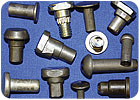
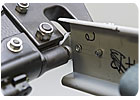


This pneumatic compression riveter heads a rivet in an assembly for a metal security door. Photo courtesy Michigan Pneumatic Tool Inc.


Sometimes, a good, hard squeeze is better than a rap on the head or a pull on the tail-at least for installing certain kinds of rivets.

Tubular and semitubular rivets are typically installed with a pedestal-mounted impact riveter. As the name implies, an impact riveter upsets the rivet with one quick, powerful blow from the ram. In contrast, a blind rivet consists of a headed, hollow rivet body and a headed, solid mandrel, or tail. The riveter grips the mandrel and pulls it through the rivet body, causing the body to expand and forcing the materials together.

Solid rivets require a different approach. Unlike tubular, semitubular and blind rivets, a solid rivet doesn’t have a hollow section that makes it easy to upset. It’s a solid shaft with a cold-formed head. Solid rivets can be made from steel, stainless steel, brass, copper, Monel, Inconel, titanium and aluminum. Shank diameters range from 0.062 to 1.75 inches, while head diameters range from 0.122 to 2.844 inches. They are available with many head styles, including round, flat, countersunk, pan, truss, universal, brazier, acorn and mushroom.

As with tubular and semitubular rivets, access to both sides of the assembly is necessary to set solid rivets. However, instead of a single, rapid strike, a solid rivet is upset with a slow, controlled squeeze. Just how slow depends on the tool, the rivet material, the shank diameter and how much force is applied. A small aluminum rivet-0.0937 to 0.25 inch in diameter-can be set in a fraction of a second, while a large steel rivet-0.25 to 0.375 inch in diameter-might take 1 to 3 seconds, says Robert Arthur, vice president of Michigan Pneumatic Tool Inc. (Detroit).

The riveting process does more than just bring the parts together and form a head on the rivet. It also expands the shaft so it completely fills the hole. “In many cases, you’re trying to make the rivet look and feel like the parts it’s assembling, as if the parts have not been penetrated,” Arthur explains.

Solid rivets are used for high-reliability structural applications in products such as trucks, buses, boats, missiles, military vehicles, bicycles, metal furniture, ladders and electrical cabinets. Solid rivets can be found in the frame, transmission mounts and shock mounts of a car, and hundreds of thousands of them are used to assemble the frame of an airplane. Solid rivets fasten the roof, sidewalls and floor rails of semitrailers.

“We’ve supplied riveting equipment for the M60 machine gun, jail cell doors and the Brooklyn Bridge,” says Arthur. “We’ve even supplied custom equipment to rivet the arms that lift the big ladles carrying molten steel in a steel mill. Each arm consists of 10 1-inch-thick steel plates that are riveted together.”
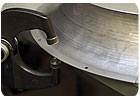
 

A pneumatic compression riveter installs a semitubular rivet in the housing for an industrial Venturi fan. Photo courtesy Michigan Pneumatic Tool Inc.

Tools for Solid Rivets

Because solid rivets are squeezed or crushed, instead of struck, the machines for setting them are known as compression riveters or rivet squeezers. This equipment comes in many forms.

Pneumatic and hydropneumatic hand tools are one option. These tools are equipped with one or two cylinders, a yoke and a two-piece rivet set (the tooling that contacts and shapes the rivet). The yoke can be shaped like a C or like alligator jaws, depending on how the tool can access the assembly and how much force must be applied to the rivet. One half of the rivet set is cupped to support the head of the rivet, while the other half is either cupped or flat.

“The cupping prevents the head from being squeezed off to one side,” says Arthur. “You want a uniform squeeze, so the formed head of the rivet and the upset end of the rivet are concentric, if not necessarily symmetrical.”

Both the yoke and the rivet set can be changed to match a new assembly or fastener. In fact, because the tool applies most of the crushing force near the end of its stroke, the rivet set and the jaws must be adjusted or changed if the length or diameter of the rivet changes.

A small single-cylinder tool with an alligator yoke weighs 3.75 to 4.75 pounds; applies 1,800 to 3,000 pounds of force; and upsets aluminum or steel rivets up to 0.0937 inch in diameter. A large two-cylinder tool with a C yoke might weigh 15 pounds and apply 12,000 pounds of force. It can upset aluminum rivets up to 0.25 inch in diameter or steel rivets up to 0.2187 inch in diameter.

In addition to riveting, these tools can be used for dimpling, punching, stamping, pressing and rivet removal. Besides Michigan Pneumatic, several other companies supply handheld rivet squeezers, including Chicago Pneumatic (Novi, MI), Advanced Air Tool Co. Inc. (Farmingdale, NY) and Atlantic Air Tool Inc. (Taft, TN).

Another hand tool option is a pneumatic riveting hammer. In most cases, installation with a riveting hammer is a two-person operation. One person holds a bucking bar against the formed head of the rivet, while the other person applies the tool to the unformed end. When the tool is actuated, it strikes the end of the rivet at a high frequency-between 900 and 2,580 blows per minute. The percussive blows form the head without excessively work-hardening the rivet or stretching the surrounding metal. Air hammers can upset steel rivets up to 0.25 inch in diameter or 2000 series aluminum-copper alloy rivets up to 0.3125 inch in diameter.

Weighing between 2.25 and 8.25 pounds, the tools are available with either pistol-grip or gooseneck handles. Besides riveting, they can be used for chipping, scraping, metal cutting, peening and other hammering applications. For ergonomic reasons, workers should wear hand and ear protection when using riveting hammers.

Riveting hammers are often used on airplanes and truck trailers. Though neither operator can see the other, a pair of skilled operators can install rivets quickly and efficiently. “It’s almost like a symphony,” says Arthur. “The guy with the bucking bar can feel through the rivet that other guy has taken the gun from one rivet and placed it on the next.”

For heavier riveting applications, a large hydraulic cylinder can be mounted in a C frame. This assembly can be mounted to a pedestal or hung from a mobile tool balancer rigged to a gantry. The latter setup enables an operator to upset multiple rivets in a row without moving the workpiece. The largest such device applies 90 tons of force to upset annealed carbon steel rivets 0.875 inch in diameter.

Another alternative would be a standalone press. The press could be pneumatic, hydraulic, hydropneumatic or electric. Instead of moving the tool to each riveting location, the operator would move the workpiece.

Riveters for the aerospace industry have become very sophisticated. Companies such as Townend Aerospace Tool Co. (Lawndale, CA) and Gemcor (West Seneca, NY) supply machines that automatically clamp the parts, drill a hole, install a rivet, set it and inspect the assembly.

Looking for quick answers on assembly and manufacturing topics? Try Ask ASM, our new smart AI search tool. Ask ASM →

Share This Story

Looking for a reprint of this article?
From high-res PDFs to custom plaques, order your copy today!

John has been with ASSEMBLY magazine since February 1997. John was formerly with a national medical news magazine, and has written for Pathology Today and the Green Bay Press-Gazette. John holds a B.A. in journalism from Northwestern University, Medill School of Journalism.

Recommended Content

JOIN TODAY
To unlock your recommendations.

Already have an account? Sign In

  • Made in the U.S.A.

    Consumer Products Manufacturing: Made in the USA

    Supply chain lessons learned during the coronavirus...
    Automated Assembly Systems
    By: Austin Weber
  • Best Practices for Press-Fit Assembly

    Best Practices for Press-Fit Assembly

    In manufacturing, ironclad formulas for success are hard...
    Assembly Presses
    By: Jim Camillo
  • aem0523leader-tesla1.jpg

    Tesla Rethinks the Assembly Line

    Engineers at Tesla Inc. have developed a new process that...
    Industries
    By: Austin Weber
Manage My Account
  • eMagazine Subscription
  • Assembly Newsletters
  • Online Registration
  • Subscription Customer Service
  • Manage My Preferences

More Videos

Sponsored Content

Sponsored Content is a special paid section where industry companies provide high quality, objective, non-commercial content around topics of interest to the ASSEMBLY audience. All Sponsored Content is supplied by the advertising company and any opinions expressed in this article are those of the author and not necessarily reflect the views of ASSEMBLY or its parent company, BNP Media. Interested in participating in our Sponsored Content section? Contact your local rep!

close
  • ultrasonic welding
    Sponsored bySonobond Ultrasonics

    Engineering Efficiency in High-Performance Assembly: How Ultrasonic Welding Enhances Throughput, Reliability and Quality

  • UV curing system
    Sponsored byDymax

    Why UV Intensity Alone Doesn’t Define Curing Performance

  • wooden pallets
    Sponsored byLEAN Manufacturing Products

    Eliminating Waste on the Shop Floor: Applying Lean Principles to Improve Manufacturing Efficiency

Popular Stories

ASSEMBLY News Now, episode-30: Volvo Redesigns EV Manufacturing

Volvo Redesigns EV Manufacturing

Boeing CEO Kelly Ortberg announces 1 billion investment

Boeing Plans $1 Billion Wichita Investment, Workforce Training Center

GE Appliances Worker on Line

GE Appliances Expands Factory AI With 800 Gemini Enterprise Agents

Watch the latest episode of ANN now!

Events

July 24, 2025

From Shop Floor to CFO: How Manufacturers Are Closing the Loop Between Operations and Finance

On Demand Learn how manufacturers are bridging the gap between the shop floor and ERP systems to gain real-time visibility, streamline operations, and kick-start digital transformation—without waiting years.

Sponsored by:

PicoStratusGreen
July 30, 2025

Buffer Analysis and Design Fundamentals for Manufacturing Excellence

On Demand In this presentation, Dr. Herman Tang shares practical insights from his industry experience and research on buffer management in manufacturing operations.

View All Submit An Event

Poll

Difficult Assembly Processes

Which assembly process gives you the most difficulty?
View Results Poll Archive

Products

Manufacturing Cost Policy Deployment (MCPD) Profitability Scenarios: Systematic and Systemic Improvement of Manufacturing Costs

Manufacturing Cost Policy Deployment (MCPD) Profitability Scenarios: Systematic and Systemic Improvement of Manufacturing Costs

See More Products
Register for webinar - Modernizing Automotive Assembly: Why Upgrading Legacy MES is a Business Imperative

Related Articles

  • Assembly Lines: Automakers Put the Squeeze on Suppliers

    See More
  • X-Y-Z: Putting the Clamps on Motion

    See More
  • GM Putting the Sun to Work in Spain

    See More

Related Products

See More Products
  • foreman.jpg

    The Foreman on the Assembly Line

  • history.jpg

    Faster, Better, Cheaper in the History of Manufacturing: From the Stone Age to Lean Manufacturing and Beyond

  • The Basics of Self-Balancing Processes: True Lean Continuous Flow

See More Products

Related Directories

  • Grant Riveters USA

    The only Riveter/Press All-In-One machine. State of the Art Process Inspector control system. The World's Oldest Riveting Machine Manufacturer 350,000+ Riveters Sold. We experience 1/2% service rate and 10 to 25 million cycles before needing parts. Experts in all riveting techniques, fastening and joining methods since 1860.
×

Never miss the latest news and trends driving the manufacturing industry

Stay in the know on the latest assembly trends.

JOIN TODAY!
  • RESOURCES
    • Advertise
    • Contact Us
    • Directories
    • Manufacturing Division
    • Store
    • Want More?
  • SIGN UP TODAY
    • Create Account
    • eMagazine
    • Newsletters
    • Customer Service
    • Manage Preferences
  • SERVICES
    • Marketing Services
    • Reprints
    • Market Research
    • List Rental
    • Survey/Respondent Access
  • STAY CONNECTED
    • LinkedIn
    • Facebook
    • Instagram
    • YouTube
    • X (Twitter)
  • PRIVACY
    • PRIVACY POLICY
    • TERMS & CONDITIONS
    • DO NOT SELL MY PERSONAL INFORMATION
    • PRIVACY REQUEST
    • ACCESSIBILITY

Copyright ©2026. All Rights Reserved BNP Media, Inc. and BNP Media II, LLC.

Design, CMS, Hosting & Web Development :: ePublishing