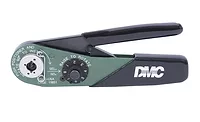
Wire Processing: Crimping Loose-Piece Contacts
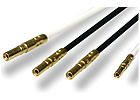
Terminals can be supplied linked together, daisy-chain style, on reels, or they can be supplied in bulk as loose pieces. Both types are crimped onto the ends of stripped wires to form a mechanical and electrical connection, but that is where the similarity ends. There are significant differences in how the crimping and quality processes are automated.
Reeled terminals are connected to a carrier strip. Each terminal is separated by the same distance, or pitch. This makes reeled terminals easier to automate than loose-piece contacts (LPCs), because the applicator tooling feeds each terminal a fixed distance equal to the pitch. Reeled terminals are available in open- or closed-barrel configurations.
LPCs are shipped in bulk. They are also known as “turned contacts” or “screw-machine contacts,” referring to the manufacturing method used to produce them. They are machined from solid rod and are always the closed-barrel type, meaning that the area where the wire will be inserted forms an unbroken, 360-degree cylinder. LPCs come in various shapes and sizes and are primarily used where quality requirements are very high, such as military, aerospace and medical applications.
Because of their broad contact area, LPCs have lower electrical resistance than stamped and formed terminals. With comparable wire cross sections and electrical currents, the heat generated in a LPC is substantially less than with other types of terminals. The voltage drop between the conductor and contact is also lower. As a result, engineers can specify smaller LPCs compared with stamped and formed terminals, saving valuable weight and space in many products.
Another advantage of LPCs is their precise cylindrical geometry. Male and female connectors mate together perfectly, forming a very reliable gas-tight and spark-free connection. This precision fit makes LPCs resistant to intermittent disconnections caused by vibration. Standard pull-force tests almost always show that the wire strands break before they are pulled out of the crimped connection.
LPCs are typically attached to a wire with a four-indent crimp, in which four indents are made at 90 degrees to each other. The specifications and quality requirements for four-indent crimps can be found in the SAE AS22520 standard, which is mainly used in the military and aerospace industry.
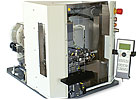
LPCs can be attached using semiautomatic or fully automatic equipment.
Process Automation
LPCs are significantly more difficult to automate than reeled terminals. Accurate and reliable processing of LPCs requires that they be automatically sorted and oriented into the correct position before being crimped onto the wire. Inserting a stripped wire into a closed-barrel LPC requires an additional axis of movement and a guide system to ensure that all the wire strands are safely inside the contact before crimping.Both semiautomatic and fully automatic systems require a number of automated process steps for reliable crimping of LPCs:
* sorting and orienting,
* feeding and positioning into the tooling,
* stripping the wire end and inserting it into the contact,
* crimping, including quality assurance,
* extracting the completed wire from the machine without damaging it.
Each step requires a technical solution that differs from those for crimping reeled terminals. A semiautomatic benchtop machine combines all five steps, including quality assurance, into one machine. The machine sorts and feeds the contacts using a drum and track system. An integrated stripping unit with trigger sensor strips the wire end. An optional “re-cut function” can be used to trim the wire, ensuring that the strip length and wire end position are exact.
Depending on production requirements, LPCs can be processed on fully automatic systems, as well.
During sorting, LPCs are brought into a defined position for further processing. A proven process is to use a rotating drum, which drops the contacts onto a vibrating feed track. The track is specifically designed for the shape of a given contact, so they can only fall into the track in a defined way and are automatically lined up for further processing. A gripper then positions each terminal into the crimping applicator.
LPCs are fed either vertically or horizontally. The contact type determines how linear feeding and positioning are executed.
There are three basic types of contacts, which are distinguished by their shape and center of gravity.
Type 1 contacts are fed vertically with the crimp zone up. This contact type has a collar or shoulder between the connection area and crimp zone. Its center of gravity is below the collar in the connection area.
Type 2 contacts are fed horizontally. Type 2 contacts have no collar, and their center of gravity is not clearly defined. As a result, vertical feeding is impossible, and the terminal must be fed horizontally.
Type 3 contacts are fed vertically with the crimp zone down. This contact type also has a collar, but its center of gravity requires upside-down feeding, with the crimp zone down.
One machine can process all three types of contacts. Quick-change tooling minimizes changeover times.
Contacts move along a vibrating feed track towards the positioning unit. The design of the positioning unit depends on the contact. The positioning unit consists of a tilting and turning module equipped with a gripper. The gripper picks up the contact from the end of the feed track and places it inside the crimping head.
Type 2 contacts are the most complex to feed and orient, because the crimp zone can be on the leading or trailing end as they move down the track. The machine must accurately detect the position of the crimp zone and orient it correctly for further processing.
Once the contact is correctly positioned inside the applicator, it can be crimped onto the stripped wire. The operator inserts the wire into the machine until the wire end touches the trigger sensor. A gripper automatically closes and holds the wire during the entire processing cycle. The machine will guide the wire strands into the contact and ensure that the wire end is at the programmed insertion depth.
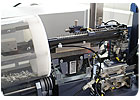
This stripper-crimper sorts and feeds LPCs using a drum and track system.
Crimping and Quality Assurance
To ensure the quality of every crimp, modern stripper-crimpers have an integrated crimp force monitoring (CFM) system. The CFM measures force vs. time while crimping a contact onto a wire. The operator teaches the CFM some good crimps, and the reference curve is stored in the CFM’s memory.During each crimp cycle, the actual force vs. time curve is compared to the reference curve. Any crimps that do not match the reference curve within preset tolerances are flagged as bad and the CFM stops the machine to allow the operator to investigate and correct the problem. The crimping head is simple to adjust and calibrate. Only the crimping depth needs to be adjusted.
Additional quality assurance methods and test procedures used with crimping reeled terminals, such as pull-force testing or visual analysis using cross-sectional micrographs, also apply to indent crimps. Quality criteria for gas-tight crimps with LPCs include strip length, insertion depth and pull-force.
ASSEMBLY ONLINE
For more information on wire processing, visit www.assemblymag.com to read these articles:* Assembly in Action: Wire-Harness Audit Improves Productivity.
* Assembly in Action: Wire Cutter and Stripper Improve Manufacturing Process.
* Assembly in Action: Automation Speeds Wire Processing.
Looking for a reprint of this article?
From high-res PDFs to custom plaques, order your copy today!