Assembly Magazine logo
search
Ask ASSEMBLY AI
cart
facebook twitter linkedin youtube
  • Sign In
  • Create Account
  • Sign Out
  • My Account
Assembly Magazine logo
  • TRENDS
    • Ask ASSEMBLY AI
    • Trends
    • News
    • New Products
  • INDUSTRIES
    • Aerospace
    • Appliance
    • DFMA Assembly
    • Medical Devices
    • Green Manufacturing
    • Lean Manufacturing
    • Machinery Assembly
    • Electronics Assembly
    • Automotive
  • TECHNOLOGIES
    • Adhesives & Dispensing
    • Assembly Presses
    • Automated Assembly Systems
    • Manufacturing Management
    • Manufacturing Software
    • Motion Control
    • Screwdriving & Riveting
    • Robotics
    • Test & Inspection
    • Plastics & Metal Welding
    • Wire Processing
    • Workstations
  • AUTONOMOUS & ELECTRIC MOBILITY
    • AEM Magazine Archives
    • Autonomy
    • Electrification
    • Mobility Services
    • Assembly & Testing
    • AV/EM News
  • MEDIA
    • Ask ASSEMBLY AI
    • Podcasts
    • Assembly News Now
    • Assembly TV
    • Webinars
    • eBooks
  • EVENTS
    • Calendar
    • The ASSEMBLY Show
  • MORE
    • Exclusives >
      • Plant of the Year
      • Capital Spending
    • Buyers Guide >
      • Supplier Insights
    • Classifieds
    • Featured Products
    • Newsletters
    • Store
    • White Papers
    • Columns
    • Sponsor Insights
  • INFOCENTER
    • Assembly & Test Solutions
  • EMAGAZINE
    • eMagazine
    • Archive Issues
    • Advertise
    • Contact Us
    • Sign Up
IndustriesAutonomous & Electric MobilityAutomotive AssemblyAssembly and TestingAV/EM NewsConnectivity

Volvo Deploys Gigacasting Technology to Assemble New EV
By Austin Weber
Volvo Cars
Volvo Cars
May 21, 2026

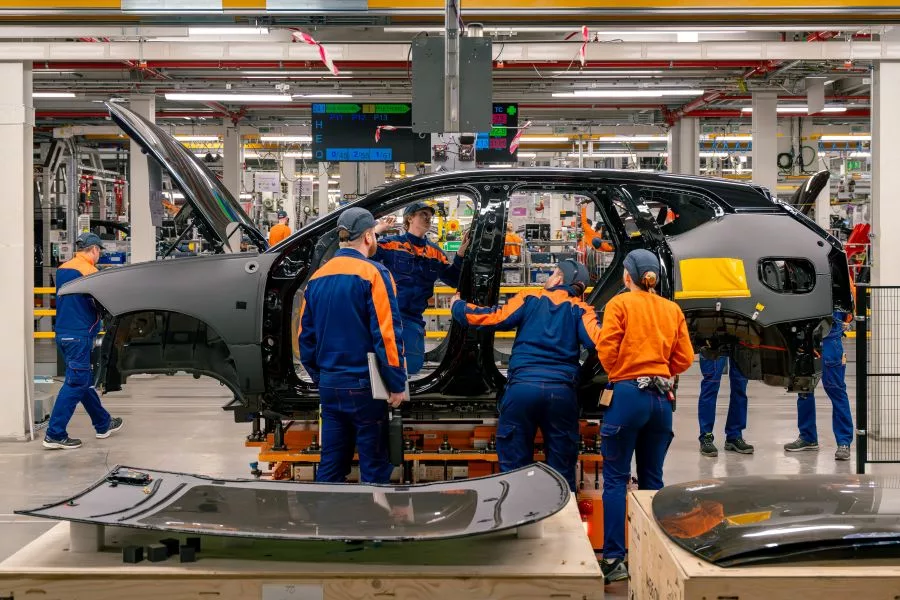
TORSLANDA, Sweden—Volvo Cars has begun assembling a new electric vehicle at its flagship assembly plant here using gigacasting technology. The EX60 is a midsize, aluminum-bodied SUV that’s based on the automaker’s innovative SPA3 platform.

The “scalable product architecture” is Volvo’s first ground-up electric vehicle platform designed without compromises from internal combustion engine requirements. This platform represents a fundamental shift in how Volvo produces electric vehicles, addressing the limitations that emerged when adapting gasoline-powered architectures for battery-electric propulsion.

The key distinction between SPA3 and previous platforms lies in engineering philosophy. Earlier Volvo electric vehicles, such as the EX90 and ES90, utilize SPA2—an architecture derived from platforms that originally accommodated gasoline engines, transmissions and exhaust systems. SPA3 optimizes every element specifically for electric propulsion.

The primary advantage stems from its singular focus. When engineers design a platform that must accommodate both gasoline and electric power trains, they make trade-offs. Battery placement works around components like transmission tunnels or fuel tank locations.

Floor structures account for exhaust routing. Suspension mounting points consider engine weight distribution. These compromises add weight, consume space, and limit optimization potential. SPA3 removes these constraints entirely.

Using a “clean sheet approach” to EVs, the new platform integrates the battery as a structural component from the beginning, using cell-to-body technology where individual battery cells bond directly to the floor structure. This approach eliminates the need for separate battery enclosures and allows engineers to reduce material thickness in surrounding structures, because the battery assembly contributes to chassis rigidity.

The result is measurable weight reduction. Eliminating redundant protective structures, removing components required for gasoline powertrains, and optimizing material use throughout the platform creates savings that directly improve range. 

Looking for quick answers on assembly and manufacturing topics? Try Ask ASM, our new smart AI search tool. Ask ASM →

SPA3 establishes standardized mounting points, electrical architectures and structural interfaces that remain consistent across different vehicles. When Volvo develops a compact crossover, a mid-size sedan or a larger SUV on SPA3, engineers work with known parameters rather than starting from scratch.

The flexible platform also supports different battery chemistries, motor configurations and power electronics without requiring a complete redesign. When battery energy density improves or new motor technology emerges, SPA3 can integrate these advances across the product line.

Gigacasting (Volvo refers to the technology as “megacasting”) also plays a strategic role in the SPA3 platform. The rear underbody structure of the EX60 features a large, single casting that eliminates hundreds of stamped and welded parts. A targeted approach to material distribution reduces weight while improving strength.

Eliminating overlapping material at weld joints removes redundant metal.  Engineers can also optimize material thickness throughout the casting based on structural load requirements—using more material where needed and less where loads are lighter.

High-pressure aluminum injection reduces complexity, improves dimensional stability, and decreases assembly time.

Gigacasting creates a single-piece rear underbody that replaces more than 100 parts and accelerates production to a 120-second cycle time.

Traditional body construction involves stamping individual panels, welding them together in specific sequences, and finishing the assembly with corrosion protection and paint. Each welding operation introduces potential variation in tolerances and structural integrity.

Gigacasting eliminates these variables. A single die creates a precisely dimensioned component with consistent material properties throughout. The reduction in weld points decreases potential failure modes and improves crash performance predictability. Fewer parts mean fewer quality control checkpoints and faster production cycles.

KEYWORDS: electric car manufacturing electric vehicle manufacturing electric vehicles Volvo

Share This Story

Looking for a reprint of this article?
From high-res PDFs to custom plaques, order your copy today!

Austinweber headshot
Austin has been senior editor for ASSEMBLY Magazine since September 1999. He has more than 21 years of b-to-b publishing experience and has written about a wide variety of manufacturing and engineering topics. Austin is a graduate of the University of Michigan.

Recommended Content

JOIN TODAY
To unlock your recommendations.

Already have an account? Sign In

  • Made in the U.S.A.

    Consumer Products Manufacturing: Made in the USA

    Supply chain lessons learned during the coronavirus...
    Automated Assembly Systems
    By: Austin Weber
  • Best Practices for Press-Fit Assembly

    Best Practices for Press-Fit Assembly

    In manufacturing, ironclad formulas for success are hard...
    Assembly Presses
    By: Jim Camillo
  • aem0523leader-tesla1.jpg

    Tesla Rethinks the Assembly Line

    Engineers at Tesla Inc. have developed a new process that...
    Assembly and Testing
    By: Austin Weber
Manage My Account
  • eMagazine Subscription
  • Assembly Newsletters
  • Online Registration
  • Subscription Customer Service
  • Manage My Preferences

More Videos

Sponsored Content

Sponsored Content is a special paid section where industry companies provide high quality, objective, non-commercial content around topics of interest to the ASSEMBLY audience. All Sponsored Content is supplied by the advertising company and any opinions expressed in this article are those of the author and not necessarily reflect the views of ASSEMBLY or its parent company, BNP Media. Interested in participating in our Sponsored Content section? Contact your local rep!

close
  • ultrasonic welding
    Sponsored bySonobond Ultrasonics

    Engineering Efficiency in High-Performance Assembly: How Ultrasonic Welding Enhances Throughput, Reliability and Quality

  • UV curing system
    Sponsored byDymax

    Why UV Intensity Alone Doesn’t Define Curing Performance

  • wooden pallets
    Sponsored byLEAN Manufacturing Products

    Eliminating Waste on the Shop Floor: Applying Lean Principles to Improve Manufacturing Efficiency

Popular Stories

Ferrari

Ferrari Unveils Four-Door EV

ASSEMBLY News Now, episode-30: Volvo Redesigns EV Manufacturing

Volvo Redesigns EV Manufacturing

Robots working at Toyota Plant in Japan

Toyota Deploys Geekplus Robots for Factory Material Handling

Watch the latest episode of ANN now!

Events

July 24, 2025

From Shop Floor to CFO: How Manufacturers Are Closing the Loop Between Operations and Finance

On Demand Learn how manufacturers are bridging the gap between the shop floor and ERP systems to gain real-time visibility, streamline operations, and kick-start digital transformation—without waiting years.

Sponsored by:

PicoStratusGreen
July 30, 2025

Buffer Analysis and Design Fundamentals for Manufacturing Excellence

On Demand In this presentation, Dr. Herman Tang shares practical insights from his industry experience and research on buffer management in manufacturing operations.

View All Submit An Event

Poll

Difficult Assembly Processes

Which assembly process gives you the most difficulty?
View Results Poll Archive

Products

Manufacturing Cost Policy Deployment (MCPD) Profitability Scenarios: Systematic and Systemic Improvement of Manufacturing Costs

Manufacturing Cost Policy Deployment (MCPD) Profitability Scenarios: Systematic and Systemic Improvement of Manufacturing Costs

See More Products
ebook

Related Articles

  • heroimage1440x750.jpg

    Alfa Romeo Leverages Advanced Automation to Assemble New SUV

    See More
  • Chrysler Belvidere assembly

    Stellantis to Assemble New Midsize Truck at Illinois Factory

    See More
  • Alabama Gearing Up to Assemble New Mercedes Sedan

    See More

Related Products

See More Products
  • Technology Of Machine Tools

  • advanced.jpg

    Advanced Manufacturing and Processing Technology

  • 0001349.jpeg

    Adhesion and Adhesives Technology 4e

See More Products

Events

View AllSubmit An Event
  • March 10, 2026

    Design for Flexibility: How to Assemble More With Less

    On Demand Whether you are specifying new equipment or improving existing processes, this session will provide practical insight into building adaptable assembly strategies that support growth, reliability, and continuous improvement. Sponsored by:
View AllSubmit An Event

Related Directories

  • Assembly & Automation Technology Inc.

    Assembly & Automation Technology delivers intelligent automation systems integrating machine learning, computer vision and smart robotics for industrial, medical and biotechnical applications. Our AI-enhanced assembly machines, robotic systems and vision-guided quality control optimize productivity while reducing human error. We engineer custom automated solutions that learn, adapt and continuously improve manufacturing processes.
×

Never miss the latest news and trends driving the manufacturing industry

Stay in the know on the latest assembly trends.

JOIN TODAY!
  • RESOURCES
    • Advertise
    • Contact Us
    • Directories
    • Manufacturing Division
    • Store
    • Want More?
  • SIGN UP TODAY
    • Create Account
    • eMagazine
    • Newsletters
    • Customer Service
    • Manage Preferences
  • SERVICES
    • Marketing Services
    • Reprints
    • Market Research
    • List Rental
    • Survey/Respondent Access
  • STAY CONNECTED
    • LinkedIn
    • Facebook
    • Instagram
    • YouTube
    • X (Twitter)
  • PRIVACY
    • PRIVACY POLICY
    • TERMS & CONDITIONS
    • DO NOT SELL MY PERSONAL INFORMATION
    • PRIVACY REQUEST
    • ACCESSIBILITY

Copyright ©2026. All Rights Reserved BNP Media, Inc. and BNP Media II, LLC.

Design, CMS, Hosting & Web Development :: ePublishing