Global Auto Industry Faces Strong Headwinds Ahead
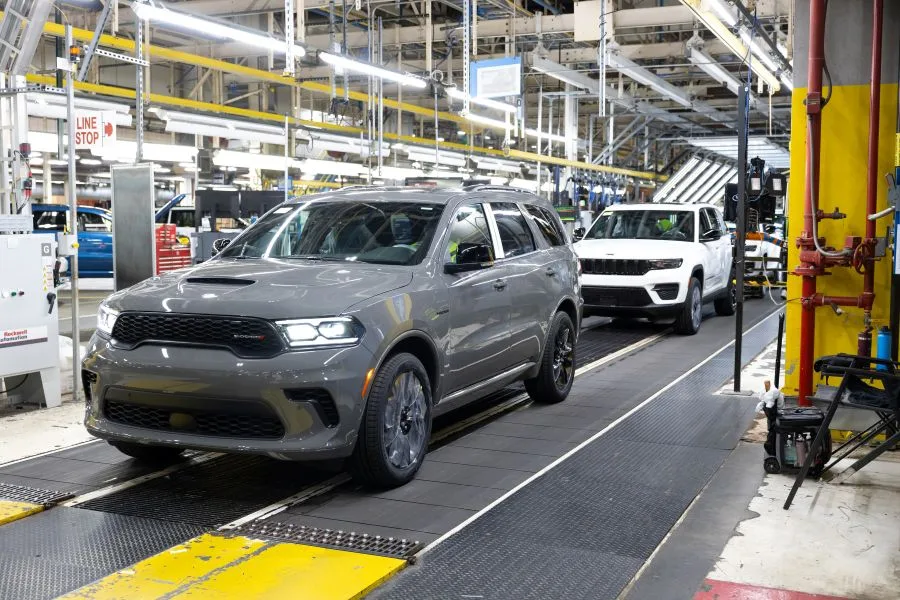
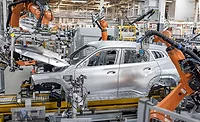
Automakers around the world are faced with supply chain uncertainty and trade risks. Photo courtesy Stellantis
DETROIT—Automakers around the world are entering a new chapter, faced with supply chain uncertainty and trade risks, according to a recent study by AlixPartners. The consulting firm says short-term challenges will force the industry to “reset on electric vehicles, face China’s increasing dominance and address the transition beyond software-defined vehicles to AI-defined vehicles.”
The 23rd annual AlixPartners Global Automotive Outlook projects demand to fall in major markets in 2026, including China and the U.S. China’s intense local competition and ongoing “involution” are also expected to drive Chinese automakers to seek growth in new markets.
“Sales volumes present a more nuanced picture,” claims Mark Wakefield, global automotive market lead at AlixPartners. “While China’s volumes are projected to show a modest recovery followed by gradual growth in the coming years, volumes in the U.S. and Europe are forecast to stagnate.”
Wakefield also expects continued volume pressure will drive a further decline in sales for foreign automakers in China, increasing pressure on non-Chinese OEMs and suppliers to refocus on competitiveness in their home markets without China as a reliable profit center.
“The auto industry’s new regionalization era lands virtually every company in this industry at a critical crossroads, weighing which markets, technologies, and partnerships to invest in at a time when significant disruption is the only constant,” says Wakefield.
“The USMCA (United State-Mexico-Canada Agreement) renegotiation may lead to added cost to U.S. vehicles, with a larger piece of a smaller pie for the U.S., or an opportunity to create a ‘Fortress North America,’ with the U.S. at the center of a resilient and competitive industry, with a supply chain leveraging the strengths and installed capacity in Mexico and Canada, and precompetitive cooperation in the U.S. on the key areas such as battery supply chains, semiconductors, autonomy and electrical architectures,” Wakefield points out.
According to Wakefield, individual markets are heading in seemingly opposite directions. “While China is firmly committed to electrification, the US appears headed for a ‘new ICE age,’ where sales of internal combustion engine and hybrid vehicles remain dominant,” he explains. “That age will eventually melt…[as] 36 percent of global sales will be plug-in electrified vehicles in 2030.”
Looking for quick answers on assembly and manufacturing topics? Try Ask ASM, our new smart AI search tool. Ask ASM
“ICE and hybrid buyers in the US present significant margin opportunities for companies in the near-term, but that could present a major longer-term risk,” warns Dan Hearsch, global co-leader of the automotive and industrial practice at AlixPartners. “Becoming complacent within a protectionist wall could inevitably open the door to Chinese companies to take share in the U.S. marketplace through joint ventures, licensing or other indirect methods.”
“Chinese automakers will export nearly 10 million vehicles in 2026, up from 7.1 million in 2025,” adds Hearsch. :But, exports are seen as just the first phase of Chinese expansion, with the eventual target being localized assembly. Bridging these two approaches may include technology licensing, local contract manufacturing and joint ventures in some protected regions.”
Looking for a reprint of this article?
From high-res PDFs to custom plaques, order your copy today!