Research Project Focuses on Solid-State EV Batteries
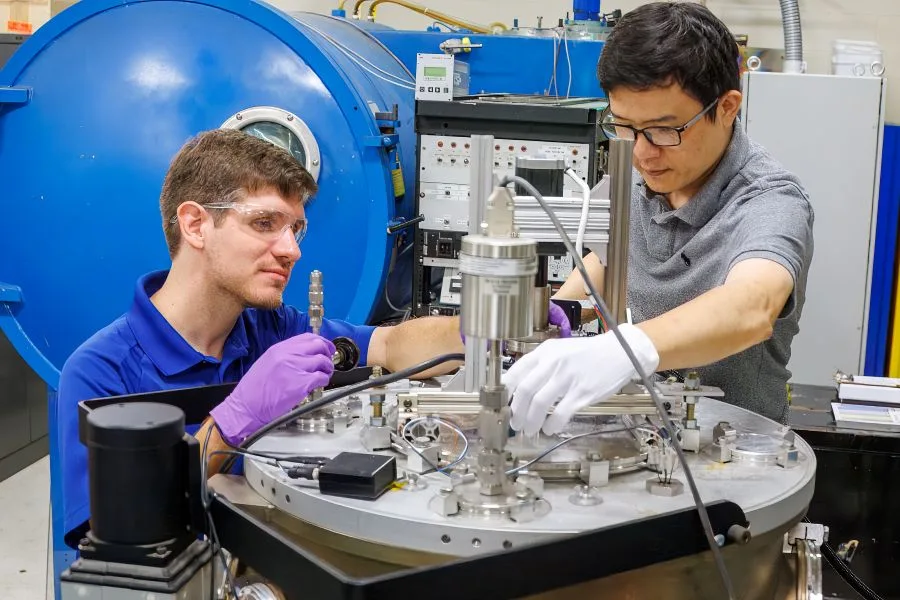
Engineers are working on an R&D project to develop solid-state battery technology for electric vehicle applications. Photo courtesy Southwest Research Institute
SAN ANTONIO, TX—Engineers at the Southwest Research Institute (SwRI) and Southern Methodist University (SMU) are collaborating on an R&D project to develop solid-state battery technology for electric vehicle applications. The goal is to develop ultra-thin films to reduce degradation and resistance at the anode-electrolyte interface, which would improve the reliability and stability of the next-generation battery technology.
Solid-state batteries are safer, longer-lasting and more efficient alternatives to traditional lithium-ion batteries, offering faster charging and greater energy storage potential. However, current designs have been held back by electrodes and interfaces that degrade over time. The SwRI and SMU engineers plan to address this bottleneck.
Solid-state batteries replace the liquid electrolyte with a solid material and use a lithium metal anode as the source of lithium ions. These components in solid-state batteries enable faster charging and significantly higher energy density, while also offering inherently safer operation because they utilize solid materials instead of flammable liquids.
“Solid-state batteries are a next generation technology with huge potential for energy storage, particularly for electric vehicles, but they haven’t been widely commercialized because of manufacturing and materials challenges,” says John Hemmerling, Ph.D., a senior research engineer in SwRI’s Materials Engineering Department. “One of the biggest technical hurdles is the unstable interface between the lithium metal anode and the solid electrolyte.”
“In solid-state batteries, a solid lithium metal anode is in direct contact with a solid electrolyte, and that interface is difficult to manage because lithium is highly reactive and can easily damage or chemically interact with materials that it touches, compromising the battery’s performance and stability,” explains Hemmerling,
“The lithium can also deposit in uneven growths, known as dendrites, that damage the contact area and hinder the transfer of ions,” Hemmerling points out. “This accelerates battery degradation, making the battery less efficient over time.”
Hemmerling and his colleagues plan to deposit ultra-thin films tens to hundreds of nanometers thick onto the anode. These films include metals, metal oxides and metal alloys, precisely tuned to stabilize the interface.
Looking for quick answers on assembly and manufacturing topics? Try Ask ASM, our new smart AI search tool. Ask ASM
The project will leverage SwRI’s expertise in thin-film deposition and SMU’s strengths in solid-state battery development to establish quantitative structure-property-performance relationships linking interfacial chemistry, lithium nucleation behavior and long-term electrochemical performance.
“Although our current work is focused on a small, proof of concept scale, the thin film deposition techniques we’re using are scalable,” claims says Hemmerling. “So, if the concepts prove successful, they can be adapted relatively easily to larger scale manufacturing.”
Looking for a reprint of this article?
From high-res PDFs to custom plaques, order your copy today!