Archer Unveils Autonomous Aircraft for Commercial and Military Use
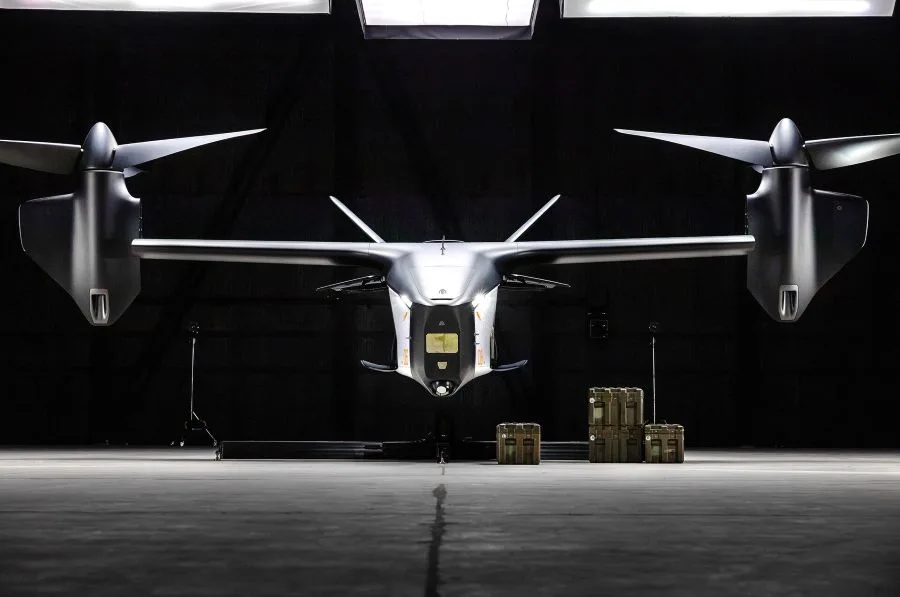
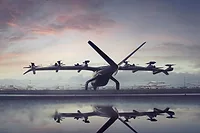
A new autonomous vertical takeoff and landing aircraft called Thunder is designed for military applications. Photo courtesy Archer Aviation Inc.
FARNBOROUGH, England—Archer Aviation Inc. and Anduril unveiled a jointly-developed autonomous vertical takeoff and landing (VTOL) aircraft. The battery-powered device is designed to serve both defense and commercial applications.
The military variant is called Thunder, while the commercial version of the rotorcraft is dubbed Halo. The dual-use platform features next-generation speed, range, payload and operating cost.
Dual tiltrotors will vary rotor speed to maintain efficiency across flight regimes, reducing power demand and fuel burn while cruising. A low acoustic signature will enhance survivability during low-altitude defense missions. The new aircraft can also transport a variety of modular, heavy payloads.
"This mission required a clean sheet design, built from the ground up to meet the needs of modern commercial and defense applications,” says Adam Goldstein, CEO of Archer Aviation. “We couldn’t simply tweak our existing [air taxi]. Instead, we took a bold first principles approach alongside Anduril to develop what we believe is the most sophisticated vertical lift aircraft ever made.
“Over the past eight years, we've engineered, tested and scaled the technology this platform is built on,” explains Goldstein. “The power train, the batteries, the motors, the manufacturing.”
“From raw performance to producibility, harnessing the best technologies from the commercial eVTOL market for defense is central to how Thunder will deliver operational value to our customers,” adds Shane Arnott, senior vice president of maneuver dominance at Anduril. “The clean-sheet, dual-use platform that we’ve built with Archer truly represents a step change in capability.”
Archer is partnering with Marubeni Aerospace Corp. to develop Halo for commercial logistics operations. According to Goldstein, the goal is “to move heavy payloads long distances, fast, into places with no runway, at a fraction of the cost of legacy platforms.”
"Currently, even in cargo transport operations that do not require onboard crew, flights are conducted with human pilots, absorbing the cost, scheduling constraints and human exposure that come with it," notes Satoru Nakagawa, president and CEO of Marubeni Aerospace. "Halo's unmanned, autonomous flight capabilities can address these challenges….”
Looking for quick answers on assembly and manufacturing topics? Try Ask ASM, our new smart AI search tool. Ask ASM
Looking for a reprint of this article?
From high-res PDFs to custom plaques, order your copy today!