Impact Riveting: Using Loose Rivets
If you were a manufacturing engineer 100 years ago, your dream job would probably have been to work for a locomotive builder. In 1901, steam power ruled the world. Companies such as Alco and Baldwin were the Amazon.com and Microsoft of their day.
Each fire-breathing behemoth they mass-produced in sprawling plants used thousands of loose rivets. Boilermaking, a key step in steam locomotive assembly, was a very slow, laborious process that required a team of highly skilled assemblers. A rivet thrower would grab a glowing-hot rivet from a furnace and flip it to a “holder-on” crouched inside the boiler that was being assembled. He placed the rivet in a hole and backed it up while a worker on the outside of the boiler hammered or peened the rivet head.
While locomotive boilermaking and rivet throwing are archaic skills today, riveting remains one of the most effective fastening methods. However, other tools and techniques, such as threaded fasteners, welding and adhesive bonding, are more commonly used to create joints.
Assemblers generally want to eliminate the use of traditional, loose rivets. Whenever possible, they prefer to use studs or bosses that are cast or otherwise formed in one of the parts. As a result, new processes and tools, such as orbital riveting, radial riveting, blind rivets and self-piercing rivets, have become more popular in recent years.
But, loose rivets still offer numerous benefits to assemblers, such as simplicity, dependability and relatively low cost. In fact, loose rivets are still the fasteners of choice for assembling products such as brake shoes, medical instruments, seatbelt retractors, scissors, pliers, air bag assemblies, door hinges, toggle clamps, pulleys, caster wheel assemblies, furniture mechanisms, staplers, chainsaws and garden tools.
Rivets are ideal for flexible joints or tightly joined mating components. They are an inexpensive alternative to threaded fasteners, especially for products that require pivot joints or mechanical repetitiveness.
“Any mechanism that moves is a candidate for loose rivets,” says Kevin Haueter, technical manager at Orbitform Inc. (Jackson, MI). He believes assemblers should consider using loose rivets whenever products can benefit from the cost savings of the fastener itself and overall assembly cost. Loose rivets generally cost several cents less than threaded fasteners.
“In general, any product design can use a loose rivet provided there is suitable access to the preformed rivet head and if the assembly supports the rivet from collapsing during the heading process,” adds Bruce McNaughton, president of Grant Assembly Technologies (Bridgeport, CT). “If the rivet or rivets being utilized are long and unsupported through the assembly, then both ends of the rivet need to be captured by some means of tooling or by an area of the assembly that provides support to the rivet.”
Looking for quick answers on assembly and manufacturing topics? Try Ask ASM, our new smart AI search tool. Ask ASM
The loose rivet remains popular because it offers multifaceted appli-cations. It allows high production rates, it is a permanent fastener, it can be used on assemblies of varying complexities, it is easy to inspect and it requires no maintenance. Additional benefits include fastener strength, product strength after riveting and a clean fastening process.
“When it comes to loose rivets, there are more advantages than disadvantages,” says Haueter. “And, when you want a product to be tamper-proof for safety or liability reasons, rivets are a very good choice.”
The biggest disadvantage of using loose rivets is disassembly. In fact, disassembly usually destroys rivets. “If you want to be able to take something apart, then a rivet is not a good choice,” warns Gary Anderson, manager of applications at Orbitform. “The only way to remove a rivet is by drilling or milling it out of the assembly.”
According to McNaughton, assemblers should also avoid loose rivets when their products cannot support the forming pressure required to generate the desired clinched rivet head shape or when an item does not lend itself to easy product handling and rivet insertion. “Other times to avoid a loose rivet design is when there is not adequate access to the rivet’s preformed head or where the head forming operation is located in a restricted and or obstructed area,” says McNaughton.
How Rivets Work
A rivet is an unthreaded, headed pin used to join two or more parts by passing the pin through holes in the parts and then forming a second head in the pin on the opposite side. A head is formed on the plain end of the pin by hammering or by direct pressure. Once the rivet has been deformed, it cannot be removed except by breaking one of the heads.There are three methods of riveting: compression, impact and nonimpact. In the compression method, the head of the rivet is formed by pulling or squeezing the rivet shank. In the impact method, the head is formed by the force of the impact against the top of the shank. In nonimpact riveting, the rivet head is formed by a rolling or spinning action against the top of the shank. A combination of impact and compression can also be used.
Rivets are used primarily for lap joints. However, McNaughton says the clearance hole into which the rivet is inserted must be close to the diameter of the rivet. Unlike some other types of fasteners, rivets swell up in the hole and provide extra support.
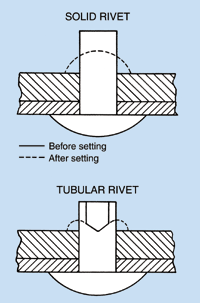
In solid impact riveting, a compressive axial load is applied to the end of the rivet shank. This causes the rivet shank to swell throughout its length as it shortens under the load. The rivet shank continues to expand until the hole in the parts being assembled restricts it from further expansion. The unrestricted rivet end then expands, forming the rivet clinch.
Because of the forged grain structure of rivets, they have higher compression and shear strengths than many other mechanical fasteners. But, rivets are not recommended for transmitting loads in tension. Their tensile and fatigue strengths are lower than those of bolts. Permanent failure may result when loads exert movements that cause a prying action on the head of a rivet. Tensile load stress should be kept at a minimum when using rivets.
Rivet Options
Loose rivets can be either solid, tubular or semitubular. Which fastener to use depends on issues such as stress and shearing. For strength and durability, solid rivets work the best. Semitubular rivets are recommended when strength is somewhat of an issue, but ease of curling is also important. Tubular rivets are the best choice for light-duty applications.Solid rivets are often used in applications where extremely high joint strength is required, such as aircraft landing gear, automobile brake shoes, or mining and construction equipment. Typical solid rivets include flat head, pan head, round head and shoulder-type rivets. The head may be of various shapes, but the shank must be of sufficient length to accommodate the thickness of the parts to be joined and to allow for the formation of the clinch head.
Flat head, pan head and button head rivets are often used for tightly joining mating components. A shoulder rivet is a solid or tubular rivet that has a shoulder under its head. Shoulder rivets are typically installed so the shoulder acts as a bearing surface, allowing the retained part to pivot. Shoulder-type rivets are normally used for pivoting or hinging joints.
A tubular rivet has a coaxial cylindrical or tapered hole in the headless end. It is secured by splaying or curling the end. To be classified as tubular, a rivet must have a hole depth that exceeds 112 percent of the mean shank diameter. Tubular rivets are ideal for light-load products that have very few strength requirements, such as electronic components.
A semitubular rivet is a rivet with a hollow end whose hole depth does not exceed 112 percent of the rivet body diameter. It requires much less insertion force and allows longer rivets to be used without buckling of the rivet shank. Rivet insertion force is typically less than 40 percent of that required for a solid rivet of the same shank diameter and material. The ability to easily curl the rivet is one of the biggest advantages of using semitubular rivets.
Whether it’s solid, tubular or semitubular, a rivet must be able to withstand rigorous cold-working without deterioration and provide the desired standards of finish and appearance. Two of the most common types of steels used in rivet manufacturing are SAE 1010 and B1113. Brass, nickel silver, bronze, copper, stainless steel and aluminum alloys are also widely used.
“In the case of rivets made from SAE 1010, the clinch head can be easily formed and will provide excellent appearance,” says McNaughton. “Rivets of B1113 steel do not lend themselves nearly as well to the riveting process. On this type of rivet, the formed closure is usually ragged around the edge and has a poor appearance.”
Plastic rivets have gained some popularity for applications that do not have high strength requirements. They are typically more expensive than steel rivets and are used to join plastic to plastic, plastic to metal or fiberglass to fiberglass. Plastic rivets are ideal for nonconductive applications or noncorrosive environments.
Riveting Methods
Standard rivet setting equipment ranges from small, handheld rivet guns to large rivet machines. Selection criteria depends on the types of rivets being used and the types of material being joined. For instance, solid rivets generally require more powerful machinery, such as a 1-ton pneumatic press.Handheld, hydraulic or pneumatic rivet guns are typically used for applications that require versatility, such as assembling products in tight or confined spaces. Pliers-like manual rivet setters are available for low-volume or custom applications, such as bookbinding.
Rivet machines include single- and double-spindle automatic riveters, multiple machine systems and automated riveting systems. The single-spindle automatic machines are the simplest, most popular riveters. They are very flexible and can be mechanically, hydraulically or pneumatically operated.
“Today, many end users are looking for riveting machines equipped with assembly process monitoring hardware and software,” says Haueter. Machines equipped with monitors and sensors can track vital information, such as the amount of force put on a rivet. They also can indicate whether a rivet is too short or too long and too hard or too soft.
Riveting Tips
Assemblers can maximize their use of loose rivets by following a few basic tips. According to Anderson, it’s important to make sure that rivets are sized correctly for the application. “Just about everyone picks rivets that are too long,” he points out. “That’s a common misperception.”McNaughton says some assemblers try to use orbital and radial forming for all loose rivet applications and product designs. “That often results in a product that does not actuate or operate as designed,” he explains. “If the product design does not support the forces required for heading, assemblers rely on a timed riveting cycle to guarantee riveting consistency vs. back pressure or an end-of-stroke sensor.”
Rivets can be used to join dissimilar materials of various thicknesses. In fact, as long as its shank length is sufficient, a rivet can fasten as many parts at one point as necessary. When two parts of different thickness are riveted together, the rivet head should be placed against the thinner part and the rivet clinch against the thicker part. When two parts of different materials, such as plastic to steel, are riveted together, the rivet head should be placed against the softer part and the rivet clinch against the harder part.
As a rule of thumb, the greatest shank expansion of the rivet during forming will be on the clinch side of the rivet. According to Anderson, this expansion will reduce the possibility of part distortion.
Looking for a reprint of this article?
From high-res PDFs to custom plaques, order your copy today!