Assembly Magazine logo
search
Ask ASSEMBLY AI
cart
facebook twitter linkedin youtube
  • Sign In
  • Create Account
  • Sign Out
  • My Account
Assembly Magazine logo
  • TRENDS
    • Ask ASSEMBLY AI
    • Trends
    • News
    • New Products
  • INDUSTRIES
    • Aerospace
    • Appliance
    • DFMA Assembly
    • Medical Devices
    • Green Manufacturing
    • Lean Manufacturing
    • Machinery Assembly
    • Electronics Assembly
    • Automotive
  • TECHNOLOGIES
    • Adhesives & Dispensing
    • Assembly Presses
    • Automated Assembly Systems
    • Manufacturing Management
    • Manufacturing Software
    • Motion Control
    • Screwdriving & Riveting
    • Robotics
    • Test & Inspection
    • Plastics & Metal Welding
    • Wire Processing
    • Workstations
  • AUTONOMOUS & ELECTRIC MOBILITY
    • AEM Magazine Archives
    • Autonomy
    • Electrification
    • Mobility Services
    • Assembly & Testing
    • AV/EM News
  • MEDIA
    • Ask ASSEMBLY AI
    • Podcasts
    • Assembly News Now
    • Assembly TV
    • Webinars
    • eBooks
  • EVENTS
    • Calendar
    • The ASSEMBLY Show
  • MORE
    • Exclusives >
      • Plant of the Year
      • Capital Spending
    • Buyers Guide >
      • Supplier Insights
    • Classifieds
    • Featured Products
    • Newsletters
    • Store
    • White Papers
    • Columns
    • Sponsor Insights
  • INFOCENTER
    • Assembly & Test Solutions
  • EMAGAZINE
    • eMagazine
    • Archive Issues
    • Advertise
    • Contact Us
    • Sign Up

Dispensing With Six-Axis Robots

September 19, 2006

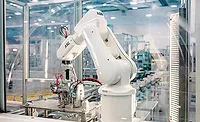
Because of their precision, reach and agility, six-axis robots are a natural for dispensing adhesives, sealants and other materials. In the automotive industry, for example, robots are employed to dispense a variety of one- and two-part materials, including adhesives, formed-in-place gaskets, lubricants, sealants, sound deadeners and structural foams. Similarly, window and door manufacturers use six-axis robots to apply adhesives and gaskets, while appliance assemblers employ six-axis robots to dispense adhesives, gaskets and insulation.

In practice, assemblers have two options for dispensing with six-axis robots. Most often, the dispenser is mounted to the robot. The metering equipment is located on or near the robot, and the material is transferred through one or more hoses to a valve attached to the robot's end effector.

Another option is to mount the dispenser in a fixed position 5 to 12 feet off the ground and use a robot to move the part beneath the valve. The advantage of this configuration is that it allows a robot to move a part through a series of process steps. For example, the robot can pick up a part from a conveyor, pass it beneath the dispenser, present it to a resistance welder and then place it on a second conveyor.

Occasionally, assemblers will mount a pair of valves on a single robot, so it can dispense two materials or two bead patterns. Another possibility is to have a pair of robots working in tandem: one holding the dispenser, while the other holds the part.

When thinking about robotic dispensing, assemblers need to keep in mind a number of variables, including material viscosity, dispensing pressure, robot speed, the dispense path and the height, or "standoff" height, of the nozzle above the workpiece.

Viscosity, in particular, can be tricky, because the material must travel a considerable distance to get from the reservoir to the part. As a result, the feed hoses and reservoir may have to be heated or insulated to isolate the system from swings in ambient temperature.

When thinking about speed, assemblers need to remember there is often a delay between when a dispenser is actuated and when the material starts moving. This delay can cause a gap at the start of the bead, if the robot begins moving before the material does. Similarly, if the robot pauses a split-second before starting to move, there could be a surge of material at the start of the bead.

Looking for quick answers on assembly and manufacturing topics? Try Ask ASM, our new smart AI search tool. Ask ASM →

In terms of standoff height, placing the nozzle too far above the workpiece can allow the bead to swirl and stray from the desired path. On the other hand, placing the nozzle too close can cause the material to accumulate ahead of the tip and producing a flat, misshapen bead. Worse still, the nozzle could crash into the workpiece, damaging the part or the dispenser.

There are several ways to avoid these problems. One is to tighten the tolerances for locating the parts in their fixtures. Another is to equip the dispensing valve with an inductive distance sensor, which provides height data to the robot controller.

Assemblers can also use machine vision to ensure that material is dispensed accurately. The camera can be mounted in a fixed position above the dispensing station, or for greater flexibility, to the robot arm itself. When a part arrives at the dispensing station, the vision system determines the exact position of various reference points, and adjusts the dispense path accordingly.

Share This Story

Looking for a reprint of this article?
From high-res PDFs to custom plaques, order your copy today!

Recommended Content

JOIN TODAY
To unlock your recommendations.

Already have an account? Sign In

  • Made in the U.S.A.

    Consumer Products Manufacturing: Made in the USA

    Supply chain lessons learned during the coronavirus...
    Automated Assembly Systems
    By: Austin Weber
  • Best Practices for Press-Fit Assembly

    Best Practices for Press-Fit Assembly

    In manufacturing, ironclad formulas for success are hard...
    Assembly Presses
    By: Jim Camillo
  • aem0523leader-tesla1.jpg

    Tesla Rethinks the Assembly Line

    Engineers at Tesla Inc. have developed a new process that...
    Industries
    By: Austin Weber
Manage My Account
  • eMagazine Subscription
  • Assembly Newsletters
  • Online Registration
  • Subscription Customer Service
  • Manage My Preferences

More Videos

Sponsored Content

Sponsored Content is a special paid section where industry companies provide high quality, objective, non-commercial content around topics of interest to the ASSEMBLY audience. All Sponsored Content is supplied by the advertising company and any opinions expressed in this article are those of the author and not necessarily reflect the views of ASSEMBLY or its parent company, BNP Media. Interested in participating in our Sponsored Content section? Contact your local rep!

close
  • ultrasonic welding
    Sponsored bySonobond Ultrasonics

    Engineering Efficiency in High-Performance Assembly: How Ultrasonic Welding Enhances Throughput, Reliability and Quality

  • UV curing system
    Sponsored byDymax

    Why UV Intensity Alone Doesn’t Define Curing Performance

  • wooden pallets
    Sponsored byLEAN Manufacturing Products

    Eliminating Waste on the Shop Floor: Applying Lean Principles to Improve Manufacturing Efficiency

Popular Stories

ASSEMBLY News Now, episode 30: Volvo Redesigns EV Manufacturing

Volvo Redesigns EV Manufacturing

Boeing CEO Kelly Ortberg announces 1 billion investment

Boeing Plans $1 Billion Wichita Investment, Workforce Training Center

GE Appliances Worker on Line

GE Appliances Expands Factory AI With 800 Gemini Enterprise Agents

Watch the latest episode of ANN now!

Events

July 24, 2025

From Shop Floor to CFO: How Manufacturers Are Closing the Loop Between Operations and Finance

On Demand Learn how manufacturers are bridging the gap between the shop floor and ERP systems to gain real-time visibility, streamline operations, and kick-start digital transformation—without waiting years.

Sponsored by:

PicoStratusGreen
July 30, 2025

Buffer Analysis and Design Fundamentals for Manufacturing Excellence

On Demand In this presentation, Dr. Herman Tang shares practical insights from his industry experience and research on buffer management in manufacturing operations.

View All Submit An Event

Poll

Difficult Assembly Processes

Which assembly process gives you the most difficulty?
View Results Poll Archive

Products

Manufacturing Cost Policy Deployment (MCPD) Profitability Scenarios: Systematic and Systemic Improvement of Manufacturing Costs

Manufacturing Cost Policy Deployment (MCPD) Profitability Scenarios: Systematic and Systemic Improvement of Manufacturing Costs

See More Products
Register for webinar - Modernizing Automotive Assembly: Why Upgrading Legacy MES is a Business Imperative

Related Articles

  • Dispensing With Six-Axis Robots

    See More
  • What’s New With Six-Axis Robots?

    What’s New With Six-Axis Robots?

    See More
  • X-Y-Z: Six-Axis Robots Provide Ultimate Flexibility

    See More

Related Products

See More Products
  • reducing.jpg

    Reducing Process Costs with Lean, Six Sigma, and Value Engineering Techniques

  • smart.jpg

    Smart Manufacturing: The Lean Six Sigma Way

  • pocket.jpg

    The Lean Six Sigma Pocket Toolbook

See More Products

Related Directories

  • Dispense Works Inc.

    Dispense Works Inc. is a full-service manufacturer specializing in robotic dispensing and automated assembly systems, including advanced robotic capping and filling machines. All of our products are proudly designed and manufactured in-house at our McHenry, Illinois facility. Made in the USA
  • DENSO Robotics

  • IPR Robotics LLC

    IPR Robotics offers an extensive range of products with innovative systems and components for assembly and handling technology. Our grippers, tool changers, alignment devices and load limiters, 7th-axis and customized solutions are used confidently by customers worldwide. Quality, technical expertise and industry knowledge are our most important factors for success.
×

Never miss the latest news and trends driving the manufacturing industry

Stay in the know on the latest assembly trends.

JOIN TODAY!
  • RESOURCES
    • Advertise
    • Contact Us
    • Directories
    • Manufacturing Division
    • Store
    • Want More?
  • SIGN UP TODAY
    • Create Account
    • eMagazine
    • Newsletters
    • Customer Service
    • Manage Preferences
  • SERVICES
    • Marketing Services
    • Reprints
    • Market Research
    • List Rental
    • Survey/Respondent Access
  • STAY CONNECTED
    • LinkedIn
    • Facebook
    • Instagram
    • YouTube
    • X (Twitter)
  • PRIVACY
    • PRIVACY POLICY
    • TERMS & CONDITIONS
    • DO NOT SELL MY PERSONAL INFORMATION
    • PRIVACY REQUEST
    • ACCESSIBILITY

Copyright ©2026. All Rights Reserved BNP Media, Inc. and BNP Media II, LLC.

Design, CMS, Hosting & Web Development :: ePublishing