Ergonomics by the Numbers
Manual assembly processes can be improved if engineers consider ergonomic guidelines that address job-related stressors.
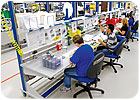
Work heights, reach standards and other ergonomic issues should be addressed by engineers when designing assembly workstations, especially in lean environments where job rotation is common. Unfortunately, no two operators are alike when it comes to height, weight, posture, arm length, arm strength and other variables. A workstation setup that “feels right” to one person may become a source of aggravation to another individual, leading to wasted motion.
Manual assembly processes can be improved if engineers consider ergonomic guidelines that address job-related stressors such as force, position, repetition and vibration. Numerous guidelines provide direction on implementing ergonomic proc-esses, as well as the design of jobs, tasks, equipment and tools.
“Poor ergonomic design directly impacts productivity, efficiency and quality from an assembly line,” warns Wayne Maynard, director of ergonomics at the Liberty Mutual Research Institute for Safety (Hopkinton, MA). “Guidelines are essential refer-ences that offer useful tools and practices for successful ergonomic program management, including risk factor identification, analysis and evaluation techniques, and suggested ergonomic interventions.”
Interventions can include specific workstation design recommendations, such as suggested heights for fixed and adjustable workstations. Some guidelines even provide anthropometric tables that apply to employees in a specific industry or occupa-tion.
“Ergonomic guidelines are generally design [criteria] for products and processes that are intended to keep work at a level where 90 percent to 95 percent of the industrial population can perform the tasks with a low risk of incurring a musculoskele-tal injury,” notes Julia Greenwald, senior ergonomist at the Ergonomics Center of North Carolina (Raleigh, NC), which is housed in the Edward P. Fitts Department of Industrial and Systems Engineering at North Carolina State Univer-sity.
By designing workstations with operators in mind, people can perform assembly tasks without being injured. “They can usu-ally perform tasks more efficiently and consistently,” adds Greenwald. “Guidelines are typically developed using published applied research studies in anthropometry, which studies measurement of the human body, muscle force generation and the other stressors.
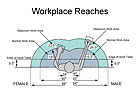
“These studies give guidance as to what percentage of the population is capable of generating an amount of force in a given posture, or how far a 5th percentile female can reach,” says Greenwald. “Design guidelines use these studies to target the extremes of the industrial population.
“If a 5th percentile female can reach 25 inches, then the rest of the population can reach that far, with the exception of the smallest 5 percent of the female population,” Greenwald points out. “By designing for this 5th percentile female and the 95th percentile male, 90 percent of the industrial population is accommodated. The same is done for strength: By designing for the 5th percentile female, 95 percent of the population can perform the task.”
In most cases, it is not economically feasible to design workstations for 100 percent of the population, Greenwald says. But, by designing for 90 percent to 95 percent of the population, the amount of risk workers are exposed to is mini-mized.
Various guidelines exist for carrying, lifting, lowering, pulling, pushing, reaching and other repetitive tasks. They are typi-cally developed by government bodies, such as the National Institute for Occupational Safety and Health (NIOSH, Washing-ton, DC), or by private entities such as Liberty Mutual Group (Boston).
“Most ergonomic guidelines are developed in a laboratory,” says Cynthia Roth, CEO of Ergonomic Technologies Corp. (Syosset, NY). “They are scientifically derived and take into consideration all the hazards found in the workplace.”
Force, Posture and Movement
“In ergonomics, the three biggest stressors, or risk factors, that can lead to a musculoskeletal injury are force, posture and movement (static or repetitive),” says Greenwald. “The more these stressors interact, such as a high-force task performed repetitively in an awkward posture, the greater the risk of injury.”Traditionally, some of the most common injuries in manufacturing are back injuries, which usually occur with manual material handling. “Recently, however, pushing and pulling tasks, and work in extreme or static postures, has become more important,” claims Thomas Waters, Ph.D., chief engineer of human factors and ergonomics research at NIOSH’s laboratory in Cincinnati. “Any task that creates high internal loads on the body joints should be considered to be important, especially when workers are exposed to combinations of these risky activities.”
Even if no ergonomic guidelines existed, reviewing manual material handling tasks alone would help reduce the risk of injury, Greenwald says. The most common analysis tools used for this are the Liberty Mutual manual material handling tables and the NIOSH lifting equation.
“These tools do require some training and education for successful use, however,” Greenwald points out. “A simpler concept to start with is designing for reach. By keeping work within reach, one can help the worker optimize their working posture, keeping them in a stronger, safer and more efficient position while they complete the [assembly] task.”
The two main factors that can be addressed with workstations and accessories are reduced force risks and elimination of awkward postures and motions. “Workstations can be made more ergonomic by reducing reach,” claims James Anderson, western region product manager at Lista International Corp. (Holliston, MA). He says it’s important to reduce workstation depth and place tools and supplies within easy reach of operators.
Sometimes, engineers specify the wrong type of workstation, which can lead to ergonomic problems. “They want too big a work surface, which results in excessive reach, and they don’t take advantage of vertical space,” explains Anderson.
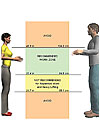
“If you control the height and reach of a workstation, you put work into the correct zone for maximum strength,” adds David Brodie, director of ergonomics services at Atlas Ergonomics LLC (Grand Haven, MI). “If you go outside that zone, assemblers are put in a position that requires more effort to do that work.”
According to David Verrill, applications support manager at IAC Industries Inc. (Brea, CA), the use of tools at workstations is often the most significant contributor to cumulative trauma disorder. Examples of these risks include torquing, applying downward force or working at unusual angles.
“Sometimes, replacing the tool itself adds benefit to the user, especially if the new one is electrically or pneumatically driven,” says Verrill. “Supporting that tool via a torque arm or tool trolley is also a key factor to consider. This makes the tool readily available for the operator’s use without the need for excessive muscle strain.”
Another important factor to consider with workstations is the storage of materials, supplies and other products necessary to complete an assigned task. “Organizing these items within an optimum working envelope minimizes reach and awkward motions,” explains Verrill. “As a side benefit, the added organization allows for quick identification by the user and enhances productivity. Of course, straight or angled shelving is one possible solution; but, swing arm accessories for parts cups, monitors and keyboards are even more beneficial.”
Guideline Challenges
Applying ergonomic guidelines to an assembly environment is not easy because of the dynamic, high-mix nature of the work. “Variability in product manufacturing and assembly requirements, as well as variations in processes and tools from line to line, make it very difficult to provide specific ergonomic guidelines,” says Waters. [“While] general ergonomic workstation layout guidelines have been provided, some customization is usually needed to make the solutions work most efficiently.”
Some experts suggest tackling ergonomic guidelines as a team effort. “The first thing the team should do is acquire any existing guidelines that would be applicable to their industry or specific design project,” says Maynard. “Recommendations for designing a workstation are available. Existing guidelines can save a lot of time and [help avoid] reinventing the wheel.
“The biggest mistake I see is where engineers design a new assembly operation, including equipment, without considering ergonomics and then, after [encountering] problems, spend additional funds to correct their mistakes,” notes Maynard. “Anthropometric data bases exist and references are available on recommended heights for fixed and adjustable workstations, sitting or standing. The ANSI B11 TR1 document is intended to provide useful guidance for all equipment design, not just machine tools.”
Unfortunately, misunderstanding or misinterpreting ergonomic guidelines often hinders manufacturing engineers. “The human body is not as consistent as a metal structure, and people are all different,” explains Greenwald. “One of the most common answers we give engineers when asked for a ‘number’ is that it depends.
“The answer may depend on the task performed, the posture the worker must use and how often it is performed,” Greenwald points out. “An answer given without all the information is most likely the wrong answer, and teaching users to see the full picture can be a challenge.” A
To learn more about ergonomics, search for the following articles at www.assemblymag.com
- Age Is an Important Ergo Factor.
- Get Ready for 'Ergobamanomics.'
- Glossary of Ergonomic Terms.
- Six Steps to Implementing Ergonomic Guidelines.
- The Human Side of Lean.
- Why Ergonomic Guidelines Aren’t Followed.
Looking for quick answers on assembly and manufacturing topics? Try Ask ASM, our new smart AI search tool. Ask ASM
Looking for a reprint of this article?
From high-res PDFs to custom plaques, order your copy today!