Automation Profiles: System Wraps, Trims, Welds Car Doors
T.A. Systems worked closely with the customer to optimize the product for assembly.
 Today’s cars seem to have more plastic than metal. This trend has caused a sea change in assembly methods, from spot welding and fasteners to ultrasonic welding and heat staking.
Integrator T.A. Systems (Rochester Hills, MI) has made a name for itself designing fully and semiautomatic systems for assembling liftgates, rocker panels, consoles and other large plastic parts. The company’s systems often use six-axis robots to load and unload assemblies or to perform processes, such as clip assembly or laser cutting.
This profile describes a three-cell system the company built recently for assembling interior door panels. For more information, call T.A. Systems at 248-656-5150 or visit www.ta-systems.com.
Describe the system. The line consists of three processes: edge-wrapping, laser trimming and ultrasonic welding.
Assembly starts with a flexible edge-wrapping machine for the upper door panels. A robot applies a bead of adhesive and then pulls and pushes a vinyl cover stock over the substrate. Pneumatic actuators hold the cover stock under pressure for an adjustable time period to wet out and set the adhesive. This cell features side-by-side stations that allow an operator to load and unload one station, while the robot is working in the other station.
Next, the panels head to the flexible laser trim cell. The cell has a two-station rotary indexer and two six-axis robots, each equipped with 500-watt fiber lasers. The robots work in tandem to trim the periphery of the product, as well as the inner openings where mating components interface to the panels. In some areas, the laser only trims the cover stock, which is 1 millimeter thick. In other areas, it trims the cover stock and the substrate, a total thickness of 3 millimeters. The indexer allows an operator to load and unload parts, while the robots are working in the opposite station.
The final process is ultrasonic welding. This cell also features a two-station rotary indexer. Using ultrasonic spot welding and staking, the cell joins the upper panel with the rest of the door trim, including the lower panel, map pocket and two sets of energy-absorbing foam. T.A. Systems integrated its own line of ultrasonic welding equipment for these processes. To minimize cycle time, the system maximizes the number of points that can be welded in a tight area. The front door has 37 welding points; the rear door has 29.
What are the parts made of? The upper panel is molded from polypropylene and wrapped with a vinyl cover stock. The vinyl is bonded to the polypropylene with a moisture-curing hot-melt adhesive. The lower door panel is also polypropylene.
What checks or inspections are included in the assembly process? Each cell is equipped with sensors to ensure that parts are present before a machine cycle is started.
What is the production rate? Two parts per minute, to match the molding cycle time.
Did you help the customer design the product for assembly? T.A. Systems worked closely with the customer to optimize the product for edge-wrapping, laser trimming and sonic welding. The laser trimming process opened up some options in the edge-wrapping process that typically wouldn’t be available if more conventional trimming methods had been used. The flexibility of the laser allowed the customer to trim the upper panels after the edge-wrap process, which is backwards from conventional processing. For this reason, the customer was able to design-in attachment features for the edge-wrap tooling that typically wouldn’t be available. These attachment features allowed the robot to pull, rather than push, the cover-stock during wrapping, which opened the door for more extreme wrapping. This enabled the customer to wrap drastic contours that typically couldn’t be achieved without additional manual operations.
For the trimming process, the customer reduced or eliminated substrate thickness wherever possible along the edges to be trimmed. These thinner areas allowed for high-speed cutting and optimum throughput.
T.A. Systems also worked with the customer’s product design team to facilitate the welding process. Engineers collaborated on the number of welds, the weld locations, and the sequence of the welding process to provide the best build tolerances for the assembly.
Can the system accommodate variants? This project was built to assemble parts for two different four-door models, for a total of eight unique upper door panels. The laser trim cells have quick-change tooling that allows changeover in under 2 minutes per tool. The tooling has identification features so the cell automatically knows which of the eight panels it’s assembling. Once the tool is installed, the robots automatically run the trim program for that panel style.
What was the most challenging aspect of designing the system? One challenge is the state of the economy, particularly in the automotive industry. Economic conditions have put tremendous pressure on program budgets and have lowered cost targets for everyone. The integrator overcame this challenge by redeploying existing capital components on this project. By using existing capital, T.A. Systems lowered the material cost of the project, which in turn allowed the company to introduce a new technology-fiber laser trimming-to its customer even under these trying times.
Another challenge was holding tight gap tolerances on the final assembly of the door panel. By trimming the ‘soft’ upper panels with the robots, the customer can adjust trim lines without tool changes. Typically, these panels would be trimmed with hard die steels that allow little adjustment and require lengthy modifications for alteration. The lasers allow the customer to fine-tune the trim lines of the panels to close up gaps in the door assembly in a matter of minutes without altering the tooling.
Editor’s note: Whether you’re a systems integrator or the in-house automation team of an OEM, if you’ve designed a system that you’re particularly proud of, tell us about it. Send an e-mail to John Sprovieri, editor of ASSEMBLY, at sprovierij@bnpmedia.com, or call 630-694-4012.
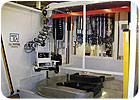
Using ultrasonic spot welding and staking, this cell joins the upper panel with the rest of the door trim, including the lower panel, map pocket and two sets of energy-absorbing foam. Photo courtesy T.A. Systems
Integrator T.A. Systems (Rochester Hills, MI) has made a name for itself designing fully and semiautomatic systems for assembling liftgates, rocker panels, consoles and other large plastic parts. The company’s systems often use six-axis robots to load and unload assemblies or to perform processes, such as clip assembly or laser cutting.
This profile describes a three-cell system the company built recently for assembling interior door panels. For more information, call T.A. Systems at 248-656-5150 or visit www.ta-systems.com.
Describe the system. The line consists of three processes: edge-wrapping, laser trimming and ultrasonic welding.
Assembly starts with a flexible edge-wrapping machine for the upper door panels. A robot applies a bead of adhesive and then pulls and pushes a vinyl cover stock over the substrate. Pneumatic actuators hold the cover stock under pressure for an adjustable time period to wet out and set the adhesive. This cell features side-by-side stations that allow an operator to load and unload one station, while the robot is working in the other station.
Next, the panels head to the flexible laser trim cell. The cell has a two-station rotary indexer and two six-axis robots, each equipped with 500-watt fiber lasers. The robots work in tandem to trim the periphery of the product, as well as the inner openings where mating components interface to the panels. In some areas, the laser only trims the cover stock, which is 1 millimeter thick. In other areas, it trims the cover stock and the substrate, a total thickness of 3 millimeters. The indexer allows an operator to load and unload parts, while the robots are working in the opposite station.
The final process is ultrasonic welding. This cell also features a two-station rotary indexer. Using ultrasonic spot welding and staking, the cell joins the upper panel with the rest of the door trim, including the lower panel, map pocket and two sets of energy-absorbing foam. T.A. Systems integrated its own line of ultrasonic welding equipment for these processes. To minimize cycle time, the system maximizes the number of points that can be welded in a tight area. The front door has 37 welding points; the rear door has 29.
What are the parts made of? The upper panel is molded from polypropylene and wrapped with a vinyl cover stock. The vinyl is bonded to the polypropylene with a moisture-curing hot-melt adhesive. The lower door panel is also polypropylene.
What checks or inspections are included in the assembly process? Each cell is equipped with sensors to ensure that parts are present before a machine cycle is started.
What is the production rate? Two parts per minute, to match the molding cycle time.
Did you help the customer design the product for assembly? T.A. Systems worked closely with the customer to optimize the product for edge-wrapping, laser trimming and sonic welding. The laser trimming process opened up some options in the edge-wrapping process that typically wouldn’t be available if more conventional trimming methods had been used. The flexibility of the laser allowed the customer to trim the upper panels after the edge-wrap process, which is backwards from conventional processing. For this reason, the customer was able to design-in attachment features for the edge-wrap tooling that typically wouldn’t be available. These attachment features allowed the robot to pull, rather than push, the cover-stock during wrapping, which opened the door for more extreme wrapping. This enabled the customer to wrap drastic contours that typically couldn’t be achieved without additional manual operations.
For the trimming process, the customer reduced or eliminated substrate thickness wherever possible along the edges to be trimmed. These thinner areas allowed for high-speed cutting and optimum throughput.
T.A. Systems also worked with the customer’s product design team to facilitate the welding process. Engineers collaborated on the number of welds, the weld locations, and the sequence of the welding process to provide the best build tolerances for the assembly.
Can the system accommodate variants? This project was built to assemble parts for two different four-door models, for a total of eight unique upper door panels. The laser trim cells have quick-change tooling that allows changeover in under 2 minutes per tool. The tooling has identification features so the cell automatically knows which of the eight panels it’s assembling. Once the tool is installed, the robots automatically run the trim program for that panel style.
What was the most challenging aspect of designing the system? One challenge is the state of the economy, particularly in the automotive industry. Economic conditions have put tremendous pressure on program budgets and have lowered cost targets for everyone. The integrator overcame this challenge by redeploying existing capital components on this project. By using existing capital, T.A. Systems lowered the material cost of the project, which in turn allowed the company to introduce a new technology-fiber laser trimming-to its customer even under these trying times.
Another challenge was holding tight gap tolerances on the final assembly of the door panel. By trimming the ‘soft’ upper panels with the robots, the customer can adjust trim lines without tool changes. Typically, these panels would be trimmed with hard die steels that allow little adjustment and require lengthy modifications for alteration. The lasers allow the customer to fine-tune the trim lines of the panels to close up gaps in the door assembly in a matter of minutes without altering the tooling.
Editor’s note: Whether you’re a systems integrator or the in-house automation team of an OEM, if you’ve designed a system that you’re particularly proud of, tell us about it. Send an e-mail to John Sprovieri, editor of ASSEMBLY, at sprovierij@bnpmedia.com, or call 630-694-4012.
Looking for a reprint of this article?
From high-res PDFs to custom plaques, order your copy today!