Wire Processing: Drive-by-Wire

The mechanical linkages and hydraulic actuators that traditionally control automotive braking and steering systems will eventually go the way of kerosene lanterns, rumble seats, running boards and hood ornaments. They will be replaced with drive-by-wire systems, such as brake-by-wire, suspension-by-wire and steer-by-wire. As a result, automakers will be putting new demands on the wire harness industry.
Replacing mechanical or hydraulic chassis and power train systems with pure electromechanical systems has long been a dream of automotive engineers. By-wire technology uses a highly organized network of wires, sensors, controllers and actuators to control “mechanical” functions.
The heart of any by-wire system is an actuating unit that converts the driver’s commands from electronic signals to motion. Drivers receive dynamic feedback via electronic signals.
Drive-by-wire systems are based on technology that was originally developed in the aerospace industry. Fly-by-wire systems have been widely used in aircraft because they reduce airframe weight and require less routine maintenance than traditional mechanical and hydraulic flight control systems.
The same benefits apply to the auto industry. Throttle-by-wire and brake-by-wire systems are already used in some cars. However, steer-by-wire technology that eliminates the traditional steering column is still a few years away.
In some new cars, the accelerator pedal is no longer attached to a spring that opens and closes the gas line; it is connected to a sensor that activates a computer-controlled relay that electronically does the job. The same with braking- the pedal doesn’t activate a pump that controls the master cylinder; it is connected to an electronic control unit.
“Throttle-by-wire is near ubiquitous [in the auto industry today],” says Ian Riches, director of the global automotive practice at Strategy Analytics Inc. “Brake-by-wire has been used in niche applications, but is not really expanding.”
“Fully automatic, hands-off parking, full automatic braking and lane-departure correction are a few examples of X-by-wire technology that is new this year or coming soon,” adds Todd Hubing, Michelin professor of vehicular electronics at the Clemson University International Center for Automotive Research. “X-by-wire is being adopted [by the auto industry] in steps rather than all at once.
“The technology is already in place,” Hubing points out. “It’s just a question of when the public will be willing to accept such a system. Given the recent publicity surrounding sudden acceleration incidents, it may be a while.”
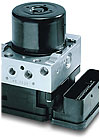
Electronic brake systems use advanced sensors to measure pressure, acceleration and yaw rate.
Safety Concerns
“Reliability of electronics and fail-safe assurance for these systems need to be ironclad before auto manufacturers will consider the possibility of introducing them,” warns Krishnasami Rajagopalan, global program manager for automotive chassis and safety systems at Frost & Sullivan Inc. “Any safety feature that malfunctions would create huge consumer backlash. Consumers might also be uncomfortable with the idea of losing the mechanical steering system.”
According to Rajagopalan, steer-by-wire and suspension-by-wire will not be introduced in the marketplace before 2015. “With carmakers facing a host of electronics-related recalls of their vehicles, there is likely to be a further delay in replacing critical systems with electronic systems that are fail-safe and reliable,” he points out.
Rajagopalan believes that potential liability concerns and public mistrust will prevent widespread adop-tion of steer-by-wire systems, which represent the holy grail of drive-by-wire technology. A steering wheel attached to gears, shafts and other mechanical linkages would no longer do the actual turning. Instead, the driver would press a button and send an electronic command for the wheels to turn.
Electric power assist technology, which is currently available on some vehicles, is a step in that direction. It replaces the hydraulic power steering system with an electric motor and various sensors.
However, true steer-by-wire promises to eliminate the mechanical link between the steering column and gear by using advanced mechatronic technologies. It will safely command the steering actuator and create electroni-cally controlled force feedback to the driver. The technology has already been successfully demonstrated in concept vehicles such as the Citroen C-Airdream, the GM Hy-wire and the Nissan EA2.
Most observers believe that steer-by-wire systems will have a major impact on the auto industry. However, “steer-by-wire is still a long way from high-volume production,” claims Riches. “Many of the possible benefits of steer-by-wire can be implemented with conventional technologies, such as electric power steering or active front steering.
“The main benefit of steer-by-wire [is that it eliminates] the steering column, thus making left-hand drive and right-hand drive assembly easier, freeing up space and potentially improving crash performance,” adds Riches. “However, the safety-related issues surrounding removal of the steering column mean that it will be a long time [before this happens]. The recent Toyota recalls have not exactly brought that date any nearer.”

This forklift uses steer-by-wire technology to improve opreator control and safety.
Numerous Benefits
Drive-by-wire systems result in less vehicle weight-up to 10 kilograms for brake systems alone-but not necessarily less complexity. Sivam Sabesan, an automotive industry analyst at Frost & Sullivan, says the development of computer algorithms is a major hurdle that needs to be addressed before there is widespread adoption of by-wire technology.
“In terms of manufacturing cost, hardware, such as sensors, wires and electronic control units, is not expen-sive,” says Sabesan. “The major cost involved is in development of algorithms for the ECU. This makes the sys-tem expensive compared to [traditional technology]. However, automakers can alleviate this cost by using the same basic system across their product range with modifications.”
“Electronics are relatively cheap when the volumes are sufficient,” adds Hubing. “Drive-by-wire systems can be expensive to design and test, but they generally have a comparable, or even lower, parts cost vs. mechanical linkages.”
In addition, installation is often easier with drive-by-wire components compared to hydraulic systems. Frost & Sullivan estimates that the elimination of hydraulic components in brake systems alone can cut vehicle assembly time by up to 10 minutes.
But, it’s not a simple cost equation. “Validation costs can be greater for by-wire systems, as ensuring safety is typically more complex than for a mechanical system,” Riches points out. “[On the other hand], “the move to x-by-wire often allows additional functionality in the vehicle. With throttle-by-wire, for instance, cruise control essentially becomes a software function. Other vehicle systems, such as transmission, stability and traction control, can regulate engine torque output independent from the driver’s right foot.”
Many initial applications of drive-by-wire technology are occurring in off-highway vehicles, such as farm tractors. For example, John Deere recently announced the availability of drive-by-wire as a primary steering system option on one of its large row-crop tractors.
“The advantage is that the steering can be optimized for both on-road and in-the-field performance,” says Bob Marjoram, senior staff engineer at LORD Corp. “We have worked over the last 10 years with an increasing number of manufacturers of fork trucks, marine propulsion systems, road pavers and mowers to implement drive-by-wire systems. Our tactile feedback device can produce a continuously variable, proportional, resistive-steering torque that delivers high-fidelity feel and maximum control to the driver.”
The system provides tactile feedback that gives operators the type of “feel” they are used to with traditional hydraulic steering. It consists of a steering position sensor, bearings and a mechanical brake with a magnetically responsive material that responds in milliseconds.
Steer-by-wire systems are currently used in low-speed, off-highway vehicles because “[in those types of vehicles], you don’t have any mechanical link,” says Gianluca Oberto, business development manager at SKF Actuation Systems. “Our electronic steering input unit uses two position sensors that communicate the steering rotation angle through two independent CAN interfaces.”
Oberto’s company has also been working with agricultural equipment manufacturers. For instance, the New Holland T7000 Auto Command tractor is equipped with an SKF electronic parking brake. It consists of a geared motor inside a sealed housing with an integrated electronic control unit.
“The electromechanical actuator stretches and releases the Bowden cable connected to the braking system being controlled by the electronic unit,” Oberto points out. “The electronic parking brake is easy to install and gives [engineers] complete freedom to position it on vehicles. It also [simplifies assembly].”
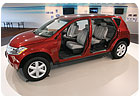
This concept vehicle uses wires and electrical impulses instead of mechanical linkages to control steering, braking and transmission.
New Role for Wire
Drive-by-wire technology affects traditional wire harnesses. As more hydraulic hoses are replaced with electric wires, more harnesses will probably be required. But, it depends on the application.
Many automotive engineers are reluctant to adopt 100 percent drive-by-wire technology without redundant backups, including mechanical linkages. That means demand for wiring harnesses should increase during the transition period.
“A few more wires [will be required], but not new wiring assemblies,” says Chris Burns, director of global innovation for electrical-electronic architecture and core engineering at Delphi Packard. “[The same type of wire] construction [will be needed], but in some cases, redundancy may be required.”
“Just replacing a mechanical system with a by-wire one will increase wiring,” adds Riches. “However, when implemented, the by-wire system can often allow much greater vehicle functionality, which, if it were to be replicated without the by-wire system, would likely require even more wiring in the vehicle.”
According to Jim Toscano, marketing manager at LORD, using electronic control systems to replace traditional hydraulic and mechanical systems will increase the need for electrical harnesses. “[New brake systems will] require wires for sensor input power, brake input current and sensor output signals,” he points out. “Depending upon the level of redundancy required, the wire harness can be quite compact. There may be other wire harnesses connecting sensors and wheel actuators to the main vehicle controllers to complete the steer-by-wire system.”
To learn more about by-wire technology, click www.assemblymag.com and search for these articles:
- The 42-Volt Challenge
- Wire’s Role in a Drive-by-Wire World
Looking for a reprint of this article?
From high-res PDFs to custom plaques, order your copy today!


