Wire Processing: It's a Very Small World
Increasingly, assemblers-particularly those in the automotive, medical and electronics industries-are singing “It’s a Very Challenging World for us All” when processing wire for their products.
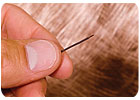
Since the 1964 World’s Fair, the world has been singing “It’s a Small World After All.” But increasingly, assemblers-particularly those in the automotive, medical and electronics industries-are singing “It’s a Very Challenging World for us All” when processing wire for their products.
The reason is that wire sized 26 AWG and smaller is becoming more prevalent as manufacturers try to save weight and space in their products. Just how small is 26 AWG wire? Its conductor diameter is 0.405 millimeter, which is about five strands of human hair.
Thin-gauge wire can have solid or stranded conductors. The latter can have seven to 44 strands. Wire this size has a cross-sectional area of 0.13 square millimeters or less. The wire’s insulation might only be a few thousandths of an inch thick.
Coaxial cable has gone micro as well. Some assemblers are processing cable as small as 40 AWG (conductor diameter of 0.08 millimeter), which still has the traditional construction (outer sheath, shield, dielectric and center conductor).
“We continue to see an increase of interest in our 26 gauge wire from all automotive OEMs,” says John Kightlinger, supervisor of advanced processes at Delphi Packard Electrical/Electronic Architecture’s technical center in Champion, OH.
Delphi has been producing 26 AWG wire since October 2008, and uses it for vehicle interiors and exteriors. The company had been using 22 AWG wire for these applications, but, to save weight and space, switched to the thinner wire once they developed a way to give it the same mechanical strength as 22 AWG.
“By downsizing to 26 gauge wire, we save 60 percent in terms of mass and bundle size, which is a big benefit to our customer. But this size wire does present challenges in terms of processing and installation,” says Kightlinger.

“Wire must be pulled gently and properly into the machine,” says Rob Boyd, crimping product manager for Schleuniger Inc., a full-line supplier of wire processing equipment. “With smaller size wire, you’re dealing with a smaller size spool, which has a much smaller core diameter and can create an extreme amount of memory. This can cause the wire to come out of the guide or feed tube and wrap right back upon itself.”
Most processing machines come equipped with wire straighteners, but they provide limited help when dealing with thin wire. A pre-feed accessory that keeps wire straight is also available from some suppliers.
Some assemblers defeat the shape-memory problem by heating the wire spools to relax the insulation so the wire stays straighter. Heat can be applied with a blow dryer or an infrared oven.
John Olsen, executive vice president of Artos Engineering Co., a full-line wire processing supplier, says his company has developed an air assist that prevents the wire from kinking or bending. “Wire is fed using a standard drive, then an airflow in the guide tube pushes the wire along without jamming,” says Olsen.
As for measuring small wire, suppliers say it poses no challenges. Standard processing machines can measure this wire with either a length encoder or a wire run-out detector.
Some suppliers say cutting small wire poses no challenges, but others disagree. For example, Olsen says the correct blade configuration and minimum wire overhang are both necessary to achieve a clean cut.
Mechtrix Corp., which makes cutting and stripping blades for large wire-processing suppliers, has specifically created several precise stripping form geometries for processing very small wires, says Bil DeGrace, vice president. Another blade supplier, Eubanks Engineering Co., says about 10 percent of its custom blades are for small wire (26 AWG - 32 AWG). “This percentage has held steady for many years,” says Dave Eubanks, president.
Stripping very small wire can be challenging, depending on the type and thickness of the insulation.
“Teflon insulation stretches like taffy, while cross-linked PVC and harder types tend to strip cleaner,” says Peter Doyon, vice president of Schleuniger. “When you strip insulation with a thickness of six thousandths of an inch or less, there’s very little margin for error. Precision becomes more important.”
Stretched insulation shrinks back on itself, affecting strip length. To counter this shrinkage, Schleuniger has developed new cutting blades for its machines and software that programs correction factors during the stripping process.
Schleuniger also has developed a machine specifically to cut and strip very small wire. Eraser Co. Inc. has machines that cut and strip magnet wire as small as 48 AWG.
Another challenge is making sure all of the wire, stranded or solid, is crimped into the terminal consistently and accurately, whether from a benchtop or automated system.
Failure to fully crimp the wire results in “strands out,” a term that refers to strands that are neither cut off nor in the crimp area. Boyd says that 10 percent strands out can be difficult to detect using traditional crimp force monitors.
Although very thin wire is now widely available, terminals small enough to be crimped onto it are less so, because they are difficult to manufacture. To counter this problem, Schleuniger developed a machine that folds the wire to double its cross-section. This lets assemblers use a more conventional size terminal with very small wire.
However, sometimes this wire is too small to be terminated and must be soldered or ultrasonically welded to a connector.
Testing crimp force when terminating very small wire is another challenge. Artos has developed new polymer technology that increases the sensitivity of the load-cell to more accurately record crimp force.
Another type of monitoring system measures crimp force in electrical units rather than newtons or pounds.
“Most crimp force monitoring technology is reaching its limits with very small wire,” says Boyd.
If assemblers think processing 26 AWG wire is challenging, the future holds little solace. Wire will continue to get thinner. For the past year, Delphi has been researching the development of 28 and 30 AWG wire for the automotive industry.
Dave Kelly, standards and industry liaison for Daniels Manufacturing Corp., knows of one manufacturer that is coating very small wire with a metal much lighter and stronger than copper but just as conductive for use in the aircraft industry.
And the medical profession is increasingly using very small wire because it lets surgeons make incisions as tiny as 3 millimeters in diameter. Into this tiny orifice, a surgeon might insert a light, camera and cauterizing tool, all of which are connected to wire as small as 40 AWG-which is thinner than a human hair. Moreover, surgeons are hoping to one day use wire as small as 50 AWG in their operations.
This halogen-free, ultra-thin-wall 26 AWG (.13mm²) cable has been used in the automotive industry since 2008. Photo courtesy Delphi Corp.
Since the 1964 World’s Fair, the world has been singing “It’s a Small World After All.” But increasingly, assemblers-particularly those in the automotive, medical and electronics industries-are singing “It’s a Very Challenging World for us All” when processing wire for their products.
The reason is that wire sized 26 AWG and smaller is becoming more prevalent as manufacturers try to save weight and space in their products. Just how small is 26 AWG wire? Its conductor diameter is 0.405 millimeter, which is about five strands of human hair.
Thin-gauge wire can have solid or stranded conductors. The latter can have seven to 44 strands. Wire this size has a cross-sectional area of 0.13 square millimeters or less. The wire’s insulation might only be a few thousandths of an inch thick.
Coaxial cable has gone micro as well. Some assemblers are processing cable as small as 40 AWG (conductor diameter of 0.08 millimeter), which still has the traditional construction (outer sheath, shield, dielectric and center conductor).
“We continue to see an increase of interest in our 26 gauge wire from all automotive OEMs,” says John Kightlinger, supervisor of advanced processes at Delphi Packard Electrical/Electronic Architecture’s technical center in Champion, OH.
Delphi has been producing 26 AWG wire since October 2008, and uses it for vehicle interiors and exteriors. The company had been using 22 AWG wire for these applications, but, to save weight and space, switched to the thinner wire once they developed a way to give it the same mechanical strength as 22 AWG.
“By downsizing to 26 gauge wire, we save 60 percent in terms of mass and bundle size, which is a big benefit to our customer. But this size wire does present challenges in terms of processing and installation,” says Kightlinger.
Specific blade alignment
reduces the amount of wire overhang. Photo
courtesy Artos Engineering Co.
Feeding and Measuring
Before wire can be cut, it must be fed and measured. The main challenge when feeding this small wire into standard processing machines is to limit the tensile stress placed upon the wire. This can occur when wire is fed from a reel that is too large or too heavy. Excessive stress on the wire can cause it to stretch or even change diameter.“Wire must be pulled gently and properly into the machine,” says Rob Boyd, crimping product manager for Schleuniger Inc., a full-line supplier of wire processing equipment. “With smaller size wire, you’re dealing with a smaller size spool, which has a much smaller core diameter and can create an extreme amount of memory. This can cause the wire to come out of the guide or feed tube and wrap right back upon itself.”
Most processing machines come equipped with wire straighteners, but they provide limited help when dealing with thin wire. A pre-feed accessory that keeps wire straight is also available from some suppliers.
Some assemblers defeat the shape-memory problem by heating the wire spools to relax the insulation so the wire stays straighter. Heat can be applied with a blow dryer or an infrared oven.
John Olsen, executive vice president of Artos Engineering Co., a full-line wire processing supplier, says his company has developed an air assist that prevents the wire from kinking or bending. “Wire is fed using a standard drive, then an airflow in the guide tube pushes the wire along without jamming,” says Olsen.
As for measuring small wire, suppliers say it poses no challenges. Standard processing machines can measure this wire with either a length encoder or a wire run-out detector.
Cutting and Stripping
Very small wire can be cut to any length-from a few millimeters for a circuit board jumper, to a run of more than a thousand feet for a battleship or airliner.Some suppliers say cutting small wire poses no challenges, but others disagree. For example, Olsen says the correct blade configuration and minimum wire overhang are both necessary to achieve a clean cut.
Mechtrix Corp., which makes cutting and stripping blades for large wire-processing suppliers, has specifically created several precise stripping form geometries for processing very small wires, says Bil DeGrace, vice president. Another blade supplier, Eubanks Engineering Co., says about 10 percent of its custom blades are for small wire (26 AWG - 32 AWG). “This percentage has held steady for many years,” says Dave Eubanks, president.
Stripping very small wire can be challenging, depending on the type and thickness of the insulation.
“Teflon insulation stretches like taffy, while cross-linked PVC and harder types tend to strip cleaner,” says Peter Doyon, vice president of Schleuniger. “When you strip insulation with a thickness of six thousandths of an inch or less, there’s very little margin for error. Precision becomes more important.”
Stretched insulation shrinks back on itself, affecting strip length. To counter this shrinkage, Schleuniger has developed new cutting blades for its machines and software that programs correction factors during the stripping process.
Schleuniger also has developed a machine specifically to cut and strip very small wire. Eraser Co. Inc. has machines that cut and strip magnet wire as small as 48 AWG.
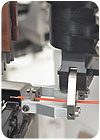
Reduced wire overhang
improves positioning accuracy during the wire crimping process. Photo courtesy Artos Engineering Co.
Termination and Testing
Terminating very small wire presents two major challenges. One is to not damage the very small terminals, which tend to be much more flimsy and easily damaged than those for standard wire.Another challenge is making sure all of the wire, stranded or solid, is crimped into the terminal consistently and accurately, whether from a benchtop or automated system.
Failure to fully crimp the wire results in “strands out,” a term that refers to strands that are neither cut off nor in the crimp area. Boyd says that 10 percent strands out can be difficult to detect using traditional crimp force monitors.
Although very thin wire is now widely available, terminals small enough to be crimped onto it are less so, because they are difficult to manufacture. To counter this problem, Schleuniger developed a machine that folds the wire to double its cross-section. This lets assemblers use a more conventional size terminal with very small wire.
However, sometimes this wire is too small to be terminated and must be soldered or ultrasonically welded to a connector.
Testing crimp force when terminating very small wire is another challenge. Artos has developed new polymer technology that increases the sensitivity of the load-cell to more accurately record crimp force.
Another type of monitoring system measures crimp force in electrical units rather than newtons or pounds.
“Most crimp force monitoring technology is reaching its limits with very small wire,” says Boyd.
Installation and Industry
Installing this wire offers other challenges. One is making sure loose strands don’t touch a nearby terminal and cause a wire to short. Marlin Shelly, president of Cirris, says this can occur when an installation requires several terminals to be very close to each other. In such cases, some manufacturers prevent shorting by “overmolding,” that is, placing a very thin layer of plastic at the back end of the crimped terminal. “This insulates the wire and makes it more stable,” says Shelly.If assemblers think processing 26 AWG wire is challenging, the future holds little solace. Wire will continue to get thinner. For the past year, Delphi has been researching the development of 28 and 30 AWG wire for the automotive industry.
Dave Kelly, standards and industry liaison for Daniels Manufacturing Corp., knows of one manufacturer that is coating very small wire with a metal much lighter and stronger than copper but just as conductive for use in the aircraft industry.
And the medical profession is increasingly using very small wire because it lets surgeons make incisions as tiny as 3 millimeters in diameter. Into this tiny orifice, a surgeon might insert a light, camera and cauterizing tool, all of which are connected to wire as small as 40 AWG-which is thinner than a human hair. Moreover, surgeons are hoping to one day use wire as small as 50 AWG in their operations.
Looking for a reprint of this article?
From high-res PDFs to custom plaques, order your copy today!