Wire Processing: On Your Mark
This article compares the myriad ways to mark wire, including labeling, hot stamping, ink-jetting and lasers. What are the benefits and limitations of each technology? When would one technology be used over another? This article provides the answers.
Every day, harness assemblers apply numbers, machine-readable codes or logos to wire. The reason for this is simple: Marking wire offers several benefits.
The main benefit is being able to identify and track wire throughout the manufacturing process and warranty period.
Other equally important benefits include:
* easier data collection;
* elimination of data transcription errors;
* improved efficiency.
Many methods are available to mark wire. To select the best method, manufacturers should consider several factors, including:
*customer specifications;
*wire type (thick or thin; colored or white);
*insulation factors (thick or thin; hard or soft);
*production volume;
*quality of marking;
*cost restrictions;
*labor and material savings goals.
“An assembler can select self-laminating, wrap-around or flag labels to mark wire, and each type has specific advantages,” says Adrien Powers, marketing product manager for wire identification at Brady Worldwide Inc. “Self-laminating labels have a white printable zone, with a clear ‘tail’ that wraps around the text for added chemical and abrasion resistance. Wrap-around labels offer the conformability needed for permanent identification. Flag labels stick away from the wire for easy-to-read identification.”
Labels can be printed using ink-jet, dot matrix, laserjet or thermal transfer printers-the latter being the most common. In thermal transfer printing, a linear printhead heats a resin or wax ribbon to transfer markings to the label material. This method provides fast printing and durable marking. Regardless of printer used, a label is applied to wire either manually or via an in-line system.
Relative to other marking methods, a labeling system requires a small capital investment. For increased flexibility, some labeling systems let users program the text to be printed via PC and use a master machine to send a print signal for the label location.
The main drawback of labels is they can be more difficult to wrap around small-diameter wire if the labels are too wide.
In this method, continuously flowing ink is electrically charged and directed onto the wire via deflector plates. The wire industry tends to use a dye or pigmented ink with an MEK (methylethylketone) base. On rare occasions, alcohol-based inks can be used as an alternative; however, doing so increases drying time and decreases production.
“Ink-jet printers are capable of marking wire up to 800 feet per minute,” says Craig Girdwood, vice president for sales and marketing at Taymer International Inc. “This type of marking also is very good on small and uneven surfaces, such as twisted wire.”
Ink-jet marking can mark wire with graphics, text, date and batch codes in various font styles and sizes. Depending on the interfacing wire processing equipment and software, ink-jet marking lets assemblers invert text and vary text strings, font sizes and bolderization.
Ink-jet printers are very effective at printing the same information repeated over long lengths of wire. This type of printer uses both black and white ink, so it can be used on black wire, although white ink does not adhere to the insulation as well as the black ink.
Nonetheless, ink-jet marking does have some limitations. First, the ink-jet printer must be used frequently or the jets will become clogged and require maintenance. Second, the ink color is difficult to change, so if you need to print black and white you will need two printers. Third, ink-jet marking doesn’t work very well on hard insulation types, such as Teflon. Finally, ink-jet markings are less durable than other print markings such as those made by a laser, hot stamp or a thermal transfer printer.
Laser marking is a noncontact process that involves moving a highly focused spot of laser light over the insulation so that it interacts with its component titanium dioxide to produce a mark. The final color of the marking depends on how the laser reacts with the insulation.
Hardware and software control where the laser moves and what shape mark it makes. Lasers can make any shape or size mark, but not all lasers make the same kind of mark on all materials. A special lens must be used to achieve large marks.
Laser marking is great for very thin insulation, which is less than 0.01 inch thick. Laser marking also is a low-maintenance alternative to ink-jet marking because it uses no consumables (ink or tape).
On the negative side, laser marking has a high initial cost. The faster the laser system operates, the more it will cost. For this reason, many assemblers tend to use it only for high-volume processes for a faster return on investment.
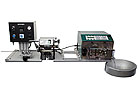
As wire is manually or automatically pulled through a wire guide, a marking foil is placed between the wire insulation and heated character wheels. A pneumatic cylinder then presses the character wheels against the foil, which consists of a backing and a pigment that imprints engraved characters on the wire insulation.
Producing the best quality mark requires the correct foil, wheel temperature, pressure and dwell time. Pressure is a measure of how hard the character wheel presses against the wire; dwell time the length of time the character wheels contact the wire.
Hot stamp marking has two important limitations. The first is it creates an embossed imprint that could possibly affect the integrity of thin insulation. Another is its slow production rate, which keeps it from being used for applications involving large amounts of wire.
If automatic cutting, stripping and terminating machines are connected inline with the hot stamper, they have to stop with every marking cycle. Also, the text must remain the same on each wire piece until the character wheels are adjusted, either manually or automatically.
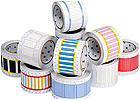
The tubing measures about ¼-inch wide and is heated with a hot air gun. A thermal transfer printer is typically used for printing on the tubing.
“Printable heat shrink tubing typically comes on a bandolier so that the markers are kitted for easy printing and dispensing by the end user,” says Todd Fries, identification systems marketing manager for HellermannTyton.
Heat shrink tubing is highly recommended for wires with thin insulation because it provides an extra layer of protection. In addition, assemblers requiring a military-approved mark will use a shrink tube rather than an adhesive label.
Suppliers note two disadvantages with heat shrink tubing. First, it’s relatively expensive compared to other types of methods mentioned above. Second, it tends to add weight to the wire, which could be a problem in certain applications, such as those involving aircraft.
The
Enduring Label.
Writing
on Wire.
Wire
Processing: Ink Jets for Wire Marking.
Self-laminating labels are applied to wire by hand or via an in-line system. Photo courtesy HellermannTyton.
Every day, harness assemblers apply numbers, machine-readable codes or logos to wire. The reason for this is simple: Marking wire offers several benefits.
The main benefit is being able to identify and track wire throughout the manufacturing process and warranty period.
Other equally important benefits include:
* easier data collection;
* elimination of data transcription errors;
* improved efficiency.
Many methods are available to mark wire. To select the best method, manufacturers should consider several factors, including:
*customer specifications;
*wire type (thick or thin; colored or white);
*insulation factors (thick or thin; hard or soft);
*production volume;
*quality of marking;
*cost restrictions;
*labor and material savings goals.
Adhesive Labels
One of the simplest and most economical ways to identify wire is to label it. A label can contain clear, readable identification information in many formats, and it can be applied to the wire after termination. Labels also are available in a variety of materials that are designed for specific end use environments.“An assembler can select self-laminating, wrap-around or flag labels to mark wire, and each type has specific advantages,” says Adrien Powers, marketing product manager for wire identification at Brady Worldwide Inc. “Self-laminating labels have a white printable zone, with a clear ‘tail’ that wraps around the text for added chemical and abrasion resistance. Wrap-around labels offer the conformability needed for permanent identification. Flag labels stick away from the wire for easy-to-read identification.”
Labels can be printed using ink-jet, dot matrix, laserjet or thermal transfer printers-the latter being the most common. In thermal transfer printing, a linear printhead heats a resin or wax ribbon to transfer markings to the label material. This method provides fast printing and durable marking. Regardless of printer used, a label is applied to wire either manually or via an in-line system.
Relative to other marking methods, a labeling system requires a small capital investment. For increased flexibility, some labeling systems let users program the text to be printed via PC and use a master machine to send a print signal for the label location.
The main drawback of labels is they can be more difficult to wrap around small-diameter wire if the labels are too wide.
This ultraviolet laser wire marker system
features a light enclosure with safety interlock to prevent the escape of UV
light to the surrounding area. Photo courtesy Taymer International Inc.
Ink-jet Marking
Ink-jet marking has grown in popularity due to recent technological improvements. These advances have resulted in faster marking, more-durable markings and less maintenance.In this method, continuously flowing ink is electrically charged and directed onto the wire via deflector plates. The wire industry tends to use a dye or pigmented ink with an MEK (methylethylketone) base. On rare occasions, alcohol-based inks can be used as an alternative; however, doing so increases drying time and decreases production.
“Ink-jet printers are capable of marking wire up to 800 feet per minute,” says Craig Girdwood, vice president for sales and marketing at Taymer International Inc. “This type of marking also is very good on small and uneven surfaces, such as twisted wire.”
Ink-jet marking can mark wire with graphics, text, date and batch codes in various font styles and sizes. Depending on the interfacing wire processing equipment and software, ink-jet marking lets assemblers invert text and vary text strings, font sizes and bolderization.
Ink-jet printers are very effective at printing the same information repeated over long lengths of wire. This type of printer uses both black and white ink, so it can be used on black wire, although white ink does not adhere to the insulation as well as the black ink.
Nonetheless, ink-jet marking does have some limitations. First, the ink-jet printer must be used frequently or the jets will become clogged and require maintenance. Second, the ink color is difficult to change, so if you need to print black and white you will need two printers. Third, ink-jet marking doesn’t work very well on hard insulation types, such as Teflon. Finally, ink-jet markings are less durable than other print markings such as those made by a laser, hot stamp or a thermal transfer printer.
Ultraviolet lasers only work on light-colored
insulation containing titanium dioxide. The final color of the marking depends
on how the laser reacts with the insulation. Photo courtesy Taymer
International Inc.
Laser Marking
“Many military and aerospace wire specifications require the use of laser marking,” says Dave Eubanks, president of Eubanks Engineering.Laser marking is a noncontact process that involves moving a highly focused spot of laser light over the insulation so that it interacts with its component titanium dioxide to produce a mark. The final color of the marking depends on how the laser reacts with the insulation.
Hardware and software control where the laser moves and what shape mark it makes. Lasers can make any shape or size mark, but not all lasers make the same kind of mark on all materials. A special lens must be used to achieve large marks.
Laser marking is great for very thin insulation, which is less than 0.01 inch thick. Laser marking also is a low-maintenance alternative to ink-jet marking because it uses no consumables (ink or tape).
On the negative side, laser marking has a high initial cost. The faster the laser system operates, the more it will cost. For this reason, many assemblers tend to use it only for high-volume processes for a faster return on investment.
Heat shrink wire marker come in a variety of
shrink ratios, material grades and temperature ratings. Photo courtesy Brady
Worldwide Inc.
Hot Stamp Marking
Around since the 1940s, hot stamp marking is the oldest and most inexpensive method for wire identification. This method produces very durable and legible markings and can be used on both soft and hard insulation, including Teflon.As wire is manually or automatically pulled through a wire guide, a marking foil is placed between the wire insulation and heated character wheels. A pneumatic cylinder then presses the character wheels against the foil, which consists of a backing and a pigment that imprints engraved characters on the wire insulation.
Producing the best quality mark requires the correct foil, wheel temperature, pressure and dwell time. Pressure is a measure of how hard the character wheel presses against the wire; dwell time the length of time the character wheels contact the wire.
Hot stamp marking has two important limitations. The first is it creates an embossed imprint that could possibly affect the integrity of thin insulation. Another is its slow production rate, which keeps it from being used for applications involving large amounts of wire.
If automatic cutting, stripping and terminating machines are connected inline with the hot stamper, they have to stop with every marking cycle. Also, the text must remain the same on each wire piece until the character wheels are adjusted, either manually or automatically.
This hot stamp wire marking machine
automatically pulls, measures, marks and cuts wire to length in one seamless
solution. Photo courtesy Taymer International Inc.
Heat Shrink Tubing
Since the late 1960s heat shrink tubing has been an effective marking method. Popular with wire harness builders, the method involves printing characters on collapsible tubing, placing it over wire and heat-shrinking it down at a ratio of 2-to-1 or 3-to-1.The tubing measures about ¼-inch wide and is heated with a hot air gun. A thermal transfer printer is typically used for printing on the tubing.
“Printable heat shrink tubing typically comes on a bandolier so that the markers are kitted for easy printing and dispensing by the end user,” says Todd Fries, identification systems marketing manager for HellermannTyton.
Heat shrink tubing is highly recommended for wires with thin insulation because it provides an extra layer of protection. In addition, assemblers requiring a military-approved mark will use a shrink tube rather than an adhesive label.
Suppliers note two disadvantages with heat shrink tubing. First, it’s relatively expensive compared to other types of methods mentioned above. Second, it tends to add weight to the wire, which could be a problem in certain applications, such as those involving aircraft.
ASSEMBLY Online
For more information on wire marking, check out the following stories online:Looking for a reprint of this article?
From high-res PDFs to custom plaques, order your copy today!