Wire Processing: Ink Jets for Wire Marking
To stay competitive, harness assemblers must be able to print information on wires without sacrificing operational efficiency or profit objectives. A fully integrated wire processing system that combines an ink-jet printer, an automatic cutting and stripping machine, and wire list management software offers the best overall solution.
Of the different types of wire marking technologies, ink-jet printing is the most versatile and production-friendly. Improvements in ink chemistry have made ink-jet marks easier to read and more durable. Improvements in printer technology have led to better management of hazardous fluids and significantly lower solvent emissions than in earlier models. Most good ink-jet printers also have features, such as gutter sensors, nozzle unclogging and automatic flushing, that virtually eliminate the possibility of ink spillage caused by nozzle clogs.
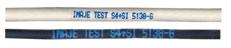
The ink-jet printer is limited only in the color of the ink that can be used. For wire processing, the most common and economical is black, dye-based ink. This type of nonpigmented ink is preferable because it can be applied with printers that are less expensive and less prone to maintenance and clogging. However, the downside is that black printing on black wire is simply not practical. If black wire is part of the harness, other ink options need to be considered. One alternative is a light-blue pigmented ink that shows excellent contrast on a wide range of wire colors.
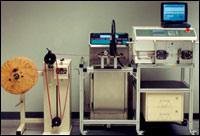
A basic wire marking and processing system includes the ink-jet printer and a printhead stand with an encoder and wire guide for precisely positioning the wire beneath the printhead. The heart of the system is the automatic cutting and stripping machine, which manages all the wire processing (including pre- and post-processing) and communicates with the ink-jet printer.
Partnerships between manufacturers of cutting and stripping machines and ink-jet printers have allowed the development of closed-loop wire marking systems with plug-and-play connections. As a result, both setup and startup times are now measured in minutes, when they used to be measured in hours or even days. Communication between machines allows operators to enter multiple distinct messages directly from the interface panel on the cutting and stripping machine.
Operational Efficiency
Not surprisingly, the trend in wire harness manufacturing is operational efficiency. Most manufacturers realize that the key to higher profitability is to use such proven concepts as just-in-time, kanban and lean manufacturing to drive down costs. The goal is to produce the right product at the right time and in the right quantity. Manufacturers now emphasize economy of operation, not just economy of scale. In this context, the economic order quantity (EOQ) becomes as small as possible to balance customer flexibility requirements with the operational efficiency needs of the organization.In the wire processing industry, one of the biggest influences on successful implementation of any of these concepts is achieving the shortest possible setup time for production changes. Because the manufacturing process is only as fast as the slowest component of the system, machine speeds are not as important as they once were when economy of scale dominated the thinking about production efficiency.
An efficiency tool that is gaining in popularity is wire list management software. Although there is no industry standard, the best packages are Windows-based and allow users to create and store an unlimited number of wire types in a raw material library. Similarly, a processing library contains basic processing parameters, such as wire length, strip length and message text, that would otherwise need to be entered through the interface of the cutting and stripping machine. All of this information is displayed true to scale (what you see is what you get) on the screen. This helps eliminate mistakes by allowing the user to preview the finished product before it's produced.
Looking for quick answers on assembly and manufacturing topics? Try Ask ASM, our new smart AI search tool. Ask ASM
Wire list data can also be imported from other programs, such as Excel, Word or Access, in a defined ASCII format. Now, an engineer can be working in his office on wire lists for future production, while an operator calls up a specific wire list and begins production with only a few mouse clicks. The operator can then work on something else without having to spend time reprogramming the machine for each wire. The productivity and efficiency savings are obvious, but some examples help quantify the savings and illustrate their magnitude.
Example 1: Manual Length Change Only--No Marking Requirement.
Let's say an assembler must produce 100 wires. Each wire is the same AWG size, has a 0.25-inch strip on both ends, and differs in length only. Although each wire has a different length, for easy calculation we'll assume an average length of 20 inches. (With today's machine speeds, the transport time is relatively insignificant compared with the processing time.) Again, for easy calculation purposes, we'll assume that this 20-inch wire can be completely processed in about 1.5 seconds. Lastly, because a length change is probably the simplest manual production change possible on a typical cutting and stripping machine, it should only take an operator an average of 10 seconds to make each change.
Given the above, the processing time is calculated to be 150 seconds (100 wires x 20 inches/wire x 1.5 seconds/20 inches), while changeover time is 1,000 seconds (100 wires x 10 seconds/wire). The total production time is 1,150 seconds. Actual wire processing comprises only 10 to 15 percent of the total processing time. Even to achieve this total time, the operator is required to be at the machine, ready to program the length change.
Clearly, minimizing changeover time will have the largest effect on productivity of both the machine and the operator. Increasing the average wire length would slightly increase the processing time as a percentage of the total time, but it would have to be a huge increase for the total wire processing to even comprise 50 percent of the total time including changeovers.
Example 2: Automatic Length Change Only--No Marking Requirement.
Using wire list management software to automatically produce the same 100 wires yields dramatically different results. In this case, approximately 10 seconds are required to import the wire list. Each wire is then produced without any manual changes being required.
The processing time remains at 150 seconds, but the changeover time is now only 10 seconds. As a result, the total processing time is now only 160 seconds, or about 14 percent of the total time required in the manual process of the previous example. Clearly the automatic process is superior.
It is important to note that although these two examples are realistic, they are very simplistic. Most harnesses actually consist of wires that are color-coded and require different processing parameters.
When ink-jet marking is factored in, the importance of changeover time becomes even more obvious. Most automatic wire processing machines have internal memory registers that allow operators to program and save several hundred different wires, including the ink-jet text messages. However, that's rarely sufficient for most wire harness manufacturers. If all the memory registers are not used up, the changeover time for a manual text change might increase to 15 seconds. However, if there are no remaining memory registers, then manual changeovers could take considerably longer. The operator would have to locate the wire with the most similar mark and edit it. This process could easily require 30 seconds or more, by the time the operator references the master list, identifies the most similar wire, and makes the change.
Example 3: Manual Length and Ink-Jet Text Change.
Assume a production requirement for the same 100 wires as in Example 1, with the exception that each wire requires a unique mark. The processing time might be a bit slower--2 seconds per piece--to ensure the ink-jet printer can keep up with the cutting and stripping machine.
Given the above, the processing time is calculated to be 200 seconds (100 wires x 20 inches/wire x 2 seconds/20 inches), while the changeover time is 4,000 seconds (100 wires x 40 seconds/wire). The total production time is 4,200 seconds.
In this case, the processing time is less than 5 percent of the total time. Even if all the text messages were saved in memory, the changeover time would still increase by 50 percent compared with Example 1. However, one of the most common complaints about a typical wire processing machine is that it lacks memory registers, so we can reasonably assume that the operator will be entering some text manually.
Example 4: Automatic Ink-Jet Text Change and Length Change.
Producing the same wires as Example 3 with wire list management software shows significant time savings. Using the same 10 seconds required to import the wire list, the total processing time increases only slightly over Example 2, due only to the slower speed of the ink-jet line. The total processing time would be 200 seconds, and the total changeover time would still be only 10 seconds. The total production time is only 210 seconds, compared with 1,650 to 4,200 seconds for the manual changeovers.
The obvious conclusion is that there are significant benefits to using wire list management software to produce simple wire harnesses. When producing more complex harnesses that also require wire marking, the benefits of using an integrated ink-jet system combined with wire list management software are even greater.
Single-Color Wire Harnesses
By themselves, wire list management software and automated cutting, stripping and marking equipment can substantially reduce change-over time. But, they can help minimize changeover time in other ways. Many harness manufacturers still produce the traditional wire harness that uses different wire colors depending on the function of the wire. However, most OEMs are not bound by any color codes for the internal wiring of their machines. Using multiple color wires is just the way it's always been done.But, engineers should consider how switching from one wire color to another affects changeover time. The operator must unload the wire from the machines and the prefeeder. He then has to rethread the prefeeder with the new wire and load the cutting and stripping machine. This process can take 1 to 3 minutes, depending on the operator and whether the new reel has to be rethreaded onto the prefeeder.
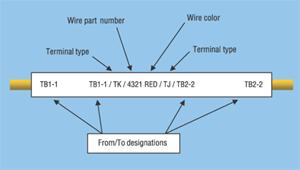
A more efficient alternative would be to produce the entire harness using the same color wire, presumably white, and use the ink jet to simply spell out the wire color in the text.
Because the volume requirement for the white wire would be substantially larger, it could be purchased in bulk (by the barrel), resulting in better pricing. Bulk wire is also easier to work with. Wire processing machines need less energy to pull wire from a barrel than to pull it from a reel, because they do not have to accelerate and decelerate as much mass. Similarly, operators do not have to lift heavy spools onto prefeeders. In fact, a prefeeder may not even be necessary. As a result, general loading and unloading time is much quicker. Processing is also improved. Bulk wire typically has less memory due to the larger radius of the winding within the barrel.
Looking for a reprint of this article?
From high-res PDFs to custom plaques, order your copy today!