Assembly Magazine logo
search
Ask ASSEMBLY AI
cart
facebook twitter linkedin youtube
  • Sign In
  • Create Account
  • Sign Out
  • My Account
Assembly Magazine logo
  • TRENDS
    • Ask ASSEMBLY AI
    • Trends
    • News
    • New Products
  • INDUSTRIES
    • Aerospace
    • Appliance
    • DFMA Assembly
    • Medical Devices
    • Green Manufacturing
    • Lean Manufacturing
    • Machinery Assembly
    • Electronics Assembly
    • Automotive
  • TECHNOLOGIES
    • Adhesives & Dispensing
    • Assembly Presses
    • Automated Assembly Systems
    • Manufacturing Management
    • Manufacturing Software
    • Motion Control
    • Screwdriving & Riveting
    • Robotics
    • Test & Inspection
    • Plastics & Metal Welding
    • Wire Processing
    • Workstations
  • AUTONOMOUS & ELECTRIC MOBILITY
    • AEM Magazine Archives
    • Autonomy
    • Electrification
    • Mobility Services
    • Assembly & Testing
    • AV/EM News
  • MEDIA
    • Ask ASSEMBLY AI
    • Podcasts
    • Assembly News Now
    • Assembly TV
    • Webinars
    • eBooks
  • EVENTS
    • Calendar
    • The ASSEMBLY Show
  • MORE
    • Exclusives >
      • Plant of the Year
      • Capital Spending
    • Buyers Guide >
      • Supplier Insights
    • Classifieds
    • Featured Products
    • Newsletters
    • Store
    • White Papers
    • Columns
    • Sponsor Insights
  • INFOCENTER
    • Assembly & Test Solutions
  • EMAGAZINE
    • eMagazine
    • Archive Issues
    • Advertise
    • Contact Us
    • Sign Up
Machinery Assembly

Tough Conditions Demand Tough Materials

By Austin Weber
December 4, 2012

Roughnecks (a term widely used in the oil and gas industry to describe oil-field workers) demand tough materials for equipment that must work around the clockTough materials in hostile environments. Delays or accidents stemming from equipment wear, malfunction or failure can have major implications.
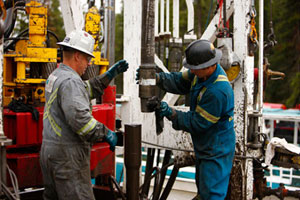
Lost production can cost hundreds of thousands of dollars per well per day, and in some cases, ultimately lead to loss of the well and the millions of dollars invested. Just like in the aerospace or medical device industry, money is often no object; cost takes a back seat to quality, safety and performance.
Unlike more cost-conscious industries, such as automotive manufacturing, it’s not uncommon for oil and gas companies to say “How quickly can I get it? I don’t care what I have to pay.”

“Stainless steels and nickel-based alloys are heavily used by oil and gas equipment manufacturers, but they have a variety of welding challenges,” says Morgan Gallagher, PhD, an applications engineer with the materials group at EWI, who previously worked in the industry. “Titanium and copper alloys are also used, [but they pose issues, too]. For instance, titanium is a finicky metal to weld, because it oxidizes rapidly.

“As the oil and gas industry drills deeper and deeper, engineers are demanding higher-strength and higher corrosion-resistant materials,” adds Gallagher.
“Often, these materials do not have proven weldability.”

For instance, high-temperature drilling environments provide a unique set of challenges for down-hole equipment. “In many of these applications, the tungsten carbide insert roller cone bits used to drill must endure hard and abrasive formations to access steam or hot rock in basement formations where temperatures can exceed 500 F,” says Guy Arrington, president of bits and advanced technologies at Schlumberger.

“At that temperature, a standard 300 F-rated bit’s elastomer seals and lubricating material quickly degrades, causing bearing failure, resulting in operational inefficiencies,” Arrington points out. “Reduced on-bottom drilling hours leads to multiple bit runs and increased development costs.”

When engineers at Schlumberger’s Smith Bits division recently developed a new line of high-temperature roller cone drill bits, they were forced to use new
materials. “A new range of advanced materials were developed, combined with an engineered design solution, to deliver improved bit performance in these applications,” claims Arrington. “These innovations increase seal life, lubricity and load capacity at elevated temperatures.”

The seals of the Kaldera bits are made from fabric-reinforced fluoroelastomer composites to provide thermal stability and wear resistance. Engineers developed a grease compound from synthetic base oils and functional additives to increase load capacity at elevated temperatures and ensure adequate lubricity of the bearing sealing system.

Engineers at another leading oil and gas equipment manufacturer, Weatherford International Ltd., recently developed an expandable sand screen system for deepwater drilling applications. The device controls the influx of sand going into wellbores on the ocean floor. Constructed of a base pipe, filtration membranes and outer shroud, the system expands when a proprietary tool is pushed from the top down.

The engineers used a spinodally hardened copper nickel tin alloy supplied by Materion Corp. ToughMet 3 TS160U rod is used within the expansion tool for its high strength, corrosion resistance and low friction-bearing properties. It ensures that the components effectively slide to expand for contact with the wellbore, thus providing stability and controlling the influx of sand.

Alloy steel with Incolloy 825, Duplex is specified by engineers at Aker Solutions ASA for producing its range of subsea control modules. “Our equipment is designed for pressures up to 1035 bar and temperature ranges from -29 C to +177 C,” says Svein Oskar Nuland, managing director of Aker Solutions’ yard in Egersund, Norway, where the company assembles and tests Christmas trees, wellheads and other equipment. “Our subsea trees have successfully been qualified to water depths of 3,000 meters.”

The company’s GasBooster compression module houses a 16-foot high vertical centrifugal machine that operates at 11,000 rpm. “An innovative design of the compressor has reduced the number of moving parts and supporting systems,” claims Nuland. “For example, the bearings are magnetic and do not require a lubrication system and need only low-voltage power for their operation.”

The compressor and its high-speed electric drive motor are housed in a single, hermetically-sealed enclosure that is pressurized with a barrier system to keep the motor and compressor spaces separate. According to Nuland, the motor and bearings are cooled by process gas in a closed-loop with an external seawater heat exchanger. Variable-speed drives for the compressor and pump are controlled from shore by signals sent through fiber-optic cables.

Looking for quick answers on assembly and manufacturing topics? Try Ask ASM, our new smart AI search tool. Ask ASM →

KEYWORDS: materials oil-field equipment manufacturing

Share This Story

Looking for a reprint of this article?
From high-res PDFs to custom plaques, order your copy today!

Austinweber headshot
Austin has been senior editor for ASSEMBLY Magazine since September 1999. He has more than 21 years of b-to-b publishing experience and has written about a wide variety of manufacturing and engineering topics. Austin is a graduate of the University of Michigan.

Recommended Content

JOIN TODAY
To unlock your recommendations.

Already have an account? Sign In

  • Made in the U.S.A.

    Consumer Products Manufacturing: Made in the USA

    Supply chain lessons learned during the coronavirus...
    Automated Assembly Systems
    By: Austin Weber
  • Best Practices for Press-Fit Assembly

    Best Practices for Press-Fit Assembly

    In manufacturing, ironclad formulas for success are hard...
    Assembly Presses
    By: Jim Camillo
  • aem0523leader-tesla1.jpg

    Tesla Rethinks the Assembly Line

    Engineers at Tesla Inc. have developed a new process that...
    Assembly and Testing
    By: Austin Weber
Manage My Account
  • eMagazine Subscription
  • Assembly Newsletters
  • Online Registration
  • Subscription Customer Service
  • Manage My Preferences

More Videos

Sponsored Content

Sponsored Content is a special paid section where industry companies provide high quality, objective, non-commercial content around topics of interest to the ASSEMBLY audience. All Sponsored Content is supplied by the advertising company and any opinions expressed in this article are those of the author and not necessarily reflect the views of ASSEMBLY or its parent company, BNP Media. Interested in participating in our Sponsored Content section? Contact your local rep!

close
  • ultrasonic welding
    Sponsored bySonobond Ultrasonics

    Engineering Efficiency in High-Performance Assembly: How Ultrasonic Welding Enhances Throughput, Reliability and Quality

  • UV curing system
    Sponsored byDymax

    Why UV Intensity Alone Doesn’t Define Curing Performance

  • wooden pallets
    Sponsored byLEAN Manufacturing Products

    Eliminating Waste on the Shop Floor: Applying Lean Principles to Improve Manufacturing Efficiency

Popular Stories

ASSEMBLY News Now, episode-30: Volvo Redesigns EV Manufacturing

Volvo Redesigns EV Manufacturing

Boeing CEO Kelly Ortberg announces 1 billion investment

Boeing Plans $1 Billion Wichita Investment, Workforce Training Center

GE Appliances Worker on Line

GE Appliances Expands Factory AI With 800 Gemini Enterprise Agents

Watch the latest episode of ANN now!

Events

July 24, 2025

From Shop Floor to CFO: How Manufacturers Are Closing the Loop Between Operations and Finance

On Demand Learn how manufacturers are bridging the gap between the shop floor and ERP systems to gain real-time visibility, streamline operations, and kick-start digital transformation—without waiting years.

Sponsored by:

PicoStratusGreen
July 30, 2025

Buffer Analysis and Design Fundamentals for Manufacturing Excellence

On Demand In this presentation, Dr. Herman Tang shares practical insights from his industry experience and research on buffer management in manufacturing operations.

View All Submit An Event

Poll

Difficult Assembly Processes

Which assembly process gives you the most difficulty?
View Results Poll Archive

Products

Manufacturing Cost Policy Deployment (MCPD) Profitability Scenarios: Systematic and Systemic Improvement of Manufacturing Costs

Manufacturing Cost Policy Deployment (MCPD) Profitability Scenarios: Systematic and Systemic Improvement of Manufacturing Costs

See More Products
Register for webinar - Modernizing Automotive Assembly: Why Upgrading Legacy MES is a Business Imperative

Related Articles

  • Assembly Plant of the Year: When the Hauling Gets Rough, the Tough Turn to Kenworth

    See More
  • A Tough End to a Tough Year for Automakers

    See More
  • VW, Peugeot, Fiat Thriving in Tough Market

    See More

Related Products

See More Products
  • Welding and Joining of Aerospace Materials, 1st Edition

  • Joining and Assembly of Medical Materials and Devices, 1st Edition

  • advanced.jpg

    Functional and Smart Materials

See More Products

Related Directories

  • Yamazen Inc.

    Yamazen Inc. - Tooling Division the exclusive importer, master distributor for Lobster brand of pneumatic and battery powered rivet and rivnut tools. Since 1888 Lobtex supplies high-quality and affordable tools for the assembly industry. Known for ergonomic, light-weight tools and imitating its trade-name, Lobster tools are tough and long-lasting.
×

Never miss the latest news and trends driving the manufacturing industry

Stay in the know on the latest assembly trends.

JOIN TODAY!
  • RESOURCES
    • Advertise
    • Contact Us
    • Directories
    • Manufacturing Division
    • Store
    • Want More?
  • SIGN UP TODAY
    • Create Account
    • eMagazine
    • Newsletters
    • Customer Service
    • Manage Preferences
  • SERVICES
    • Marketing Services
    • Reprints
    • Market Research
    • List Rental
    • Survey/Respondent Access
  • STAY CONNECTED
    • LinkedIn
    • Facebook
    • Instagram
    • YouTube
    • X (Twitter)
  • PRIVACY
    • PRIVACY POLICY
    • TERMS & CONDITIONS
    • DO NOT SELL MY PERSONAL INFORMATION
    • PRIVACY REQUEST
    • ACCESSIBILITY

Copyright ©2026. All Rights Reserved BNP Media, Inc. and BNP Media II, LLC.

Design, CMS, Hosting & Web Development :: ePublishing