Rate your suppliers to help them improve
Machinery manufacturer Butler Automatic has developed a unique system to measure the performance of its suppliers and help them improve.
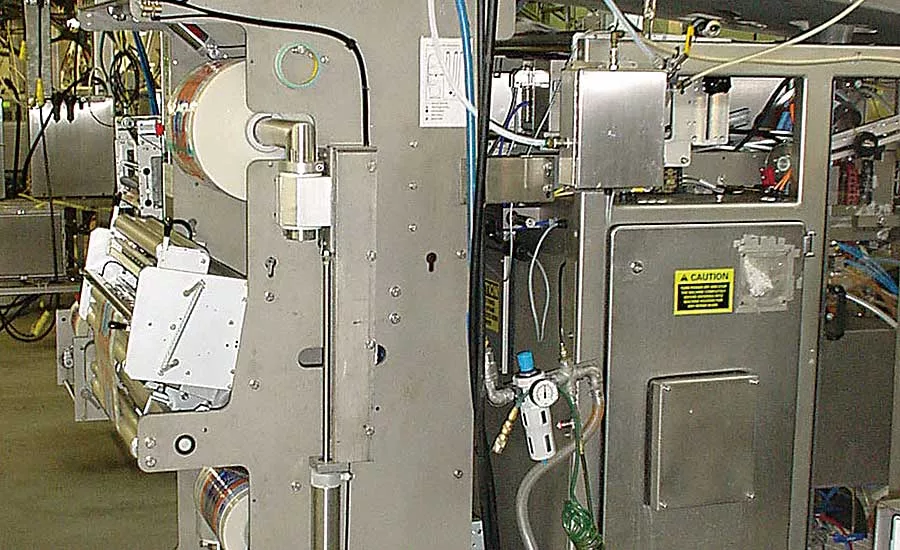
Butler Automatic makes equipment for splicing rolls of plastic film on packaging lines. Photo courtesy Butler Automatic Inc.
In professional sports, every team wants to find and retain “franchise players”—those few key personnel who are vital to winning a championship.
Similarly, Butler Automatic has developed a performance measurement system to help it find “franchise player” suppliers and service providers. Such companies are continuously improving, so they can provide a safety net for changing customer requirements. This helps us—and them—stay competitive in the global marketplace. Finding these key players comes somewhat naturally to me, since I’m also an associate scout for Major League Baseball’s Seattle Mariners.
In some areas, long-term partnerships and agreements are critical. In sports, even franchise players can’t stay on top forever. Similarly, it may be unrealistic to expect franchise suppliers to always be the best manufacturers. They can “go into a slump,” or their performance can change due to various factors that arise in the fast-changing manufacturing environment.
Scouting for new players doesn’t mean we’re disrespecting our existing stars, but it does mean we are always looking out for the best interests of Butler Automatic. And, a bit of extra competition usually does not hurt. While we have our key providers, scouting enables us to build up the weaker players. The goal is to constantly upgrade the supplier pool to build a stronger organization, just like any scout would want to build a strong team. Lead times are short and customer demands are high, so one must always be scouting. It’s vital to have a contingency plan with “backup bench players” who can fill in when the key suppliers may be constrained.
Purchasing and material control can play a key role in the success of lean manufacturing processes. At Butler Automatic, our supplier performance measurement system has been the key to ensuring the continuous improvement required by lean manufacturing. The system features a rigorous and comprehensive supplier scorecard and periodic audits. With a focus on coaching and training, this system helps improve manufacturing operations and on-time delivery.
To conclude the sports analogy, our performance measurement program is similar to the analytics department or on-staff analytics expert that every major professional sports team now has. Like scouting, finding good and reliable suppliers takes a great deal of time. Monitoring their performance is the only way to do that job effectively.
Measuring Supplier Performance
Continuous improvement is a central tenet of lean manufacturing. As a manufacturer of automatic splicing equipment, Butler wanted to focus a portion of its continuous improvement initiatives on the supply chain for the key parts that go into the manufacturing process. Developing methods to measure suppliers’ performance would form the foundation of that initiative.
Looking for quick answers on assembly and manufacturing topics? Try Ask ASM, our new smart AI search tool. Ask ASM
Performance measurement was by no means envisioned as an adversarial activity. Instead, we want to work together with our suppliers to understand
their strengths and weaknesses. We want to understand our suppliers’ problems and partner with them to develop solutions that benefit both parties.
The system involves gathering facts and performance information from our enterprise resource planning (ERP) system, including prices and on time delivery. An outgrowth of the desire to measure supplier performance was a new understanding of the importance of giving suppliers precise, factual and accurate data on purchase orders. The desire to hold suppliers accountable led to better internal departmental information on Butler’s end.
The system measures performance with regard to delivery, quality and a third factor, which we call supply chain management.
Delivery is a more or less straightforward assessment of on-time delivery and is measured based on the specific supplier’s delivery policy.
Quality measurements contain several elements. We begin by measuring whether the incoming part meets specifications. Did the supplier ship 10 parts and all 10 are good? Or, did it ship 100 parts, 10 of which are bad, causing disruption to our customer or our manufacturing process? Incoming parts go directly to the manufacturing cell, so any problems are picked up on the shop floor. If the purchasing agent must be called to the assembly floor because a part does not work or does not fit, or if there is any other question about the part, this causes a disruption that will be logged and factored into the performance evaluation.
In other words, the performance system uses a definition of quality that includes the ability to trust that the suppliers’ parts are correct. Of course, trust goes both ways. We trust our suppliers, and they, in turn, trust that we will evaluate them fairly and accurately.
The quality measurement also considers whether the packing list and invoice are completely accurate to the information on the purchase order. For example, is the price exactly as noted on the invoice? If it doesn’t match, the accounts payable personnel have to obtain approval, which could slow down the manufacturing process. This falls under the subcategory “administration (perfect order).”
Supply chain management is based on three elements: price and cost, lead time, and business practices. Price and cost includes terms on the purchase order and pricing stability. Lead time is based on the current market lead time. The business practice element may be the most important. It includes open communication, honesty, integrity and responsibility.
Capturing Performance in a Scorecard
All these performance elements are captured in our supplier scorecard. It’s basically a report card that is sent to suppliers twice a year. Some elements are based strictly on data retrieved from the ERP system, while others are more subjective evaluations on how the particular element affects the business.
We developed the scorecard based on research into similar performance evaluations. We then tailored it to Butler Automatic’s specific needs. The format was developed as a group effort, with the support and input from the entire management team, including the engineering manager and the director of finance and administration.
The scorecard is sent to our suppliers and discussed during twice-yearly audits. The goal is to help both us and them improve. The information we provide is truly intended to make their jobs easier. The scorecard provides an overall rating, which is a weighted average of the scores achieved in each category.
Unacceptable performance means action is required. Marginal performance means investigation is needed. Acceptable performance means the supplier meets most standards. Preferred provider status is reserved for those achieving the highest scores. The scorecard creates a conversation in terms of how both parties can improve.
When the program started, the data available was not accurate enough to use for performance tracking. Over time, Butler revised its systems to be able to do so. For example, we built in an acknowledgement step into the purchasing cycle. External providers now acknowledge their explicit agreement with certain data elements and understand that they will be measured on them. They get the purchase order, review it and update it with actual dates to ensure that it agrees with promised delivery dates. The acknowledgement can be either a formal computerized document or just a simple email saying that the dates look fine. The purchasing department then stores that acknowledgement in the ERP system.
Communication and feedback is another important factor. For example, if the purchase order has a delivery date of Nov. 1, and a supplier tells us that the order will arrive on Nov. 3, we update our records and the supplier’s performance in that area is not affected. If the supplier does not communicate that the delivery will be late, their score will be reduced.
The suppliers that stand out usually welcome the designation and are pleased to receive kudos for performance. Most companies like to shine compared to their competitors. The process is not intended to be adversarial. If supplier continues with poor performance, we may stop doing business with it. But, we also offer our help to those that are struggling.
The results of our audits are shared monthly in a presentation to the entire manufacturing team. The company measures monthly on-time performance as part of its continuous improvement initiatives; supplier performance has a direct result on the assembly floor and also effects on-time delivery. As a result of the monthly meetings, the entire company is always aware of how specific suppliers are affecting on-time performance. The information is also important to the team that is working on the company’s ISO 9001 certification.
Looking for a reprint of this article?
From high-res PDFs to custom plaques, order your copy today!