Five Things: Aerospace Assembly
Lockheed Cuts Production Time by 20 to 40 Percent
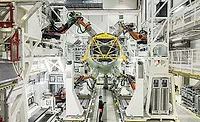
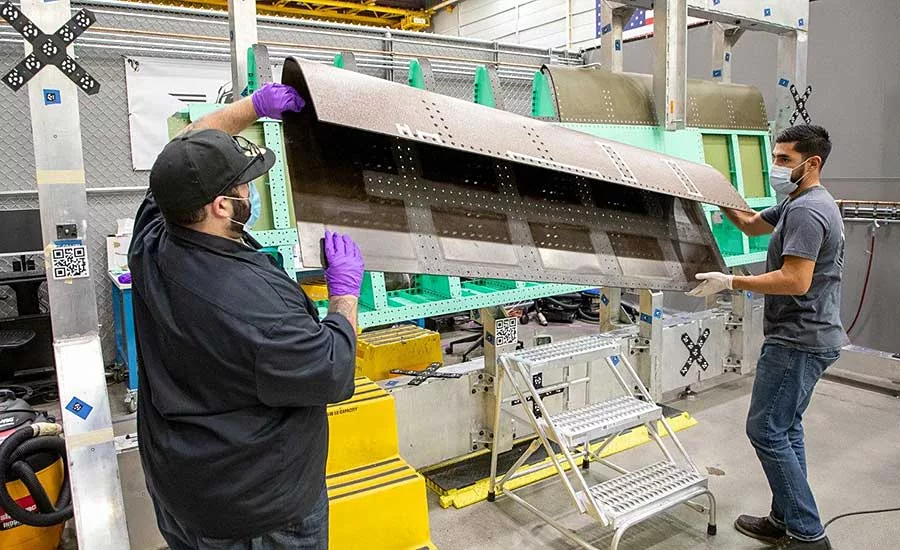
Engineers at Lockheed Martin’s Skunk Works recently completed a prototype aircraft article that demonstrates how transformational technologies can enable aircraft components to be built more than 50 percent faster, reducing total production time by 20 to 40 percent.
The prototype, dubbed CHARLIE, is an aircraft article built using full-size determinant assembly (FSDA) on composite skins. The project was made possible through digital engineering and advanced machining.
FSDA significantly reduces build time by moving drilling to the component fabrication process, where it is more controlled and efficient. At assembly, manufacturing teams simply need to align the predrilled holes and install fasteners, completing precision assemblies much faster. Manufacturers have used FSDA for metallic substructures for years, but CHARLIE takes that process one step further by applying it to composite skins, unlocking quality and ergonomic improvements as well as schedule gains.
Without FSDA, the process for building an aircraft is sequential. Mechanics track skins into place, manually adjust them into the right position, apply liquid shim to keep the skins in place, drill holes, remove the skins, install underlying subsystems, bond nut plates on the substructure, put the skins back on, and then finally install the skins with fasteners. Drilling takes place before complex subsystems are installed to protect them from metal shavings and debris.
FSDA skins disrupt that process, allowing for the optimal build sequence of structure and subsystems in parallel. This is a key enabler for time and cost savings.
“The further we integrate FSDA, the fewer constraints we have to design for manufacturability,” says Shawn Sauerwein, the CHARLIE program manager. “It’s more efficient for mechanics to install subsystems when there’s better access and increased ergonomics. Plus, with digital engineering, we can virtually build ahead of physical build to prevent some design rework as we simulate sequence—particularly in hard-to-reach subsystems and tight areas. Precise digital models enable us to complete a virtual build to verify tools will fit and the optimum sequence was chosen.”
CHARLIE is the first “born-digital” prototype of Project StarDrive, a multiyear, up-front investment to re-engineer how Lockheed develops and assembles aircraft, introducing processes and tools that operate in a fully integrated digital work environment and connect previously disparate systems.
Looking for quick answers on assembly and manufacturing topics? Try Ask ASM, our new smart AI search tool. Ask ASM
With StarDrive, the team is closely measuring cost and schedule savings to produce proven, accurate and competitive program bids for future programs.
The CHARLIE results speak for themselves:
- 100 percent hole alignment between metallic substructure and composite parts the first time.
- Zero fastener rework.
- Zero quality escapes.
Built 70 percent faster than previous articles of a similar size.
Rolls-Royce Harnesses AI for Engine Inspection
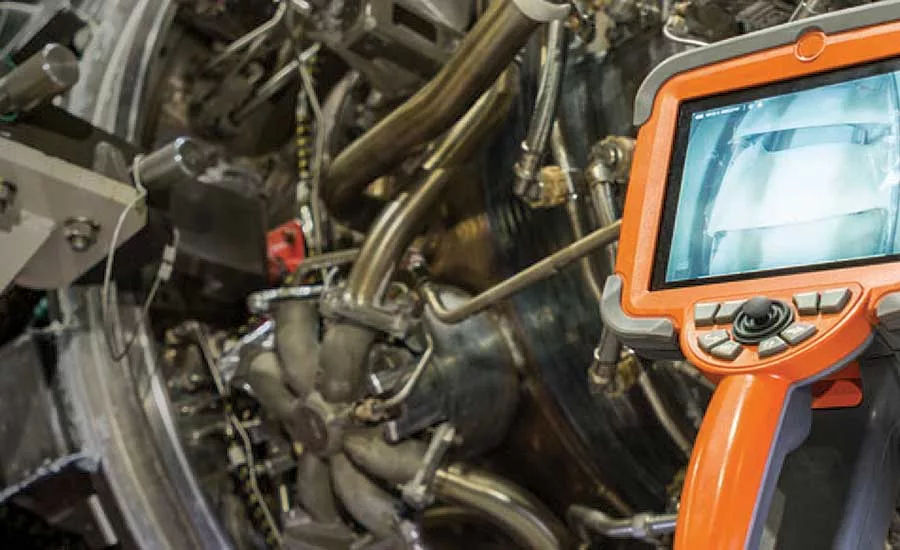
Engineers at Rolls-Royce have developed an Intelligent Borescope that can reduce the time needed to inspect a jet engine by 75 percent and save up to $138 million in inspection costs over five years.
“Our new Intelligent Borescope capability brings together cutting-edge technology and artificial intelligence in a way that has never been used in the aviation industry,” says Adriano Pulisciano, Rolls-Royce imaging and computer vision specialist.
An average aircraft completes 20,000 flights in its lifetime. That’s the equivalent of 60 million miles or 2,400 times around the world. Regular inspections of the plane’s engines are essential to ensure everything is in working order. A jet engine has some 20,000 components, but not all of them are easily accessible. One way of getting inside the engine to look at them is with a borescope.
“A routine borescope inspection can take an aircraft out of service for 12 hours,” adds Pulisciano. “The Intelligent Borescope dramatically reduces the time taken to complete…certain inspections.”
The Intelligent Borescope is equipped with a state-of-the-art remote visual inspection unit from Waygate Technologies. The AI software was developed with the help of Roke Manor Research, an R&D firm specializing in communications, networks and sensors. Roke is best-known for developing the Hawk-Eye vision system used in professional tennis and other sports.
“This technology will not only speed up inspection times, but also transform many aspects of our business through the capture and analysis of high-quality standardized data from all of our engines, which can be exploited to maximize the efficiency of our entire fleet and improve future design,” explains Pulisciano.
The tip of the borescope, which is about the size of a pen cap, is enabled with a scanner that can generate 3D color images. It can scan objects as large as high-pressure turbine blades. As it moves through the engine, the borescope captures images that are analyzed by the AI software and then sent to the Rolls-Royce cloud. Connectivity to the cloud means that certain inspections can even be completed offline once the data has been captured, a first for the aviation industry.
The borescope is connected to an electronic turning tool from Rhinestahl Corp. that automatically and safely rotates the engine shaft, positioning each blade correctly for inspection. After each blade is in position, the turning tool tells the borescope to capture the image.
The next step is to process the data in the software, which is achieved using AI technology similar to that used for facial recognition. The software maps the blade in the same way a face is mapped, looking for key image features that represent inconsistencies or irregularities. This is the first time facial recognition technology has been applied to aerospace inspections, and it required the team to design and build the AI network from scratch with representative data collected from across the company’s fleet of engines.
Once the AI process is complete, the inspector must review and approve the software’s analysis and service-life predictions. During the review process, inspectors can easily fine tune the predictions if needed. In the past, processing this data took 90 minutes. Now, it takes just 10.
The first of three Rolls-Royce AI software apps was delivered this year. “The first app is related to the inspection of turbine blades,” says Pulisciano, “and is available to every customer who needs to carry out inspections wherever they are located in the world. All they have to do is download it from our Care Portal directly onto their borescope handset.”
Exoskeleton Improves Ergonomics at Lockheed
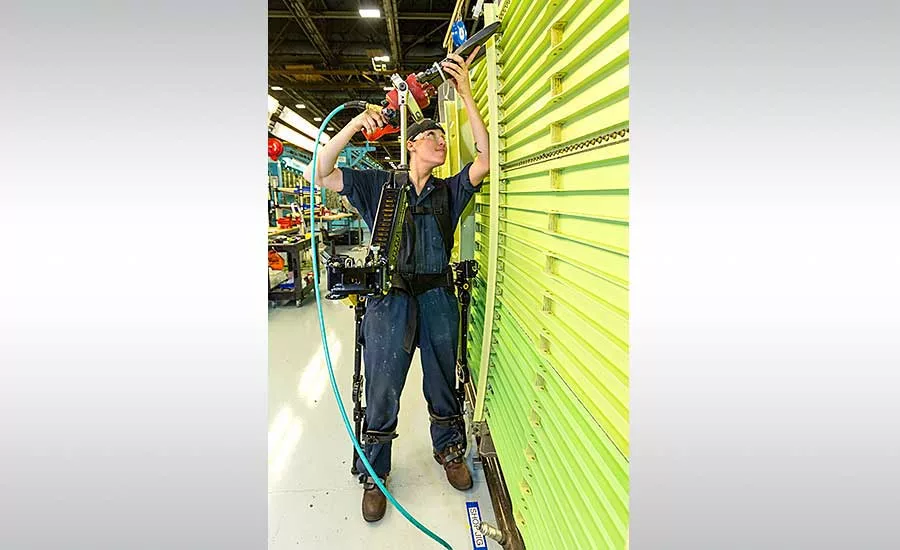
Engineers at Lockheed Martin Corp. have developed an unpowered, lightweight exoskeleton that allows assemblers to use heavy tools as if they were weightless.
The device, called FORTIS, increases an operator’s strength and endurance by transferring the weight of heavy loads from the operator’s body directly to the ground through a series of joints at the hips, knees and ankles. The device works in both the standing and kneeling positions, and it can support up to 36 pounds.
Designed to move naturally with the body, FORTIS adapts to different body types and heights.
Integral to the exoskeleton, but also sold separately, is the FORTIS Tool Arm. It supports tool weight and helps isolate tool vibration and torque kick from the user. It can be mounted on workbenches, scaffolding or stanchions to meet a variety of applications. Users of the exoskeleton and tool arm report two-thirds less fatigue, resulting in higher quality work, greater productivity and fewer musculoskeletal injuries.
The exoskeleton’s design originated from Lockheed’s research to assist soldiers in carrying heavy equipment over long distances. FORTIS has been recognized with seven international design awards, including Red Dot’s Best of the Best, the Green Good Design Award, SPARK and The Icon Award.
Lockheed offers training and service for the FORTIS products. Prices start at $7,149 for the FORTIS tool arm and $24,750 for the full FORTIS industrial exoskeleton.
Airbus Automates Array Assembly
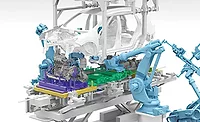
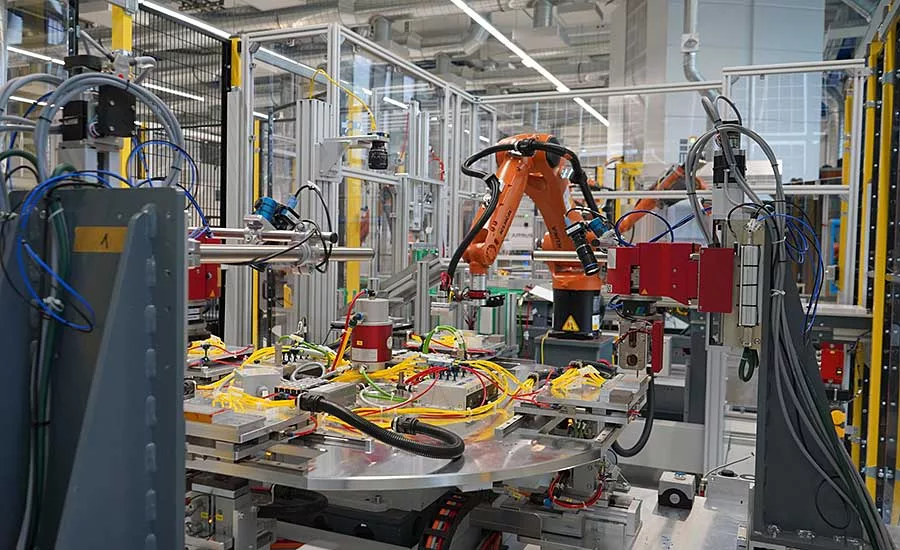
At the Airbus Defense and Space facility in Ottobrunn, Germany, a six-axis robot, dubbed Sirius, picks up a solar cell and places it on a turntable. Next, the cell’s connector is attached and welded, the finished unit is inserted into a magazine, and the entire process starts again.
Sirius and 17 robots (all named after stars in the Milky Way) form the heart of Europe’s first fully automated solar-array production facility, which began operations in July. The arrays are used on satellites and spacecraft to provide power from sunlight.
Airbus has invested more than $17.7 million in the facility, which the company hopes will serve as a flagship project for its next-gen manufacturing strategy. “Sirius never gets tired and doesn’t make any mistakes,” says Jens Birkel, who is in charge of solar array production and test at the plant.
From an individual cell to a completed solar array, the robots carry out a total of 60 steps across six stations. After Sirius has fed the individual solar cells into the assembly line, another robot, Vega, laminates the cells with a glass covering to protect them against cosmic radiation.
Capella then welds diodes to the solar cells, before Bellatrix connects them together into strings, as the individual sections of a solar array are called. Antarix cleans the panels and prepares them for adhesion. Once that is complete, Rigel takes over and inserts the individual sections into an solar array.
“The Ottobrunn facility combines automation, robotization, digitalization and artificial intelligence to boost productivity, quality and cost efficiency,” explains Andreas Vogel, head of engineering and operations at Airbus’ Spacecraft Equipment division.
Ottobrunn’s robots have cut lead times for solar array production in half. Costs are going down, as well. “It’s increasing our competitiveness on the global market,” Andreas adds.
After some initial apprehension from staff at the plant, Birkel says that everyone has learned to work well with the robots. People focus on tasks that the machines cannot manage, such as wiring or testing the solar panels.
“The 18 robots take care of the monotonous and repetitive work, freeing up time for Airbus personnel to focus more on innovations, such as new solar-array designs or the manufacturing of customer parts—far away from the pressures of production. Sirius and the other 17 robots then put these innovations into practice,” says Birkel.
5,084
At the end of June, Boeing’s backlog for passenger jets was 5,084 aircraft. Boeing’s all-time backlog high of 5,964 aircraft was set in August 2018. At the company’s 2018 production levels, it will take the aerospace giant approximately 6.3 years to meet its outstanding orders. At the company’s 2020 production levels, however, it would last more than 32.4 years. In 2020, Boeing delivered 157 aircraft, compared to 380 in 2019 and 806 in 2018.
Looking for a reprint of this article?
From high-res PDFs to custom plaques, order your copy today!