Assembly Magazine logo
search
Ask ASSEMBLY AI
cart
facebook twitter linkedin youtube
  • Sign In
  • Create Account
  • Sign Out
  • My Account
Assembly Magazine logo
  • TRENDS
    • Ask ASSEMBLY AI
    • Trends
    • News
    • New Products
  • INDUSTRIES
    • Aerospace
    • Appliance
    • DFMA Assembly
    • Medical Devices
    • Green Manufacturing
    • Lean Manufacturing
    • Machinery Assembly
    • Electronics Assembly
    • Automotive
  • TECHNOLOGIES
    • Adhesives & Dispensing
    • Assembly Presses
    • Automated Assembly Systems
    • Manufacturing Management
    • Manufacturing Software
    • Motion Control
    • Screwdriving & Riveting
    • Robotics
    • Test & Inspection
    • Plastics & Metal Welding
    • Wire Processing
    • Workstations
  • AUTONOMOUS & ELECTRIC MOBILITY
    • AEM Magazine Archives
    • Autonomy
    • Electrification
    • Mobility Services
    • Assembly & Testing
    • AV/EM News
  • MEDIA
    • Ask ASSEMBLY AI
    • Podcasts
    • Assembly News Now
    • Assembly TV
    • Webinars
    • eBooks
  • EVENTS
    • Calendar
    • The ASSEMBLY Show
  • MORE
    • Exclusives >
      • Plant of the Year
      • Capital Spending
    • Buyers Guide >
      • Supplier Insights
    • Classifieds
    • Featured Products
    • Newsletters
    • Store
    • White Papers
    • Columns
    • Sponsor Insights
  • INFOCENTER
    • Assembly & Test Solutions
  • EMAGAZINE
    • eMagazine
    • Archive Issues
    • Advertise
    • Contact Us
    • Sign Up

Powering Through Evolving Times: How Track Busway Systems Can Boost Flexibility of Assembly Plants
By Doug Moore
starline april 2022
April 29, 2022

Perhaps the biggest takeaway from the past couple of years was recognizing how simultaneous events—wars, pandemics, natural disasters—can have significant global implications.

For manufacturers, these “compounded extremes” have provided incentive for better planning. They have also sparked a call to strengthen the domestic supply chain, especially for crucial products like medical devices and semiconductors. Many manufacturers are opting to reshore production—to bring manufacturing and services back to the United States from overseas.

If manufacturers are to survive in today’s dynamic and unpredictable world, they must be more flexible than ever. The companies that will thrive are not necessarily the largest or most innovative, but the ones that have the flexibility to adapt quickly to changing needs and unexpected events. Indeed, a recent survey conducted by Starline found that manufacturers will make at least one significant change to their production environment every six to 12 months.

There are any number of reasons a company might decide to move its manufacturing operations to a facility in a different location. It might want to get closer to a customer. It might want to expand or consolidate. Or, it might simply be looking for tax breaks or lower real estate costs.

The COVID‐19 pandemic is a classic example of an unexpected event that required companies to rethink their business models. The pandemic forced many manufacturers to reorganize their facilities and operations around employee safety. A big challenge was how to introduce the concept of social distancing into manufacturing work environments. For some companies, this required them to reorganize equipment and workstations to provide a safe distance of six feet between employees as they were working.

Flexibility and Personnel

Unfortunately, becoming more flexible isn’t so easy, given the current state of manufacturing employment. According to a report from Deloitte and The Manufacturing Institute, “Creating Pathways for Tomorrow’s Workforce Today: Beyond Reskilling in Manufacturing,” the pandemic outbreak initially erased approximately 1.4 million U.S. manufacturing jobs, undoing more than a decade of manufacturing job gains. While the industry was able to hire back 1.2 million of these jobs through March 2022, the remaining 175,000 have not been added back, despite more than 500,000 job openings.

Looking for quick answers on assembly and manufacturing topics? Try Ask ASM, our new smart AI search tool. Ask ASM →

If that wasn’t bad enough, our country’s electrical workers are aging. Electrical workers are retiring at a rapid pace, and the training of new electricians is failing to keep up. According to data from the Census Bureau, the median age of electricians in the U.S. is 41 years old. At the same time, the Bureau of Labor Statistics has estimated that the need for electricians over the next 10 years will grow by more than 10 percent, based on current policies and trends.

And that’s a problem. When companies are forced to retool or reconfigure production layouts, it will invariably require modifications to the facility’s power distribution system. For decades, manufacturers have relied on traditional electrical conduit and wiring systems—informally known as “pipe and wire systems”—to deliver power to manufacturing equipment, such as assembly‐line machinery.

These pipe and wire systems have numerous drawbacks, the primary one being their lack of flexibility in adapting to changes. Whenever manufacturers must move, add or replace machinery on the factory floor, they must often reconfigure their power distribution system, which means hiring outside labor to run additional wiring. That means increased labor costs, complicated scheduling, and potentially considerable downtime.

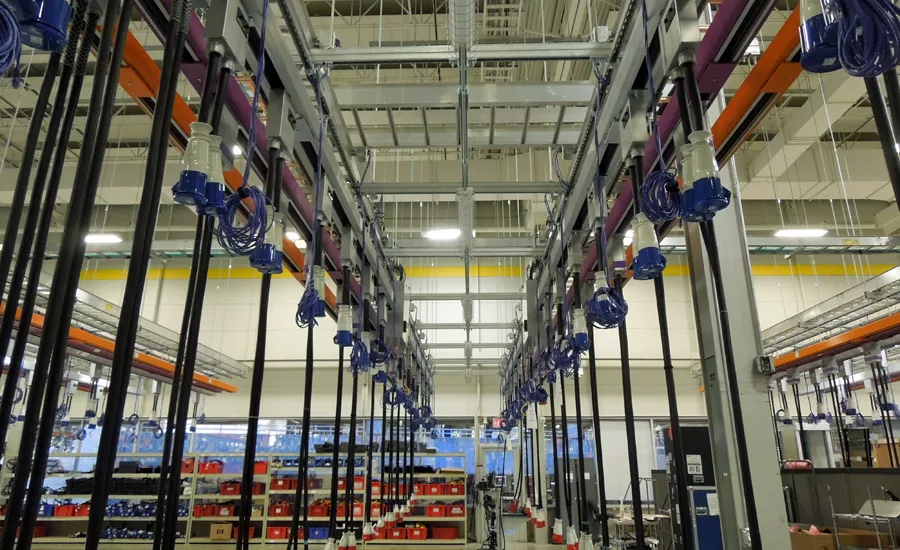
Fortunately, there is an alternative. A track busway system provides the same high‐performance power delivery as traditional pipe and wire systems. But, track busways also offer the flexibility to make quick and easy changes to a power distribution layout and the scalability to accommodate higher power loads. A track busway system lets anyone adapt their power distribution to the changing needs of the facility, with far less trouble and cost.

Unlike traditional wiring, open channel busways enable operators to relocate power access points and outlets directly where power is needed in a matter of minutes—without contracting scarce electricians. A busway’s continuous access design makes this flexibility possible. Contrary to bus-duct systems which have fixed access points called ports, the full length of the busway is available for inserting plug-and-play tap-off boxes. Point of use power lets manufacturers arrange their power access to suit their production layout requirements.

Busway systems can also be installed faster than traditional conduit installations. For example, the rapid installation and flexibility afforded by busways enabled a major Detroit automaker to reconfigure a portion of its assembly plant for ventilator manufacturing in response to the COVID-19 pandemic. The automaker was able to source materials, train its employees, and reconfigure its facility in just 11 days.

Conclusion

There are many unforeseen challenges and planned changes facility managers are continually facing. Properly responding to these issues can mean the difference between maintaining profitability and experiencing unnecessary long‐term costs. Leveraging an agile, high‐performance power delivery system will help you avoid the latter.

A track busway system provides a competitive edge for any manufacturing company, allowing you to make quick changes to power delivery with little to no interruption. When reconfiguring machinery, a track busway lets you quickly return to full productivity, with minimal difficulties and downtime. If you’re scaling up your manufacturing operations with a new or expanded facility, a track busway system allows you to open that facility faster since the busway system can be installed up to 90 percent more quickly.

KEYWORDS: assembly line design busway systems flexible assembly

Share This Story

Looking for a reprint of this article?
From high-res PDFs to custom plaques, order your copy today!

Industrial Product Manager
Starline
Canonsburg, PA
800-245-6378
https://www.starlinepower.com

Doug Moore is industrial product manager at Starline, a brand of Legrand. He is responsible for development and management of the Starline product portfolio, supporting various global industrial sectors, such as manufacturing, automotive, aerospace, biomedical, education and distribution. Doug has more than 18 years of experience working in the electrical industry in various sales, marketing and product management roles within power generation, transmission and distribution, and component manufacturing. Doug has a bachelor’s degree in industrial engineering and an MBA. Prior to joining Starline, he spent time at Westinghouse, Maclean Power Systems, and Honeywell.

Recommended Content

JOIN TODAY
To unlock your recommendations.

Already have an account? Sign In

  • Made in the U.S.A.

    Consumer Products Manufacturing: Made in the USA

    Supply chain lessons learned during the coronavirus...
    Automated Assembly Systems
    By: Austin Weber
  • Best Practices for Press-Fit Assembly

    Best Practices for Press-Fit Assembly

    In manufacturing, ironclad formulas for success are hard...
    Assembly Presses
    By: Jim Camillo
  • aem0523leader-tesla1.jpg

    Tesla Rethinks the Assembly Line

    Engineers at Tesla Inc. have developed a new process that...
    Electrification
    By: Austin Weber
Manage My Account
  • eMagazine Subscription
  • Assembly Newsletters
  • Online Registration
  • Subscription Customer Service
  • Manage My Preferences

More Videos

Sponsored Content

Sponsored Content is a special paid section where industry companies provide high quality, objective, non-commercial content around topics of interest to the ASSEMBLY audience. All Sponsored Content is supplied by the advertising company and any opinions expressed in this article are those of the author and not necessarily reflect the views of ASSEMBLY or its parent company, BNP Media. Interested in participating in our Sponsored Content section? Contact your local rep!

close
  • ultrasonic welding
    Sponsored bySonobond Ultrasonics

    Engineering Efficiency in High-Performance Assembly: How Ultrasonic Welding Enhances Throughput, Reliability and Quality

  • UV curing system
    Sponsored byDymax

    Why UV Intensity Alone Doesn’t Define Curing Performance

  • wooden pallets
    Sponsored byLEAN Manufacturing Products

    Eliminating Waste on the Shop Floor: Applying Lean Principles to Improve Manufacturing Efficiency

Popular Stories

ASSEMBLY News Now, episode-30: Volvo Redesigns EV Manufacturing

Volvo Redesigns EV Manufacturing

Boeing CEO Kelly Ortberg announces 1 billion investment

Boeing Plans $1 Billion Wichita Investment, Workforce Training Center

GE Appliances Worker on Line

GE Appliances Expands Factory AI With 800 Gemini Enterprise Agents

Watch the latest episode of ANN now!

Events

July 24, 2025

From Shop Floor to CFO: How Manufacturers Are Closing the Loop Between Operations and Finance

On Demand Learn how manufacturers are bridging the gap between the shop floor and ERP systems to gain real-time visibility, streamline operations, and kick-start digital transformation—without waiting years.

Sponsored by:

PicoStratusGreen
July 30, 2025

Buffer Analysis and Design Fundamentals for Manufacturing Excellence

On Demand In this presentation, Dr. Herman Tang shares practical insights from his industry experience and research on buffer management in manufacturing operations.

View All Submit An Event

Poll

Difficult Assembly Processes

Which assembly process gives you the most difficulty?
View Results Poll Archive

Products

Manufacturing Cost Policy Deployment (MCPD) Profitability Scenarios: Systematic and Systemic Improvement of Manufacturing Costs

Manufacturing Cost Policy Deployment (MCPD) Profitability Scenarios: Systematic and Systemic Improvement of Manufacturing Costs

See More Products
Register for webinar - Modernizing Automotive Assembly: Why Upgrading Legacy MES is a Business Imperative

Related Articles

  • Night and Day: A Tale of Two Assembly Plants

    See More
  • gm robot

    GM Plans Major Expansion of Lansing Assembly Plants

    See More
  • Electrolux manufacturing

    Half of Electrolux Assembly Plants Are “Zero Waste to Landfill” Facilities

    See More

Related Products

See More Products
  • Joining and Assembly of Medical Materials and Devices, 1st Edition

  • achieving

    Achieving Excellence Through Lean Manufacturing: A Lean Leader’s Journey

  • design for.jpg

    Design for Six Sigma: A Practical Approach through Innovation

See More Products

Related Directories

  • Starline

    With its continuous open-access slot, Starline Track Busway gives you the flexibility to adapt your power distribution to the ever-changing landscapes of manufacturing environments. A versatile selection of plug-in units can be employed in any configuration to meet all the various demands of your workspace and equipment requirements.
  • Track Systems Inc.

×

Never miss the latest news and trends driving the manufacturing industry

Stay in the know on the latest assembly trends.

JOIN TODAY!
  • RESOURCES
    • Advertise
    • Contact Us
    • Directories
    • Manufacturing Division
    • Store
    • Want More?
  • SIGN UP TODAY
    • Create Account
    • eMagazine
    • Newsletters
    • Customer Service
    • Manage Preferences
  • SERVICES
    • Marketing Services
    • Reprints
    • Market Research
    • List Rental
    • Survey/Respondent Access
  • STAY CONNECTED
    • LinkedIn
    • Facebook
    • Instagram
    • YouTube
    • X (Twitter)
  • PRIVACY
    • PRIVACY POLICY
    • TERMS & CONDITIONS
    • DO NOT SELL MY PERSONAL INFORMATION
    • PRIVACY REQUEST
    • ACCESSIBILITY

Copyright ©2026. All Rights Reserved BNP Media, Inc. and BNP Media II, LLC.

Design, CMS, Hosting & Web Development :: ePublishing