Assembly Magazine logo
search
Ask ASSEMBLY AI
cart
facebook twitter linkedin youtube
  • Sign In
  • Create Account
  • Sign Out
  • My Account
Assembly Magazine logo
  • TRENDS
    • Ask ASSEMBLY AI
    • Trends
    • News
    • New Products
  • INDUSTRIES
    • Aerospace
    • Appliance
    • DFMA Assembly
    • Medical Devices
    • Green Manufacturing
    • Lean Manufacturing
    • Machinery Assembly
    • Electronics Assembly
    • Automotive
  • TECHNOLOGIES
    • Adhesives & Dispensing
    • Assembly Presses
    • Automated Assembly Systems
    • Manufacturing Management
    • Manufacturing Software
    • Motion Control
    • Screwdriving & Riveting
    • Robotics
    • Test & Inspection
    • Plastics & Metal Welding
    • Wire Processing
    • Workstations
  • AUTONOMOUS & ELECTRIC MOBILITY
    • AEM Magazine Archives
    • Autonomy
    • Electrification
    • Mobility Services
    • Assembly & Testing
    • AV/EM News
  • MEDIA
    • Ask ASSEMBLY AI
    • Podcasts
    • Assembly News Now
    • Assembly TV
    • Webinars
    • eBooks
  • EVENTS
    • Calendar
    • The ASSEMBLY Show
  • MORE
    • Exclusives >
      • Plant of the Year
      • Capital Spending
    • Buyers Guide >
      • Supplier Insights
    • Classifieds
    • Featured Products
    • Newsletters
    • Store
    • White Papers
    • Columns
    • Sponsor Insights
  • INFOCENTER
    • Assembly & Test Solutions
  • EMAGAZINE
    • eMagazine
    • Archive Issues
    • Advertise
    • Contact Us
    • Sign Up
ColumnsScrewdriving and Riveting AssemblyWorkstations Assembly

Signaling Technology Boosts Efficiency at Metabo
By John Sprovieri
asb1121aia6.jpg
December 2, 2022

In 1923, Albrecht Schnizler designed a hand-cranked drill dubbed the Metallbohrdreher, or “metal drill driver.” That drill became the inspiration for the brand Metabo.

Today, Metabo manufactures a variety of pneumatic and electric tools, including angle grinders, screwdrivers, saws, vacuums and—still—drills. The company employs some 2,000 people, 1,200 of whom are based in Nürtingen, Germany.

Tobias Weißhaar has been working for Metabo since 2010, beginning as an industrial mechanic. “After my training, I worked as a ‘supplier’ and supplied my colleagues in assembly with material,” says Weißhaar. “That gave me a wide range of insights into our processes and logistics.”

The young man was quickly appointed deputy team leader of the assembly department, but then decided to hit the school bench again. After passing the master craftsman’s examination, a challenging position awaited him at Metabo: As a team coordinator in assembly, he ensures that assembly lines run smoothly, and he supervises various projects to increase efficiency and optimize processes.

“Thanks to my own involvement in assembly, I already knew where problems could arise in the process,” he recalls. “I can now build on this and tackle individual process steps in a targeted manner to permanently optimize them.”

More than 180 employees work in assembly at Metabo. Weißhaar is responsible for packaging cordless tools. Here, the tools, including accessories, are assembled, packaged and labelled ready for dispatch to the customer. “At each of the 11 packing workstations, the basic machine is assembled with the corresponding accessories,” says Weißhaar. “To this end, the employees receive the material directly from the logistics specialists.”

Weißhaar quickly recognized considerable potential for optimization: “We have well-equipped assembly and packing workstations with motivated and great employees—but I noticed that there were always longer waiting and idle times when materials or supplies were needed. We needed to find a solution—and fast.”

Looking for quick answers on assembly and manufacturing topics? Try Ask ASM, our new smart AI search tool. Ask ASM →

Weißhaar got to work looking for ways to optimize this process and reduce idle times.

“My basic idea was that the employee would signal directly from his seat if he needed help, supplies or material,” he says. “We quickly stuck a green card on one side of a broomstick and a red card on the other. This made it easy for employees to use the traffic light principle to indicate whether everything was OK (green) or whether they need help (red).

“Of course, we knew that using a broom handle like this was just a temporary solution. However, we were sure that we wanted to maintain the traffic light principle.”

In a fortuitous coincidence, it was then that signal device manufacturer WERMA Signaltechnik asked Metabo if it would like to be the first user of a new product, WeASSIST, being developed for process optimization.

“We already knew WERMA and had been relying on its products for a long time. Of course, we immediately agreed,” Weißhaar explains. “WeASSIST turned out to be perfect for our requirements.”

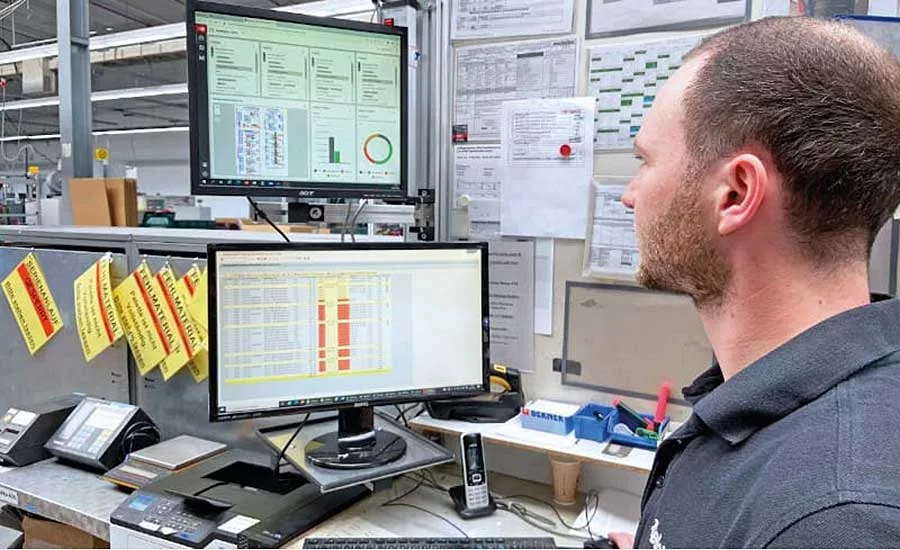
WeASSIST hardware and software is quickly deployed. The technology can easily be retrofit into existing structures. “Because it is a cloud solution, you can always stay on top of things from anywhere using any devices,” says Weißhaar. “I can immediately see, by glancing at my smartphone, laptop or shift supervisor’s PC, which workstation needs help.”

The company implemented the technology at four of the 11 workstations in the cordless tool area. This initial implementation was so successful that three other workstations were equipped with WeASSIST.

“The WERMA solution met all our expectations,” says Weißhaar. “I was enthusiastic from the very first minute and still am. I hope we can use the system in other departments and areas.”

WeASSIST is a plug-and-play system for monitoring production and logistics processes. It is cloud-based, easy to install, retrofittable and scalable. Whether used on individual machines or entire systems, WeASSIST provides visibility into production—digitally and in real time. This helps engineers identify problems before they arise and to optimize processes.

“It is particularly great that the system consists of software and hardware,” says Weißhaar. “You get a single package, and you can get started right away.”

Weißhaar is pleased with the wide range of analysis and evaluation options. All relevant data is clearly displayed regardless of the source. Once the hardware is integrated into a machine or workstation, engineers configure the software and dashboards and assign roles and users. All integrated machines and workstations will immediately report their status directly to the software via a gateway. This allows problems to be identified right away and processes to be optimized constantly through analysis.

For more information on process optimization technology, visit www.werma.com.

KEYWORDS: flexible assembly flexible automation

Share This Story

Looking for a reprint of this article?
From high-res PDFs to custom plaques, order your copy today!

John has been with ASSEMBLY magazine since February 1997. John was formerly with a national medical news magazine, and has written for Pathology Today and the Green Bay Press-Gazette. John holds a B.A. in journalism from Northwestern University, Medill School of Journalism.

Recommended Content

JOIN TODAY
To unlock your recommendations.

Already have an account? Sign In

  • Made in the U.S.A.

    Consumer Products Manufacturing: Made in the USA

    Supply chain lessons learned during the coronavirus...
    Automated Assembly Systems
    By: Austin Weber
  • Best Practices for Press-Fit Assembly

    Best Practices for Press-Fit Assembly

    In manufacturing, ironclad formulas for success are hard...
    Assembly Presses
    By: Jim Camillo
  • aem0523leader-tesla1.jpg

    Tesla Rethinks the Assembly Line

    Engineers at Tesla Inc. have developed a new process that...
    Electrification
    By: Austin Weber
Manage My Account
  • eMagazine Subscription
  • Assembly Newsletters
  • Online Registration
  • Subscription Customer Service
  • Manage My Preferences

More Videos

Sponsored Content

Sponsored Content is a special paid section where industry companies provide high quality, objective, non-commercial content around topics of interest to the ASSEMBLY audience. All Sponsored Content is supplied by the advertising company and any opinions expressed in this article are those of the author and not necessarily reflect the views of ASSEMBLY or its parent company, BNP Media. Interested in participating in our Sponsored Content section? Contact your local rep!

close
  • ultrasonic welding
    Sponsored bySonobond Ultrasonics

    Engineering Efficiency in High-Performance Assembly: How Ultrasonic Welding Enhances Throughput, Reliability and Quality

  • UV curing system
    Sponsored byDymax

    Why UV Intensity Alone Doesn’t Define Curing Performance

  • wooden pallets
    Sponsored byLEAN Manufacturing Products

    Eliminating Waste on the Shop Floor: Applying Lean Principles to Improve Manufacturing Efficiency

Popular Stories

ASSEMBLY News Now, episode 30: Volvo Redesigns EV Manufacturing

Volvo Redesigns EV Manufacturing

ASSEMBLY News Now, Episode 29: Mercedes-Benz to Invest $4 billion in Alabama Assembly Plant

Mercedes-Benz to Invest $4 billion in Alabama Assembly Plant

Boeing CEO Kelly Ortberg announces 1 billion investment

Boeing Plans $1 Billion Wichita Investment, Workforce Training Center

Watch the latest episode of ANN now!

Events

July 24, 2025

From Shop Floor to CFO: How Manufacturers Are Closing the Loop Between Operations and Finance

On Demand Learn how manufacturers are bridging the gap between the shop floor and ERP systems to gain real-time visibility, streamline operations, and kick-start digital transformation—without waiting years.

Sponsored by:

PicoStratusGreen
July 30, 2025

Buffer Analysis and Design Fundamentals for Manufacturing Excellence

On Demand In this presentation, Dr. Herman Tang shares practical insights from his industry experience and research on buffer management in manufacturing operations.

View All Submit An Event

Poll

Difficult Assembly Processes

Which assembly process gives you the most difficulty?
View Results Poll Archive

Products

Manufacturing Cost Policy Deployment (MCPD) Profitability Scenarios: Systematic and Systemic Improvement of Manufacturing Costs

Manufacturing Cost Policy Deployment (MCPD) Profitability Scenarios: Systematic and Systemic Improvement of Manufacturing Costs

See More Products
Register for webinar - Modernizing Automotive Assembly: Why Upgrading Legacy MES is a Business Imperative

Related Articles

  • material handling system with two tiers for goods coming in and goods going out

    Automation Boosts Efficiency at Drive Manufacturer

    See More
  • New Material Boosts Efficiency of Solar Cells

    See More
  • magna4.jpg

    Mobile Computers Boost Efficiency at Magna

    See More

Related Products

See More Products
  • 0001349.jpeg

    Adhesion and Adhesives Technology 4e

  • Technology Of Machine Tools

  • investment.jpg

    Investment Decisions in Advanced Manufacturing Technology

See More Products

Related Directories

  • ATS Automation

×

Never miss the latest news and trends driving the manufacturing industry

Stay in the know on the latest assembly trends.

JOIN TODAY!
  • RESOURCES
    • Advertise
    • Contact Us
    • Directories
    • Manufacturing Division
    • Store
    • Want More?
  • SIGN UP TODAY
    • Create Account
    • eMagazine
    • Newsletters
    • Customer Service
    • Manage Preferences
  • SERVICES
    • Marketing Services
    • Reprints
    • Market Research
    • List Rental
    • Survey/Respondent Access
  • STAY CONNECTED
    • LinkedIn
    • Facebook
    • Instagram
    • YouTube
    • X (Twitter)
  • PRIVACY
    • PRIVACY POLICY
    • TERMS & CONDITIONS
    • DO NOT SELL MY PERSONAL INFORMATION
    • PRIVACY REQUEST
    • ACCESSIBILITY

Copyright ©2026. All Rights Reserved BNP Media, Inc. and BNP Media II, LLC.

Design, CMS, Hosting & Web Development :: ePublishing