Adhesives and Dispensing
The Sticky Business of Adhesive Sourcing and Replacement
The process of identifying alternative sources for adhesives is more complex than that for other assembly components.
Manufacturers in nearly every industry have dealt with numerous supply chain disruptions over the past several years. Identifying alternative sources for materials and parts is necessary for any company trying to limit the ramifications of these disruptions.
In most cases, finding a second source for some parts, such as fasteners, is fairly straightforward. Screws, nuts and bolts are typically commodity products and readily available from myriad suppliers.
The process is more complicated with adhesives, however, since adhesive performance varies broadly depending on the base chemistry and specific formulation. Finding the optimal balance of properties for each application is therefore key when sourcing adhesive products. However, this process can be challenging for companies that do not have personnel with a background in chemistry or a thorough understanding of adhesive formulations.
A manufacturer of architectural products ran into these challenges when it saw demand increase significantly due to the COVID-19 pandemic, and its long-standing overseas adhesive supplier could not keep up. Lacking the internal resources to identify a viable second adhesive source, the company turned to the ChemQuest Technology Institute (CQTI) for assistance.
Benchmarking Roadblocks
The first step in determining a suitable second source is often to study the performance of the existing product. In this case, benchmark test data were not available, and specifications for test methods and performance properties were limited. The client had been successfully using the existing single-source adhesive for some time and had not felt the need to perform tests to validate the adhesive’s performance.
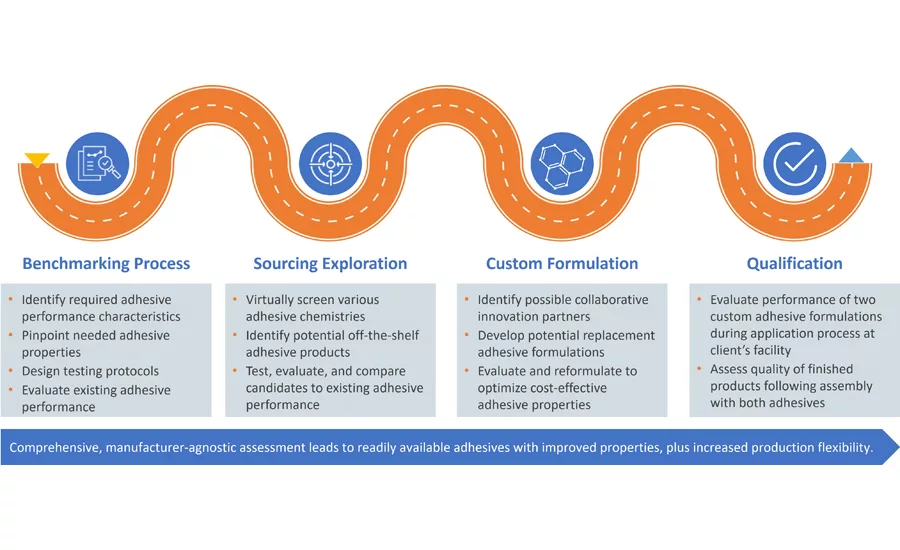
As a result, CQTI’s first task was to identify and design testing procedures that would enable us to benchmark the adhesive’s characteristics and performance. Our team determined the tests needed based on the adhesive’s performance requirements. For this application, it was important that the adhesive formulation be 100 percent solids (i.e., contain no solvents) and that it could be sprayed at a defined ratio.
Rheology was a highly significant property as well, for numerous reasons. Rheology is a measure of a material’s flow characteristics; thinner materials flow more readily than those that are thicker (think water vs. syrup). The rheology of this particular adhesive formulation needed to be thin enough to be sprayable, but thick enough to remain on the substrate without dripping.
Looking for quick answers on assembly and manufacturing topics? Try Ask ASM, our new smart AI search tool. Ask ASM
An adhesive’s open time refers to the amount of time it takes for the adhesive to begin to form a solid as it cures. For example, cyanoacrylates typically have short open times. Anyone who has inadvertently glued their fingers together knows that these products cure exceptionally quickly.
While a fast cure can be of benefit in numerous applications, longer open times are often necessary in multistep manufacturing operations. If an adhesive cures too quickly, it might not be able to appropriately wet the substrate as the part is assembled, which is necessary to create a full chemical bond. On the other hand, assembly operations often require parts to be manipulated or moved to another area of the facility after they are bonded. If the adhesive’s open time is too long, the parts will simply fall apart.
Tailoring an adhesive’s open time can be a delicate balance. For this manufacturer’s application, the ideal open time was 45 minutes. This means that the assembled component can be handled 45 minutes after the adhesive has been applied and the sections bonded together.
Since this manufacturer produces architectural components, the adhesive’s strength and durability were also key. The CQTI team discovered that traditional testing protocols were not sufficient to measure the adhesive’s performance in this application, so we designed and fabricated a new test device that more accurately reflected the mode of failure.
Second-Source Exploration
Once the team completed testing to benchmark the existing adhesive product, we turned to the client’s original sourcing objective. The first step was a virtual screening process, wherein numerous adhesive chemistries were considered with respect to the needs of the specific application. Depth of knowledge and experience were key in this phase, as an educated perspective reduces both time and cost requirements by narrowing down the potential chemistries without the need to perform broad testing.
After determining the ideal type of chemistry, the CQTI team investigated numerous suppliers of off-the-shelf adhesives to explore which could potentially meet the requirements of the client’s application. Some suppliers were suggested by the client, while others were considered good possibilities based on CQTI’s knowledge of the industry.
The adhesives that were determined to be a possible fit were put through the same testing procedures developed for the existing adhesive. Unfortunately, the results showed that none had the balance of properties needed for optimal performance in the application.
Custom Formulation Development
The need for a custom adhesive formulation became clear following the numerous unsuccessful tests of existing commercial adhesives. During this phase of the project, CQTI reached out to known adhesive manufacturers, as well as a coatings producer with expertise in the desired chemistry, to gauge their interest in taking on this technology development project.
Throughout a comprehensive collaborative innovation process led by CQTI, two companies developed multiple formulations in the quest to reach the best balance of finished properties while also addressing cost concerns. As a result, two adhesive formulations will soon go into field trials at the client’s facility. CQTI will evaluate both products’ properties during the application process, as well as the resulting quality of the client’s end products when assembled with both adhesives, to ensure suitability.
During the course of this project, CQTI also conducted additional evaluations on adhesive pump systems, with the goal of providing the client with added flexibility during the application process. The team was able to identify a customizable commercial system that will enable the operator to change from one adhesive to another without being limited by a specific mix ratio.
Unbiased Answers
Though the client’s initial request for assistance in determining a second adhesive source was not as straightforward as it first appeared, the comprehensive, manufacturer-agnostic, third-party exploration of numerous options will provide long-term benefits. The CQTI team was able to pinpoint two nearby sources of the adhesive, alleviating supply chain constraints and streamlining operations.
In addition, testing showed that both new custom adhesive formulations outperform the existing adhesive product. Following field trials, we anticipate that the company’s products will benefit from increased reliability and higher strength.
To learn more, email me at dcorrigan@chemquest.com or visit https://chemquest.com.Looking for a reprint of this article?
From high-res PDFs to custom plaques, order your copy today!