Assembly Magazine logo
search
Ask ASSEMBLY AI
cart
facebook twitter linkedin youtube
  • Sign In
  • Create Account
  • Sign Out
  • My Account
Assembly Magazine logo
  • TRENDS
    • Ask ASSEMBLY AI
    • Trends
    • News
    • New Products
  • INDUSTRIES
    • Aerospace
    • Appliance
    • DFMA Assembly
    • Medical Devices
    • Green Manufacturing
    • Lean Manufacturing
    • Machinery Assembly
    • Electronics Assembly
    • Automotive
  • TECHNOLOGIES
    • Adhesives & Dispensing
    • Assembly Presses
    • Automated Assembly Systems
    • Manufacturing Management
    • Manufacturing Software
    • Motion Control
    • Screwdriving & Riveting
    • Robotics
    • Test & Inspection
    • Plastics & Metal Welding
    • Wire Processing
    • Workstations
  • AUTONOMOUS & ELECTRIC MOBILITY
    • AEM Magazine Archives
    • Autonomy
    • Electrification
    • Mobility Services
    • Assembly & Testing
    • AV/EM News
  • MEDIA
    • Ask ASSEMBLY AI
    • Podcasts
    • Assembly News Now
    • Assembly TV
    • Webinars
    • eBooks
  • EVENTS
    • Calendar
    • The ASSEMBLY Show
  • MORE
    • Exclusives >
      • Plant of the Year
      • Capital Spending
    • Buyers Guide >
      • Supplier Insights
    • Classifieds
    • Featured Products
    • Newsletters
    • Store
    • White Papers
    • Columns
    • Sponsor Insights
  • INFOCENTER
    • Assembly & Test Solutions
  • EMAGAZINE
    • eMagazine
    • Archive Issues
    • Advertise
    • Contact Us
    • Sign Up
IndustriesAutonomous & Electric MobilityAerospace AssemblyElectrification

Air Taxi Batteries Demand Unique Power Densities for Safe Operation
By Austin Weber
aem0524tech1.jpg

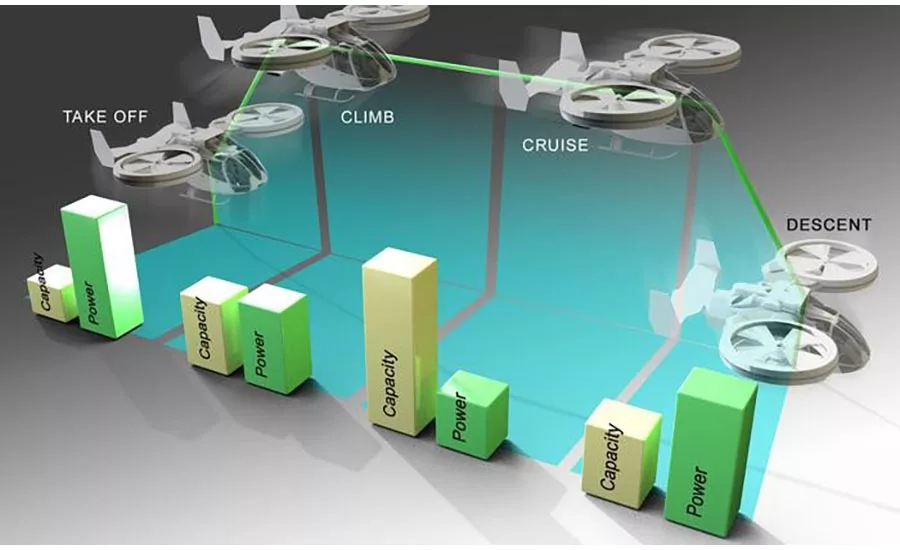
The operating phases of an eVTOL need varying amounts of power. Some require the battery to discharge high amounts of current rapidly, reducing the distance an aircraft can travel before its battery must be recharged.

Illustration courtesy Oak Ridge National Laboratory

May 27, 2024

Electric vertical takeoff and landing (eVTOL) aircraft are one of the hottest segments of the aerospace industry, with legacy manufacturers and startups scrambling to develop a variety of urban air taxis and delivery drones. The new breed of vehicles are designed to rise into the air like a helicopter and fly using wing-borne lift like an airplane.

Compared with helicopters, eVTOLs generally use more rotors spinning at a lower speed, making them both safer and quieter. However, developing lightweight, yet powerful batteries is a big challenge.

According to engineers tackling the issue at Oak Ridge National Laboratory (ORNL), eVTOL batteries can’t just be adapted from electric car batteries, as some people think. So, they are evaluating how lithium-ion batteries fare under extremely high power draw, and developing new energy-dense materials and control systems.

“eVTOLs present a unique opportunity for creating a brand new type of battery with very different requirements and capabilities than what we have seen before," says Ilias Belharouak, Ph.D., head of the electrification section at ORNL. “This requires us to answer questions about the interplay of battery safety, cycle life and stability at high temperatures, while balancing the need for short bursts of high power with energy reserves for longer-range flight.”

According to Belharouak, the power and performance demands for eVTOL batteries can significantly reduce their longevity and durability. Unlike electric car batteries, which typically drain at a steady rate, eVTOL batteries need varying amounts of power for flight stages such as climbing, hovering and descent, with some phases requiring high bursts of power.

Belharouak and his colleagues recently made lithium-ion batteries at ORNL’s Battery Manufacturing Facility and ran them through simulated climb stages of eVTOL aircraft. They studied what happens inside the battery during cycling, including how much energy is rapidly accessible during the demanding takeoff phase. Afterwards, they tested the battery materials for corrosion and other chemical or structural changes.

As they push the limits for battery power, payload and safety, the engineers are also working on further improvements to the electrolyte and other battery components. Recent experiments involved collecting real-world data from drone flights over the lab’s campus, then using that information to develop a customized profile of the load and draw on the battery. Batteries made at ORNL were then run through the same cycles.


Looking for quick answers on assembly and manufacturing topics? Try Ask ASM, our new smart AI search tool. Ask ASM →

KEYWORDS: air taxi battery technology electric aircraft

Share This Story

Looking for a reprint of this article?
From high-res PDFs to custom plaques, order your copy today!

Austinweber headshot
Austin has been senior editor for ASSEMBLY Magazine since September 1999. He has more than 21 years of b-to-b publishing experience and has written about a wide variety of manufacturing and engineering topics. Austin is a graduate of the University of Michigan.

Recommended Content

JOIN TODAY
To unlock your recommendations.

Already have an account? Sign In

  • Made in the U.S.A.

    Consumer Products Manufacturing: Made in the USA

    Supply chain lessons learned during the coronavirus...
    Automated Assembly Systems
    By: Austin Weber
  • Best Practices for Press-Fit Assembly

    Best Practices for Press-Fit Assembly

    In manufacturing, ironclad formulas for success are hard...
    Assembly Presses
    By: Jim Camillo
  • aem0523leader-tesla1.jpg

    Tesla Rethinks the Assembly Line

    Engineers at Tesla Inc. have developed a new process that...
    Electrification
    By: Austin Weber
Manage My Account
  • eMagazine Subscription
  • Assembly Newsletters
  • Online Registration
  • Subscription Customer Service
  • Manage My Preferences

More Videos

Sponsored Content

Sponsored Content is a special paid section where industry companies provide high quality, objective, non-commercial content around topics of interest to the ASSEMBLY audience. All Sponsored Content is supplied by the advertising company and any opinions expressed in this article are those of the author and not necessarily reflect the views of ASSEMBLY or its parent company, BNP Media. Interested in participating in our Sponsored Content section? Contact your local rep!

close
  • ultrasonic welding
    Sponsored bySonobond Ultrasonics

    Engineering Efficiency in High-Performance Assembly: How Ultrasonic Welding Enhances Throughput, Reliability and Quality

  • UV curing system
    Sponsored byDymax

    Why UV Intensity Alone Doesn’t Define Curing Performance

  • wooden pallets
    Sponsored byLEAN Manufacturing Products

    Eliminating Waste on the Shop Floor: Applying Lean Principles to Improve Manufacturing Efficiency

Popular Stories

ASSEMBLY News Now, episode-30: Volvo Redesigns EV Manufacturing

Volvo Redesigns EV Manufacturing

Boeing CEO Kelly Ortberg announces 1 billion investment

Boeing Plans $1 Billion Wichita Investment, Workforce Training Center

GE Appliances Worker on Line

GE Appliances Expands Factory AI With 800 Gemini Enterprise Agents

Watch the latest episode of ANN now!

Events

July 24, 2025

From Shop Floor to CFO: How Manufacturers Are Closing the Loop Between Operations and Finance

On Demand Learn how manufacturers are bridging the gap between the shop floor and ERP systems to gain real-time visibility, streamline operations, and kick-start digital transformation—without waiting years.

Sponsored by:

PicoStratusGreen
July 30, 2025

Buffer Analysis and Design Fundamentals for Manufacturing Excellence

On Demand In this presentation, Dr. Herman Tang shares practical insights from his industry experience and research on buffer management in manufacturing operations.

View All Submit An Event

Poll

Difficult Assembly Processes

Which assembly process gives you the most difficulty?
View Results Poll Archive

Products

Manufacturing Cost Policy Deployment (MCPD) Profitability Scenarios: Systematic and Systemic Improvement of Manufacturing Costs

Manufacturing Cost Policy Deployment (MCPD) Profitability Scenarios: Systematic and Systemic Improvement of Manufacturing Costs

See More Products
Register for webinar - Modernizing Automotive Assembly: Why Upgrading Legacy MES is a Business Imperative

Related Articles

  • Lilium.jpg

    GKN to Provide Electrical System for Lilium Air Taxi

    See More
  • Joby has begun manufacturing air taxi propellor blades at its factory in Dayton, OH.

    Joby Begins Producing Air Taxi Propeller Blades in Ohio

    See More
  • Archerplant.jpg

    Archer Aviation Completes Construction of Air Taxi Assembly Plant

    See More

Related Products

See More Products
  • strong.jpg

    Strong Supply Chains Through Resilient Operations: Five Principles for Leaders to Win in a Volatile World

  • design.jpg

    Design for Manufacturability, 2nd Edition

See More Products

Events

View AllSubmit An Event
  • September 16, 2025

    From Paper Chaos to Digital Clarity: Unlocking the Power of Audit-Proof Data in Manufacturing

    On Demand Learn how digitization enables compliance, analytics, dashboards, and even AI-driven insights.Sponsored by:
View AllSubmit An Event

Related Directories

  • PowerSafe Automation

×

Never miss the latest news and trends driving the manufacturing industry

Stay in the know on the latest assembly trends.

JOIN TODAY!
  • RESOURCES
    • Advertise
    • Contact Us
    • Directories
    • Manufacturing Division
    • Store
    • Want More?
  • SIGN UP TODAY
    • Create Account
    • eMagazine
    • Newsletters
    • Customer Service
    • Manage Preferences
  • SERVICES
    • Marketing Services
    • Reprints
    • Market Research
    • List Rental
    • Survey/Respondent Access
  • STAY CONNECTED
    • LinkedIn
    • Facebook
    • Instagram
    • YouTube
    • X (Twitter)
  • PRIVACY
    • PRIVACY POLICY
    • TERMS & CONDITIONS
    • DO NOT SELL MY PERSONAL INFORMATION
    • PRIVACY REQUEST
    • ACCESSIBILITY

Copyright ©2026. All Rights Reserved BNP Media, Inc. and BNP Media II, LLC.

Design, CMS, Hosting & Web Development :: ePublishing