Assembly Magazine logo
search
Ask ASSEMBLY AI
cart
facebook twitter linkedin youtube
  • Sign In
  • Create Account
  • Sign Out
  • My Account
Assembly Magazine logo
  • TRENDS
    • Ask ASSEMBLY AI
    • Trends
    • News
    • New Products
  • INDUSTRIES
    • Aerospace
    • Appliance
    • DFMA Assembly
    • Medical Devices
    • Green Manufacturing
    • Lean Manufacturing
    • Machinery Assembly
    • Electronics Assembly
    • Automotive
  • TECHNOLOGIES
    • Adhesives & Dispensing
    • Assembly Presses
    • Automated Assembly Systems
    • Manufacturing Management
    • Manufacturing Software
    • Motion Control
    • Screwdriving & Riveting
    • Robotics
    • Test & Inspection
    • Plastics & Metal Welding
    • Wire Processing
    • Workstations
  • AUTONOMOUS & ELECTRIC MOBILITY
    • AEM Magazine Archives
    • Autonomy
    • Electrification
    • Mobility Services
    • Assembly & Testing
    • AV/EM News
  • MEDIA
    • Ask ASSEMBLY AI
    • Podcasts
    • Assembly News Now
    • Assembly TV
    • Webinars
    • eBooks
  • EVENTS
    • Calendar
    • The ASSEMBLY Show
  • MORE
    • Exclusives >
      • Plant of the Year
      • Capital Spending
    • Buyers Guide >
      • Supplier Insights
    • Classifieds
    • Featured Products
    • Newsletters
    • Store
    • White Papers
    • Columns
    • Sponsor Insights
  • INFOCENTER
    • Assembly & Test Solutions
  • EMAGAZINE
    • eMagazine
    • Archive Issues
    • Advertise
    • Contact Us
    • Sign Up

Chicago Once Ruled the Bike World
By Austin Weber
085.jpg
July 15, 2021

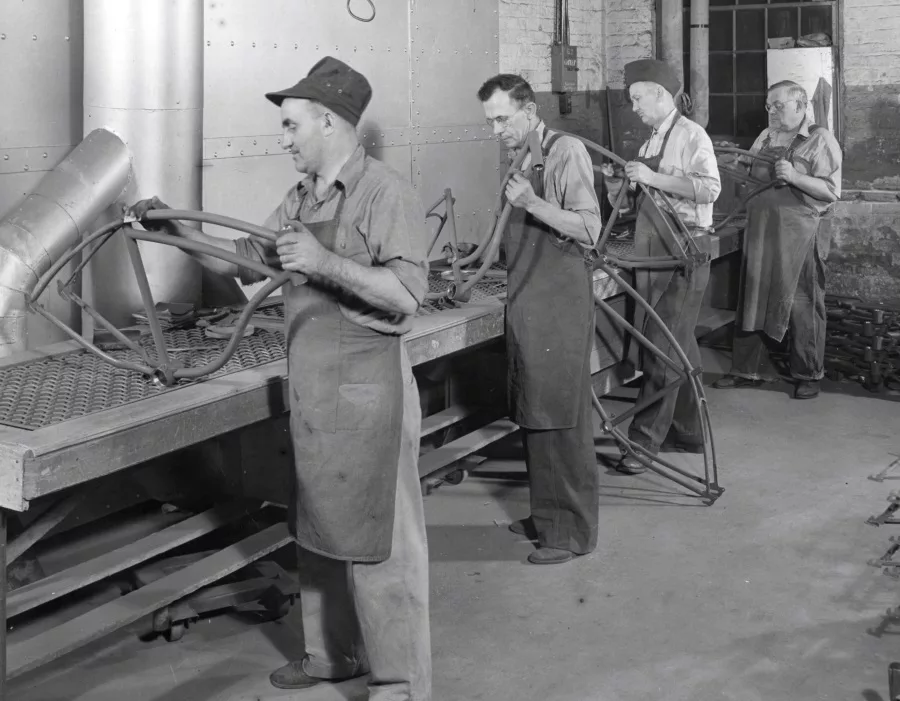
A century ago, the West Side of Chicago was the epicenter of the bicycle manufacturing world. From the early 1880s to the early 1980s, Windy City companies mass-produced bikes in all colors, shapes and sizes. In fact, for most of the 20th century, more than two-thirds of all bikes sold in the United States were assembled in Chicago.

One of the first companies in the industry, Loring & Keene (a former manufacturer of water pipes), began producing a new-fangled contraption called a “velocipede” in 1869. By the 1890s, a stretch of Lake Street was known locally as “bicycle row,” because it was home to more than 40 manufacturers. In 1897, 88 Chicago companies were producing 250,000 bikes annually.

Many factories were small operations, but several became large enterprises that pioneered mass-production techniques eventually adopted by the auto industry. The Gormully & Jeffery Manufacturing Co. was one of the largest bicycle producers in America between 1878 and 1900. It was run by R. Philip Gormully and Thomas Jeffery.

Originally, Gormully & Jeffery produced high-wheeled penny-farthings, but they eventually developed a successful line of “safety” bicycles under the Rambler brand name. The company was acquired by the American Bicycle Co. in 1900.

Two year later, Thomas Jeffery became an early pioneer in the U.S. auto industry when he began making Rambler runabouts at a factory 50 miles north of Chicago in Kenosha, WI. Through a series of mergers and acquisitions, Jeffery’s company eventually morphed into American Motors and Chrysler.

Another innovative manufacturer was Western Wheel Works, which at one time operated the world’s largest bicycle factory on the North Side of Chicago. During the 1890s, the company pioneered mass-production techniques, such as sheet metal stamping and electric resistance welding. Western Wheel Works was the first American bike company to assemble its products, including the best-selling Crescent brand, out of stamped metal parts.

For decades, the king of the bike world was Arnold, Schwinn & Co. The company was established in 1895 by a young German bicycle maker named Ignaz Schwinn who immigrated to America in the early 1890s and settled in Chicago.

Looking for quick answers on assembly and manufacturing topics? Try Ask ASM, our new smart AI search tool. Ask ASM →

Schwinn perfected the art of brazing and welding tubular steel to make sturdy, lightweight frames. That attention to quality, combined with eye-catching designs, an unmatched marketing prowess and a vertically integrated supply chain, helped the company dominate the bike industry. By 1950, one in every four bicycles sold in the U.S. was a Schwinn. The company produced 1 million bikes in 1968. However, the last Chicago-built Schwinn was made in 1982.

Other manufacturers that once mass-produced bicycles in Chicago included Adams & Westlake, Arrow, Excelsior, Kenwood, Manton & Smith, Mead Cycle, Monarch, Monark Silver King and Sterling Cycle Works. Today, many of their products are prized by collectors.

To view photos of Schwinn’s assembly line and learn more about other bike factories that made Chicago a production powerhouse, see Made in Chicago: The Windy City’s Manufacturing Heritage.

KEYWORDS: bicycle manufacturing Chicago manufacturing made in the USA manufacturing history

Share This Story

Looking for a reprint of this article?
From high-res PDFs to custom plaques, order your copy today!

Austinweber headshot
Austin has been senior editor for ASSEMBLY Magazine since September 1999. He has more than 21 years of b-to-b publishing experience and has written about a wide variety of manufacturing and engineering topics. Austin is a graduate of the University of Michigan.

Recommended Content

JOIN TODAY
To unlock your recommendations.

Already have an account? Sign In

  • Made in the U.S.A.

    Consumer Products Manufacturing: Made in the USA

    Supply chain lessons learned during the coronavirus...
    Automated Assembly Systems
    By: Austin Weber
  • Best Practices for Press-Fit Assembly

    Best Practices for Press-Fit Assembly

    In manufacturing, ironclad formulas for success are hard...
    Assembly Presses
    By: Jim Camillo
  • aem0523leader-tesla1.jpg

    Tesla Rethinks the Assembly Line

    Engineers at Tesla Inc. have developed a new process that...
    Automotive Assembly
    By: Austin Weber
Manage My Account
  • eMagazine Subscription
  • Assembly Newsletters
  • Online Registration
  • Subscription Customer Service
  • Manage My Preferences

More Videos

Sponsored Content

Sponsored Content is a special paid section where industry companies provide high quality, objective, non-commercial content around topics of interest to the ASSEMBLY audience. All Sponsored Content is supplied by the advertising company and any opinions expressed in this article are those of the author and not necessarily reflect the views of ASSEMBLY or its parent company, BNP Media. Interested in participating in our Sponsored Content section? Contact your local rep!

close
  • ultrasonic welding
    Sponsored bySonobond Ultrasonics

    Engineering Efficiency in High-Performance Assembly: How Ultrasonic Welding Enhances Throughput, Reliability and Quality

  • UV curing system
    Sponsored byDymax

    Why UV Intensity Alone Doesn’t Define Curing Performance

  • wooden pallets
    Sponsored byLEAN Manufacturing Products

    Eliminating Waste on the Shop Floor: Applying Lean Principles to Improve Manufacturing Efficiency

Popular Stories

Ferrari

Ferrari Unveils Four-Door EV

ASSEMBLY News Now, episode-30: Volvo Redesigns EV Manufacturing

Volvo Redesigns EV Manufacturing

workstation

Knife Maker Redesigns Assembly Line

Watch the latest episode of ANN now!

Events

July 24, 2025

From Shop Floor to CFO: How Manufacturers Are Closing the Loop Between Operations and Finance

On Demand Learn how manufacturers are bridging the gap between the shop floor and ERP systems to gain real-time visibility, streamline operations, and kick-start digital transformation—without waiting years.

Sponsored by:

PicoStratusGreen
July 30, 2025

Buffer Analysis and Design Fundamentals for Manufacturing Excellence

On Demand In this presentation, Dr. Herman Tang shares practical insights from his industry experience and research on buffer management in manufacturing operations.

View All Submit An Event

Poll

Difficult Assembly Processes

Which assembly process gives you the most difficulty?
View Results Poll Archive

Products

Manufacturing Cost Policy Deployment (MCPD) Profitability Scenarios: Systematic and Systemic Improvement of Manufacturing Costs

Manufacturing Cost Policy Deployment (MCPD) Profitability Scenarios: Systematic and Systemic Improvement of Manufacturing Costs

See More Products
ebook

Related Articles

  • 2019-11-05-15-36-16-01.jpg

    Stewart-Warner Was Once the 'King' of the Dashboard

    See More
  • Engineers Take the Spotlight in Chicago and Milwaukee

    See More
  • access-1921_ford_model_t_coupe_neg_31830.jpg

    How the Model T Was Assembled in Chicago

    See More

Related Products

See More Products
  • Kaizen Assembly: Designing, Constructing, and Managing a Lean Assembly Line

  • strong.jpg

    Strong Supply Chains Through Resilient Operations: Five Principles for Leaders to Win in a Volatile World

  • foreman.jpg

    The Foreman on the Assembly Line

See More Products
×

Never miss the latest news and trends driving the manufacturing industry

Stay in the know on the latest assembly trends.

JOIN TODAY!
  • RESOURCES
    • Advertise
    • Contact Us
    • Directories
    • Manufacturing Division
    • Store
    • Want More?
  • SIGN UP TODAY
    • Create Account
    • eMagazine
    • Newsletters
    • Customer Service
    • Manage Preferences
  • SERVICES
    • Marketing Services
    • Reprints
    • Market Research
    • List Rental
    • Survey/Respondent Access
  • STAY CONNECTED
    • LinkedIn
    • Facebook
    • Instagram
    • YouTube
    • X (Twitter)
  • PRIVACY
    • PRIVACY POLICY
    • TERMS & CONDITIONS
    • DO NOT SELL MY PERSONAL INFORMATION
    • PRIVACY REQUEST
    • ACCESSIBILITY

Copyright ©2026. All Rights Reserved BNP Media, Inc. and BNP Media II, LLC.

Design, CMS, Hosting & Web Development :: ePublishing