Where to Locate EV Assembly Plants
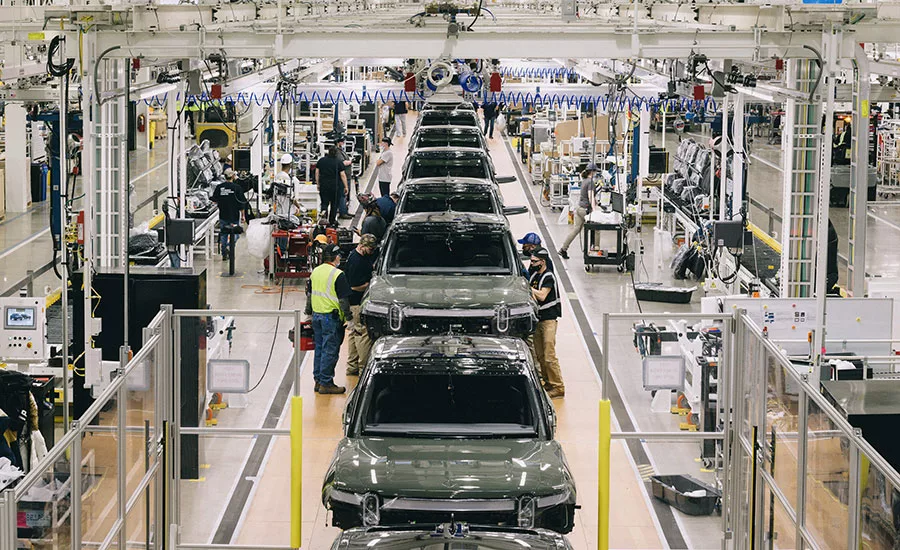
Rivian’s factory is one of a handful of facilities in North America that only produce electric vehicles. Photo courtesy Rivian Automotive Inc.
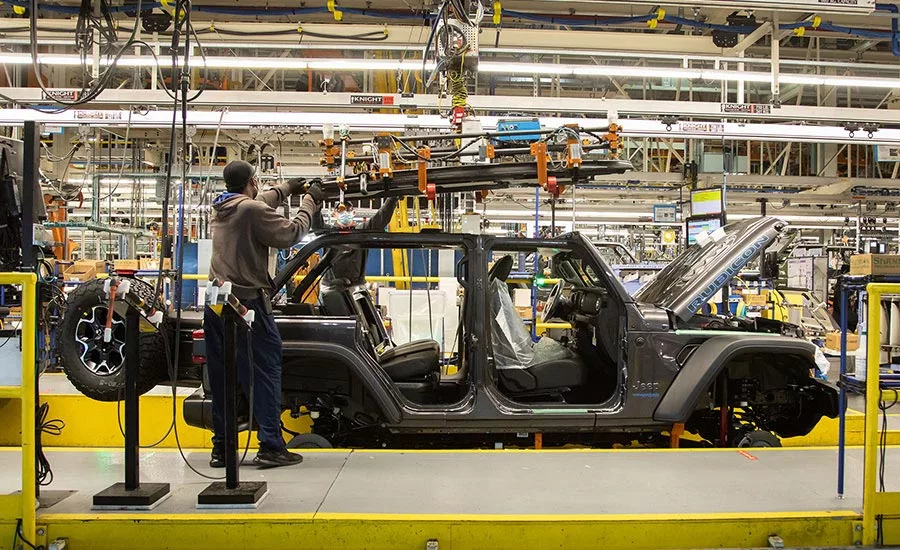
Most legacy automakers are reconfiguring their existing facilities to accommodate a larger variety of different power trains. Photo courtesy Stellantis
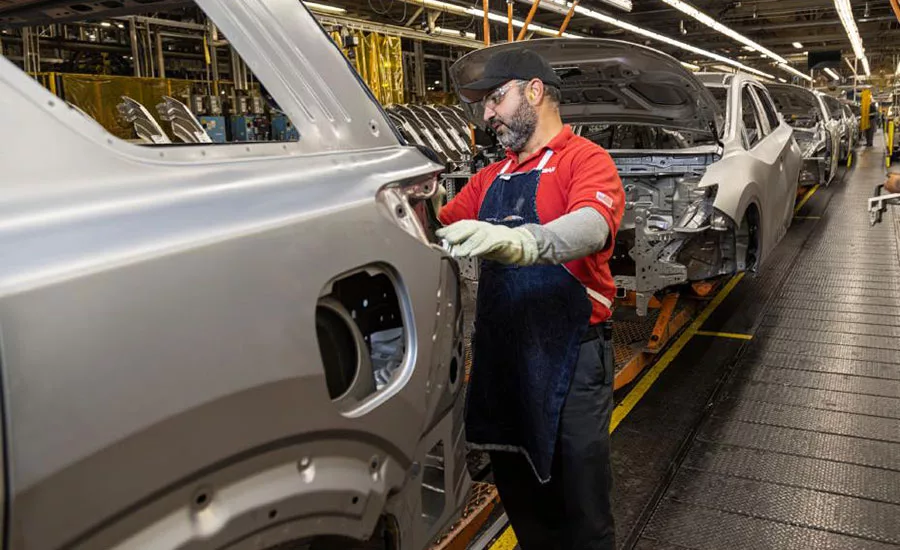
Many automakers operate flexible factories that can assemble a mix of different power trains. Photo courtesy Nissan Motor Corp.
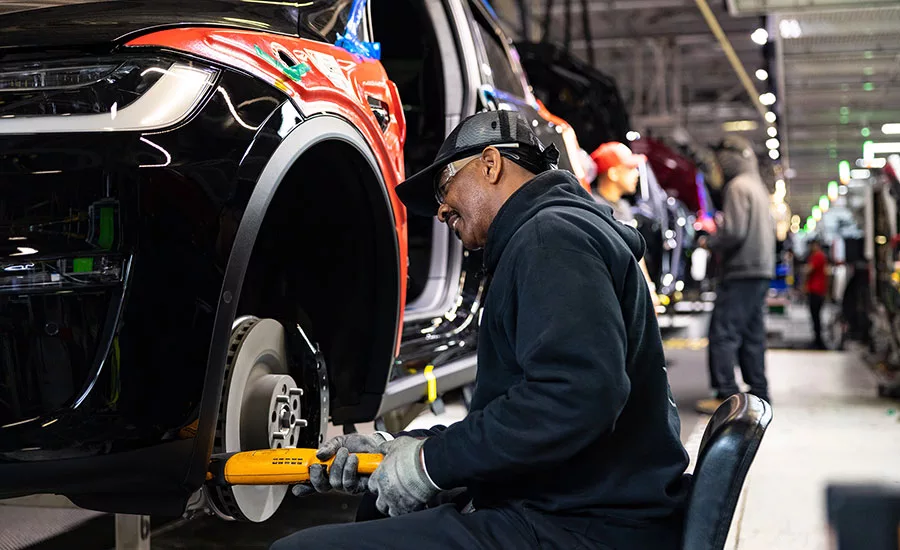
Tesla is one of the only automakers that does not have a presence in Auto Alley. Photo courtesy Tesla Inc.
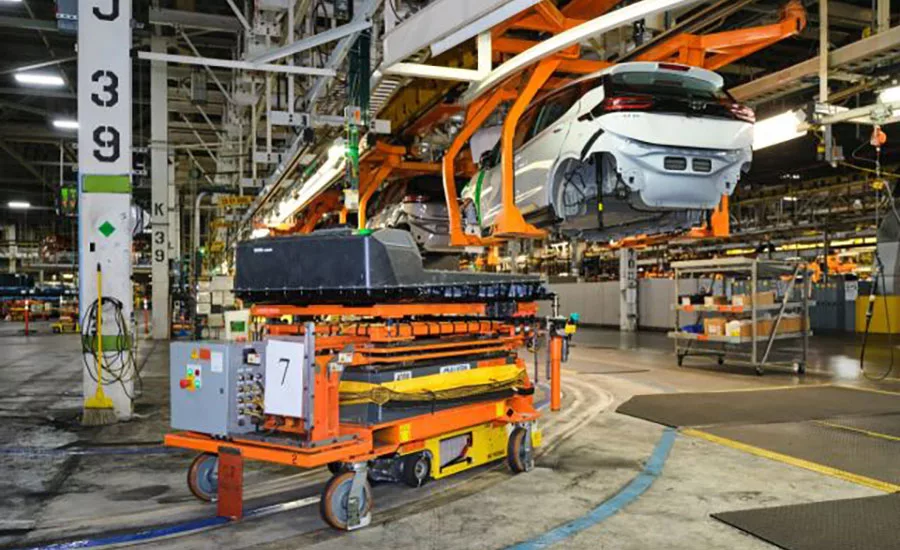
Over the next five years, there will be very little change to the geographic footprint of light vehicle production in North America. Photo courtesy General Motors
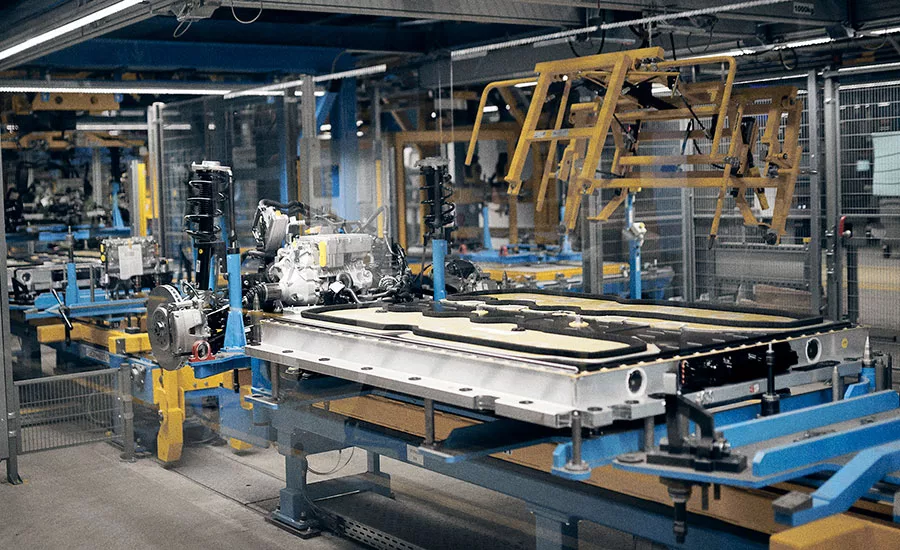
Battery pack assembly facilities tend to be located near vehicle final assembly plants. Photo courtesy Ford Motor Co.
Served by the Federal Reserve Bank of Chicago, the Seventh Federal Reserve District comprises Iowa and most of Illinois, Indiana, Michigan and Wisconsin. Because the auto industry is a major contributor to the district’s economy, the Chicago Fed closely monitors the economic impact of everything from technological advancements to labor-management relations. Part of that effort includes conducting research on manufacturing trends, issues and challenges.
The Chicago Fed recently published a study examining how the shift to electric vehicles will impact automakers and suppliers over the next decade. Economists used detailed forecasts for light vehicle assembly, as well as engine and battery production, through 2029 to explore the possible changes to the auto industry’s footprint across North America.
In their analysis, economists distinguished light vehicles with a plug (battery electric vehicles, plus plug-in hybrids) from those without one (vehicles with internal combustion engines, as well as hybrids).
In 2022, the Chicago Fed released a companion report entitled “North America’s Rapidly Growing Electric Vehicle Market: Implications for the Geography of Automotive Production.”
Both studies were conducted under the auspices of Thomas Klier, Ph.D., a senior economist and economic advisor in the Economic Research Department at the Federal Reserve Bank of Chicago. He co-authored both reports along with James Rubenstein, Ph.D., professor emeritus of geography at Miami University.
Klier’s research focuses on the effects of changes in manufacturing technology, the spatial distribution of economic activity and regional economic development, including the changing structure of the U.S. auto industry. Rubenstein’s work on the auto industry focuses on the changing geography of production in Europe and North America.
Autonomous and Electric Mobility recently asked Klier and Rubenstein to share some highlights from their most recent study and discuss how the domestic EV manufacturing landscape will unfold in the near future.
Looking for quick answers on assembly and manufacturing topics? Try Ask ASM, our new smart AI search tool. Ask ASM
AEM: What were the main takeaways from your recent study?
Klier: We analyzed data to predict where the auto industry is headed in the next five years. In this space, everything is changing with vehicle electrification. What we found in terms of changes to the production mix is not surprising. There’s a dramatic change already under way. While the production level is relatively stable, the composition is changing. The production of around 6 million ICE vehicles will be replaced with 6 million EV units in North America.
That change will not materially impact the assembly of light vehicles. That’s because most automakers will reconfigure their existing facilities to accommodate a larger variety of different power trains. They will be producing traditional ICE vehicles, in addition to battery electric vehicles, hybrid-electric vehicles and plug-in hybrids.
[M]ost automakers will reconfigure their existing facilities to accommodate a larger variety of different power trains.
The number of assembly plants that will make three variants will jump from 11 facilities in 2023 to 21 in 2029. That flexibility will help the industry avoid building a bunch of new plants. There will only be seven new light vehicles assembly plants opening between now and the end of the decade. The number of engine plants will not drop significantly. That’s because hybrids need both batteries and gas-powered engines.
Rubenstein: To guide our analysis, we relied on comprehensive production forecasts by S&P Global Mobility. The time horizon of those forecasts allowed us to look ahead along an expected path for the auto industry’s transition toward electrification over the medium term. There’s not going to be a dramatic change in the geographic production footprint. Any changes will be on a micro scale, not a macro scale.
However, the data supports a dramatic increase in battery cell and battery pack plants in North America. The logic behind where these plants are located is very similar to a traditional engine plant. Batteries are heavy objects that you don’t want to ship over large distances. The distances between battery plants and final assembly plants are remarkably similar to ICE plants are today.
AEM: What is “Auto Alley”?
Klier: Auto Alley is a North-South region from which companies can economically ship their products across the market. It stretches from Ontario, Canada, to Alabama, Mississippi and western Georgia. It includes northeastern Illinois, Indiana, Michigan, Ohio, Kentucky and Tennessee. Parts of North and South Carolina are also included.
The logic for locating a vehicle assembly plant is essentially unchanged over the last three to four decades. Today, one make and model is typically produced in only one location. Auto Alley is alive and well, and will be existence at least until the end of this decade. Despite all the turbulence affecting OEMs and suppliers, that production footprint logic still holds up. Any manufacturers thinking of setting up new assembly plants to build vehicles or components need to consider Auto Alley locations.
AEM: How many North American auto factories are currently assembling electric vehicles?
Rubenstein: Some plants are producing very minimal numbers. If we look at facilities that are assembling at least 10,000 pure electric vehicles annually, there are 13 plants. That includes facilities such as Ford’s Rouge Electric Vehicle Center in Dearborn, MI; General Motors’ Factory ZERO in Detroit; Rivian’s plant in Normal, IL; and Tesla’s factory in Austin, TX. If we look at facilities that are also producing plug-in hybrids, we’d have to add seven more plants. In 2029, there will be 57 plants producing light passenger electric vehicles in North America. However, many will be assembling a mix of ICE, battery and hybrid models.
AEM: Where will the seven new light passenger EV assembly plants be located in North America?
Klier: The facilities include Ford Motor Co.’s Blue Oval City in Stanton, TN; Kia Motors in West Pont, GA; Rivian in Stanton Spring, GA; Scout Motors in Blythwood, SC; Tesla in Monterrey, Mexico; and VinFast in Moncure, NC.
AEM: How many North American factories will be producing EV batteries in 2029?
Klier: There will be 28 battery cell plants and 28 battery pack plants. The vast majority of those facilities will be located in the United States. Many of those plants will be in close proximity to final assembly facilities. We calculate that in 2029, the median distance between pack plants and final assembly plants in North America is expected to be 284 miles. That distance is rather similar to the current median distance between engine plants and final assembly plants, which is 272 miles (it’s expected to be 222 miles in 2029).
Our analysis of S&P Global Mobility’s forecast data for 2029 indicates 56 percent of battery packs are expected to be made in final assembly plants and 36 percent in cell plants. We calculated the median distance between cell plants and pack plants to be only 40 miles, dramatically lower than the median distance between pack plants or engine plants and final assembly plants.
Rubenstein: We don’t find any examples of standalone battery module plants. They’re located either with battery cell plants or battery pack plants, or with both. Battery pack assembly facilities also rarely stand alone. They tend to be located with either battery cell plants or vehicle final assembly plants.
AEM: In terms of geography, will the auto industry undergo a “revolution” or an “evolution” over the next decade?
Klier: It will be an evolution. Last year, there were 74 light vehicle assembly facilities in operation in North America. The only one that is scheduled to close in the near future is the COMPAS plant, a joint-venture between Mercedes-Benz and Nissan in Aguascalientes, Mexico. Most of the new plants that will ramp up over the next five years are following the same location logic as facilities that already exist.
AEM: How will legacy automakers and start-ups be affected by the “evolution” taking place in the industry?
Klier: The challenges for incumbents and new entrants, which tend to be pure electric players, are different. The former have to figure out a path to switch out of something that’s profitable (ICE vehicles), but expected to decline in volume over the years ahead. It requires significant upfront investment, and a reconfiguration of internal practices and operations. For instance, the software-defined vehicle is a radical new concept for them.
Rubenstein: For legacy automakers, what we’re seeing in North America (and in Europe) is a convergence of existing assembly plants. It’s not cheap to convert a gas-engine vehicle production facility over to electric, but it’s not impossible. That convergence will help automakers avoid a dramatic EV over capacity, which is occurring in China. Unlike start-ups, legacy automakers have the ability to hedge their bets and constantly retweak their mix of ICE, EV and hybrid cars.
AEM: What will the geographic footprint of the auto industry look like in 2029?
Klier: What we learned suggests that there will be rather minimal changes to the industry’s footprint over the medium term. Existing vehicle assembly plants will be able to accommodate the production of vehicles featuring propulsion systems other than the internal combustion engine. One factor that’s driving the way the footprint is evolving is the fact that hybrids are growing. They need both a gas engine and a battery. Increased production of hybrid vehicles will likely further limit changes in the geography of motor vehicle production across North America.
Rubenstein: There will be very little material change to the footprint of light vehicle production in North America, despite that fact that just about everything else in the industry is going to change.
Looking for a reprint of this article?
From high-res PDFs to custom plaques, order your copy today!