Assembly Magazine logo
search
Ask ASSEMBLY AI
cart
facebook twitter linkedin youtube
  • Sign In
  • Create Account
  • Sign Out
  • My Account
Assembly Magazine logo
  • TRENDS
    • Ask ASSEMBLY AI
    • Trends
    • News
    • New Products
  • INDUSTRIES
    • Aerospace
    • Appliance
    • DFMA Assembly
    • Medical Devices
    • Green Manufacturing
    • Lean Manufacturing
    • Machinery Assembly
    • Electronics Assembly
    • Automotive
  • TECHNOLOGIES
    • Adhesives & Dispensing
    • Assembly Presses
    • Automated Assembly Systems
    • Manufacturing Management
    • Manufacturing Software
    • Motion Control
    • Screwdriving & Riveting
    • Robotics
    • Test & Inspection
    • Plastics & Metal Welding
    • Wire Processing
    • Workstations
  • AUTONOMOUS & ELECTRIC MOBILITY
    • AEM Magazine Archives
    • Autonomy
    • Electrification
    • Mobility Services
    • Assembly & Testing
    • AV/EM News
  • MEDIA
    • Ask ASSEMBLY AI
    • Podcasts
    • Assembly News Now
    • Assembly TV
    • Webinars
    • eBooks
  • EVENTS
    • Calendar
    • The ASSEMBLY Show
  • MORE
    • Exclusives >
      • Plant of the Year
      • Capital Spending
    • Buyers Guide >
      • Supplier Insights
    • Classifieds
    • Featured Products
    • Newsletters
    • Store
    • White Papers
    • Columns
    • Sponsor Insights
  • INFOCENTER
    • Assembly & Test Solutions
  • EMAGAZINE
    • eMagazine
    • Archive Issues
    • Advertise
    • Contact Us
    • Sign Up
IndustriesAutonomous & Electric MobilityAutomotive AssemblyAssembly and TestingAV/EM NewsElectrification

EV Production Boosts Auto Jobs
By Austin Weber
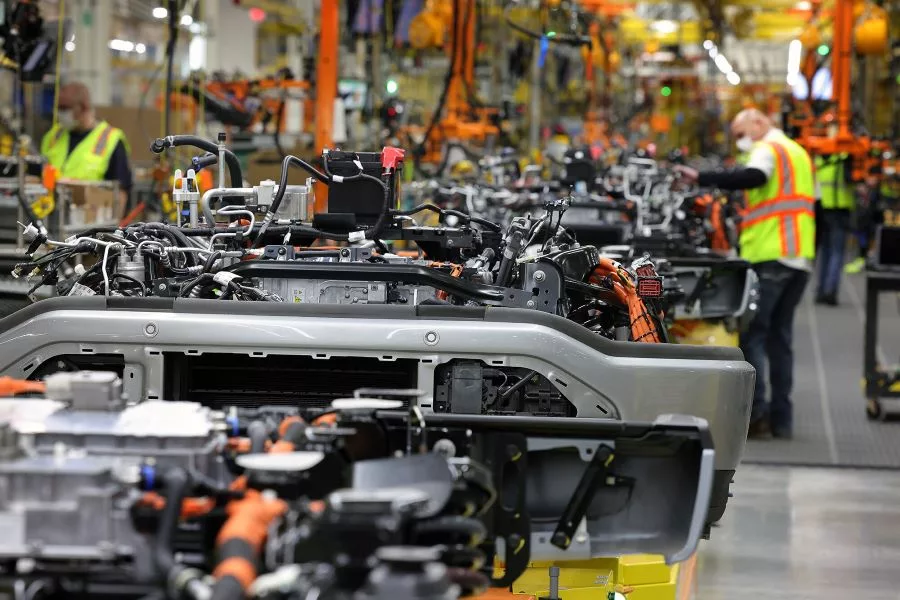
FordF150ev.jpg

Photo courtesy Michigan Engineering/Brenda Ahearn

September 15, 2024

ANN ARBOR, MI—Contrary to popular belief, electric vehicle production is not eliminating jobs in auto assembly plants. According to research conducted by the University of Michigan, U.S. factories producing EVs have required a larger workforce than traditional internal combustion engine facilities.

The recent study revealed that auto plants in the ramp-up stages of transitioning to full-scale EV production saw assembly jobs increase as much as 10 times. And, at one plant studied, the number of workers needed to make each vehicle has remained three times higher.

"There is a shortage of information out there about how the transition is shaping up," says Anna Stefanopoulou, Ph.D., a professor of mechanical engineering at the University of Michigan who conducted the study. "What we're seeing, with the data that's available, is that the loss of employment predicted for EVs is not happening."

Previous estimates of what EV manufacturing would mean for autoworkers depicted a 30 percent to 40 percent reduction—a loss of 200,000 jobs or more. According to Stefanopoulou, much of that miscalculation stems from the basic difference between electric- and gas-powered cars.

Electric vehicles require roughly 100 fewer parts than their ICE counterparts, and their power train designs are far simpler. Transmissions, exhaust and cooling systems are not part of the EV equation, so the expectation has been that assembly jobs would be lost. But, the recent U-M findings show the opposite.

Stefanopoulou believes that several factors are likely contributing to higher numbers of assembly workers at EV plants, including:

•    Investment in the development of new manufacturing technologies, which often requires more labor to improve.

•    Higher vehicle complexity. Companies beginning to manufacture EVs usually start out making premium vehicles with the most advanced features and technologies.

Looking for quick answers on assembly and manufacturing topics? Try Ask ASM, our new smart AI search tool. Ask ASM →

•    Some manufacturers have consolidated workers in a single, central location to lower costs from outsourcing.

Stefanopoulou and her colleagues studied three assembly plants that have transitioned from building only ICEs to EVs exclusively: General Motors, Orion Township, MI; Rivian Automotive Inc., Normal, IL (formerly a Mitsubishi facility); and Tesla Inc., Fremont, CA (formerly a GM-Toyota joint venture). They compiled two decades of data on the number of assembly workers at the three plants using public census data in the U.S., as well as production data from the Automotive News Research & Data Center.

While the research results clearly show that the number of assembly workers in the plants has increased in many cases, the jury is still out in terms of parts manufacturing jobs, which will largely depend on where battery cell manufacturing takes place.

Tesla's Fremont plant offers the longest stretch of EV production to study. Gabriel Ehrlich, Ph.D., an associate research scientist and director of U-M's Research Seminar in Quantitative Economics, believe there are important lessons to be gleaned from that facility’s data.

"The plant has been operating for 10 years now, and they've obviously been able to improve labor efficiency," notes Ehrlich. "But, the pace of improvement indicates that it can take up to 15 years for a plant to reach parity with its ICE predecessor. It's going to be a slow process; one that gives communities, companies and workers time to adjust."

KEYWORDS: electric car manufacturing electric vehicle manufacturing electric vehicles Jobs

Share This Story

Looking for a reprint of this article?
From high-res PDFs to custom plaques, order your copy today!

Austinweber headshot
Austin has been senior editor for ASSEMBLY Magazine since September 1999. He has more than 21 years of b-to-b publishing experience and has written about a wide variety of manufacturing and engineering topics. Austin is a graduate of the University of Michigan.

Recommended Content

JOIN TODAY
To unlock your recommendations.

Already have an account? Sign In

  • Made in the U.S.A.

    Consumer Products Manufacturing: Made in the USA

    Supply chain lessons learned during the coronavirus...
    Automated Assembly Systems
    By: Austin Weber
  • Best Practices for Press-Fit Assembly

    Best Practices for Press-Fit Assembly

    In manufacturing, ironclad formulas for success are hard...
    Assembly Presses
    By: Jim Camillo
  • aem0523leader-tesla1.jpg

    Tesla Rethinks the Assembly Line

    Engineers at Tesla Inc. have developed a new process that...
    Assembly and Testing
    By: Austin Weber
Manage My Account
  • eMagazine Subscription
  • Assembly Newsletters
  • Online Registration
  • Subscription Customer Service
  • Manage My Preferences

More Videos

Sponsored Content

Sponsored Content is a special paid section where industry companies provide high quality, objective, non-commercial content around topics of interest to the ASSEMBLY audience. All Sponsored Content is supplied by the advertising company and any opinions expressed in this article are those of the author and not necessarily reflect the views of ASSEMBLY or its parent company, BNP Media. Interested in participating in our Sponsored Content section? Contact your local rep!

close
  • ultrasonic welding
    Sponsored bySonobond Ultrasonics

    Engineering Efficiency in High-Performance Assembly: How Ultrasonic Welding Enhances Throughput, Reliability and Quality

  • UV curing system
    Sponsored byDymax

    Why UV Intensity Alone Doesn’t Define Curing Performance

  • wooden pallets
    Sponsored byLEAN Manufacturing Products

    Eliminating Waste on the Shop Floor: Applying Lean Principles to Improve Manufacturing Efficiency

Popular Stories

Ferrari

Ferrari Unveils Four-Door EV

ASSEMBLY News Now, episode-30: Volvo Redesigns EV Manufacturing

Volvo Redesigns EV Manufacturing

Robots working at Toyota Plant in Japan

Toyota Deploys Geekplus Robots for Factory Material Handling

Watch the latest episode of ANN now!

Events

July 24, 2025

From Shop Floor to CFO: How Manufacturers Are Closing the Loop Between Operations and Finance

On Demand Learn how manufacturers are bridging the gap between the shop floor and ERP systems to gain real-time visibility, streamline operations, and kick-start digital transformation—without waiting years.

Sponsored by:

PicoStratusGreen
July 30, 2025

Buffer Analysis and Design Fundamentals for Manufacturing Excellence

On Demand In this presentation, Dr. Herman Tang shares practical insights from his industry experience and research on buffer management in manufacturing operations.

View All Submit An Event

Poll

Difficult Assembly Processes

Which assembly process gives you the most difficulty?
View Results Poll Archive

Products

Manufacturing Cost Policy Deployment (MCPD) Profitability Scenarios: Systematic and Systemic Improvement of Manufacturing Costs

Manufacturing Cost Policy Deployment (MCPD) Profitability Scenarios: Systematic and Systemic Improvement of Manufacturing Costs

See More Products
ebook

Related Articles

  • NAFTA Math May Not Add Up to More US Auto Jobs

    See More
  • Softening Sales, Rising Automation Limit Auto Jobs Growth in Ohio

    See More
  • Michigan Loses 34% of Auto Jobs, Still Leads Nation

    See More

Related Products

See More Products
  • leaner

    Leaner Manufacturing: How to Make the Lean Production Process Easier, Faster, and More Cost-Effective

  • Kaizen Assembly: Designing, Constructing, and Managing a Lean Assembly Line

  • The Automotive Body Manufacturing Systems and Processes

See More Products

Related Directories

  • PennAuto

×

Never miss the latest news and trends driving the manufacturing industry

Stay in the know on the latest assembly trends.

JOIN TODAY!
  • RESOURCES
    • Advertise
    • Contact Us
    • Directories
    • Manufacturing Division
    • Store
    • Want More?
  • SIGN UP TODAY
    • Create Account
    • eMagazine
    • Newsletters
    • Customer Service
    • Manage Preferences
  • SERVICES
    • Marketing Services
    • Reprints
    • Market Research
    • List Rental
    • Survey/Respondent Access
  • STAY CONNECTED
    • LinkedIn
    • Facebook
    • Instagram
    • YouTube
    • X (Twitter)
  • PRIVACY
    • PRIVACY POLICY
    • TERMS & CONDITIONS
    • DO NOT SELL MY PERSONAL INFORMATION
    • PRIVACY REQUEST
    • ACCESSIBILITY

Copyright ©2026. All Rights Reserved BNP Media, Inc. and BNP Media II, LLC.

Design, CMS, Hosting & Web Development :: ePublishing