Manufacturing Software
How to Manage Multilevel Bills of Material
ERP software can facilitate the process of manufacturing large, complex assemblies.
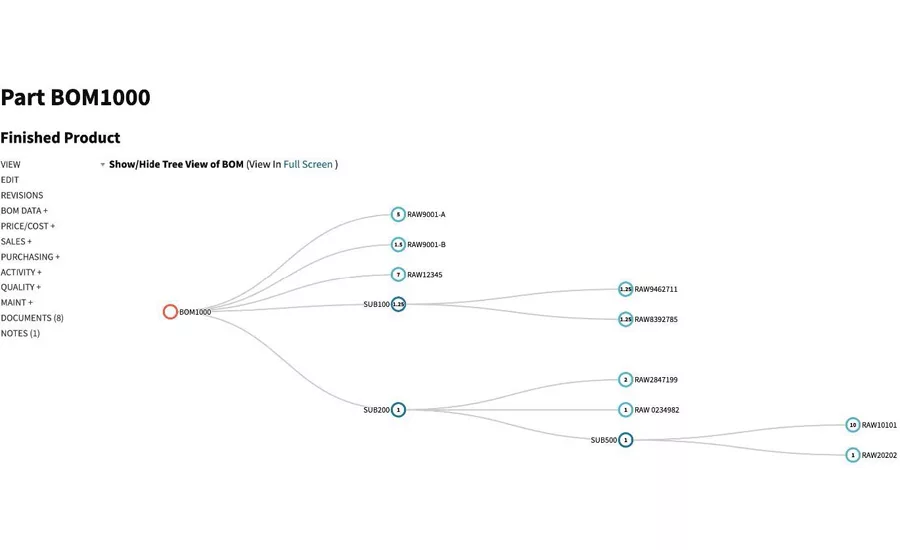
'BOM Tree View' of a sample multilevel, hierarchical (or indented) bill of materials modeled in an ERP system. Source: Cetec ERP
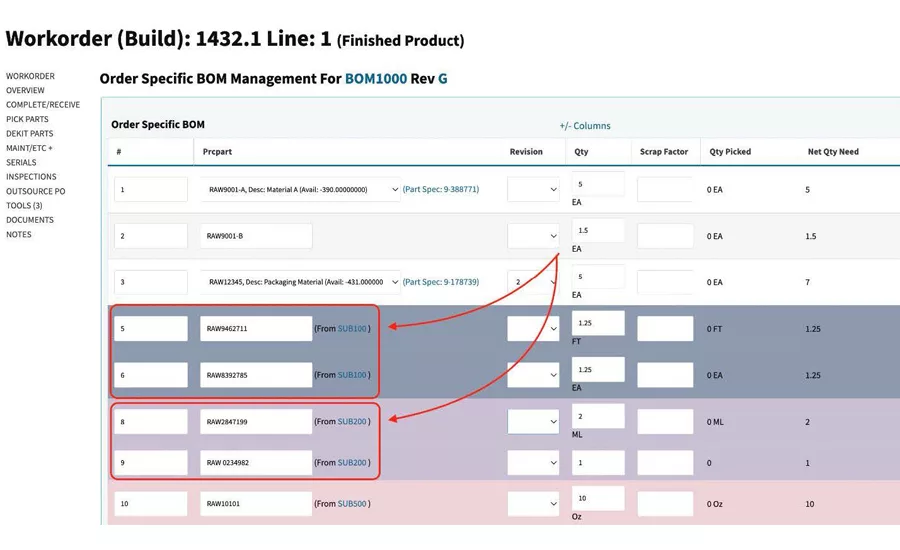
Example of a phantom BOM on a work order. The material and labor of subassemblies roll up into the parent BOM, taking a product with a complex BOM structure from engineering and simplifying it into a single work order for production. Source: Cetec ERP
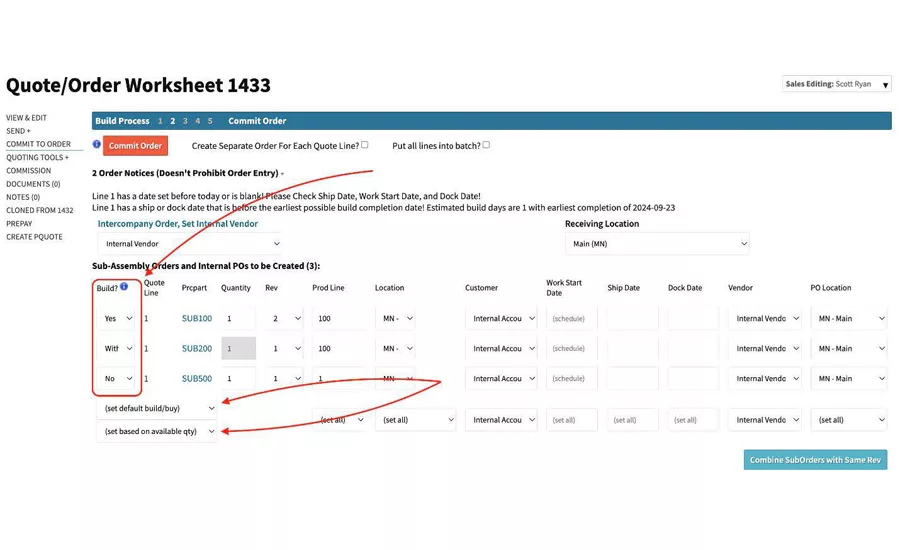
Example of order entry for a top level BOM containing multiple sub-BOMs, highlighting different paths for managing material planning and production. Source: Cetec ERP
In engineering-heavy manufacturing environments, decisions about part numbering and structuring multilevel bills of materials (BOMs) can impact the entire company’s operational efficiency significantly and in unexpected ways.
For manufacturing engineers, creating multilevel BOMs seems natural. It mirrors the product’s logical build flow, often with subassemblies reflecting nested dependencies. However, this engineering-driven approach may not always align with production realities, causing inefficiencies on the shop floor. Production workers are faced with building through these layers in real time, which can create unnecessary paperwork and slow everything down.
So how can both engineering and production collaborate more effectively to minimize inefficiencies without compromising product quality or complexity?
Best Practice When Dividing Assemblies Into Subcomponents
In deciding what drives the creation of sub-BOMs and whether to divide a larger assembly into subassemblies, it’s essential to evaluate the long-term impact on production. A flexible enterprise resource planning (ERP) system allows the creation of complex, multilevel BOMs, but also supports simple, flat BOM structures.
Take the boat-building process as an example. You can create a single BOM for the entire boat, encompassing the engine, shell and wheelhouse. Or, you can divide it into subassemblies for the engine, shell and wheelhouse, which are then combined during final assembly.
Both approaches will result in a functional boat, but the decision to structure it as one or multiple BOMs depends on your production goals. If a subassembly is frequently overbuilt or needs to be stored separately, the best practice is to create a distinct subassembly in the BOM model. If the subassembly is common to multiple final products, this shared component structure provides flexibility and control in production planning.
Looking for quick answers on assembly and manufacturing topics? Try Ask ASM, our new smart AI search tool. Ask ASM
However, if the subassembly is not frequently overbuilt or “custom” to the end project, then dividing parts unnecessarily will almost certainly add complexity and overhead to your production team responsible for tracking these things through the work order process in your ERP system.
This example applies to any engineer-to-order (ETO) manufacturing environment, such as custom automation systems, vehicle manufacturing, industrial machinery manufacturing.
Impact of Subassemblies on Production
When a work order for a top-level BOM is entered into your ERP, the system should auto-detect any sub-BOMs within the overall BOM structure. For example, with Cetec’s ERP system, engineers have three options for handling sub-BOMs at the time of entering a work order for the top-level BOM.
The first is “Build = Yes.” This option creates a work order for the subassembly, nesting it beneath the parent work order. The entire work order structure is dynamic, allowing easy adjustments to schedules through the “related orders” page. This option is ideal for scenarios where subassemblies are built internally, providing full control over the production flow.
The second option is “Build = No.” If you choose this option, the subassembly is treated as a purchased component. The system will not create a work order, which is useful when outsourcing the subassembly or when the subassembly is used across multiple products. This option also allows demand to flow through the material requirements planning system, letting production planners manage it independently.
The third option is “Build = With Top (Phantom BOM).” This is a phantom BOM setting, which effectively bypasses the subassembly. Instead of creating separate work orders for each subassembly, all components of the subassembly are pulled into the parent BOM. This method simplifies production by treating the subassembly as part of the top-level product.
Optimizing Sub-BOM Settings
To further streamline production, you can automate the build settings for subassemblies based on available inventory. If sufficient inventory of a subassembly exists, the system can automatically select “Build = No.” If no stock is available, it can set “Build = Yes” and even calculate the exact quantity needed. This eliminates manual intervention and ensures that production schedules align with material availability, minimizing delays.
The third sub-BOM option provides a compromise to the problem of overly structured BOMs that slow down production. For manufacturers running multilevel assembly processes, creating separate work orders for each subassembly can be cumbersome. Phantom BOMs allow companies to model complex product structures without generating a surplus of unnecessary production orders.
For instance, consider an autombile engine with components like the block, camshaft and piston assemblies. While each of these could be treated as separate subassemblies, creating production orders for each is impractical. By marking the piston assembly as a phantom BOM, you combine its components into the top-level engine BOM. This simplifies the workflow, as production workers only need to issue one production order that includes all the materials for the piston assemblies.
Phantom BOMs flatten the BOM structure while preserving the logical dependencies engineers value. They enable streamlined production by bundling subassemblies together, reducing the number of work orders required.
The use of phantom BOMs solves several key issues:
- Reducing paperwork: Production workers are no longer burdened with processing multiple work orders for nested subassemblies. Everything needed for the top-level build is laid out in a single BOM, cutting down on paperwork and approval processes.
- Improving workflow: By eliminating sub-orders for each component, phantom BOMs speed up production, making it easier for workers to gather materials and complete assembly tasks. This is especially useful in environments where subassembly tracking isn’t critical.
- Flexibility in production: Phantom BOMs give production teams the freedom to assemble subassemblies as part of the main build, bypassing the need for sequential builds. This ensures that production lines move faster and with fewer interruptions.
Achieving Efficiency Through BOM Structuring and ERP Tools
Manufacturers often face a balancing act between engineering-driven product structuring and production efficiency. While multilevel BOMs are essential for complex products, they can hinder production if not managed properly. By leveraging best practices in BOM structuring, subassembly management and phantom BOMs, companies can maintain a detailed engineering framework while keeping production workflows streamlined.
A well-integrated manufacturing ERP system can offer powerful tools for managing these complex BOM structures, ensuring that both engineering and production departments can work together efficiently. By automating build decisions, optimizing work orders, and leveraging phantom BOMs, companies can minimize paperwork, improve scheduling, and maintain high levels of production without sacrificing engineering integrity.Looking for a reprint of this article?
From high-res PDFs to custom plaques, order your copy today!