Assembly Magazine logo
search
Ask ASSEMBLY AI
cart
facebook twitter linkedin youtube
  • Sign In
  • Create Account
  • Sign Out
  • My Account
Assembly Magazine logo
  • TRENDS
    • Ask ASSEMBLY AI
    • Trends
    • News
    • New Products
  • INDUSTRIES
    • Aerospace
    • Appliance
    • DFMA Assembly
    • Medical Devices
    • Green Manufacturing
    • Lean Manufacturing
    • Machinery Assembly
    • Electronics Assembly
    • Automotive
  • TECHNOLOGIES
    • Adhesives & Dispensing
    • Assembly Presses
    • Automated Assembly Systems
    • Manufacturing Management
    • Manufacturing Software
    • Motion Control
    • Screwdriving & Riveting
    • Robotics
    • Test & Inspection
    • Plastics & Metal Welding
    • Wire Processing
    • Workstations
  • AUTONOMOUS & ELECTRIC MOBILITY
    • AEM Magazine Archives
    • Autonomy
    • Electrification
    • Mobility Services
    • Assembly & Testing
    • AV/EM News
  • MEDIA
    • Ask ASSEMBLY AI
    • Podcasts
    • Assembly News Now
    • Assembly TV
    • Webinars
    • eBooks
  • EVENTS
    • Calendar
    • The ASSEMBLY Show
  • MORE
    • Exclusives >
      • Plant of the Year
      • Capital Spending
    • Buyers Guide >
      • Supplier Insights
    • Classifieds
    • Featured Products
    • Newsletters
    • Store
    • White Papers
    • Columns
    • Sponsor Insights
  • INFOCENTER
    • Assembly & Test Solutions
  • EMAGAZINE
    • eMagazine
    • Archive Issues
    • Advertise
    • Contact Us
    • Sign Up
Autonomous & Electric MobilityAssembly and TestingAV/EM NewsElectrification

Mercedes-Benz Touts Future EV Technology
By Austin Weber
Mercedesindrivebrake.jpg
Mercedes-Benz AG

Photo courtesy Mercedes-Benz AG

November 26, 2024

STUTTGART—As it prepares to celebrate the 140th anniversary of the world’s first automobile (a three-wheeled contraption invented by Carl Benz in 1885) in 2025, Mercedes-Benz AG is looking to the future of mobility. It recently provided a glimpse of new EV technology that its engineers are working on, including next-generation brakes, electric drives and photovoltaic body panels.

“Innovative strength was and is among the most important driving forces of Mercedes-Benz,” says Markus Schäfer, chief technology officer at Mercedes-Benz Group. “Our brand has been shaping automotive progress for almost 140 years with pioneering technologies. For us, innovation only makes sense if it offers our customers real added value.”

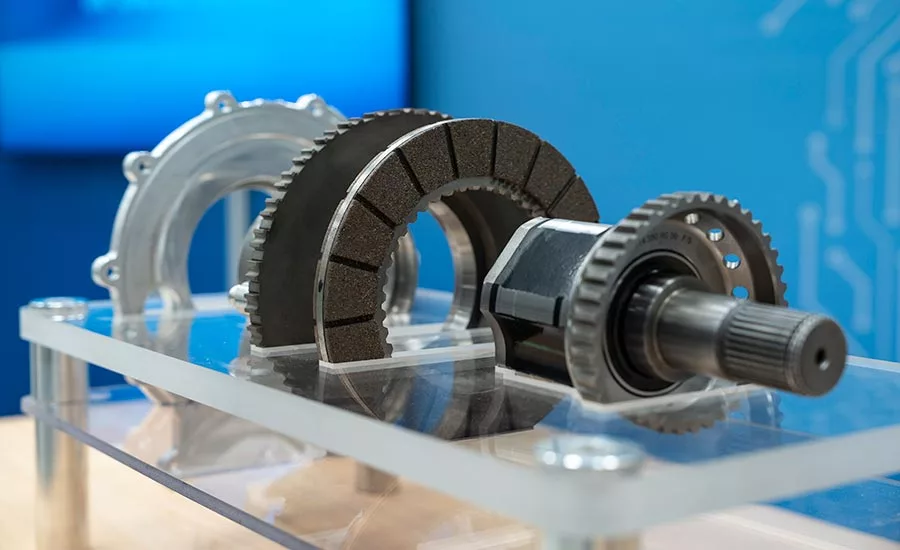
Mercedes-Benz engineers are in the process of developing a brake system for EVs that no longer occupies its conventional location inside the wheel. Instead, it is integrated into the electric drive unit at the front or rear axle (see photo above). It occupies very little space and is subject to minimal wear, doesn’t rust and is virtually maintenance-free. 

According to Schäfer, the new design enables a significantly lighter wheel-tire combination and therefore lower unsprung mass, which, in turn, improves ride characteristics. In addition, it would facilitate fully closed rims for optimized aerodynamics, because openings for brake cooling would no longer be required.

Engineers are also developing a new generation of EV power electronics. In the future, a programmable micro-converter could go beyond the limits of current electrical inverter systems and revolutionize existing high-voltage architectures. The basis for this is the integration of these micro-converters directly at battery-cell level, which could enable individual control of battery-cell pairs as well as communication between cells.

Schäfer says the programmable micro-converters could reduce the production variants of electrical components and could also be easily reprogrammed for the latest updates. The new technology has the potential to enable integration of several power electronics functions into high-voltage batteries.

The significantly improved use of space, as well as a reduction in the number of variants, would open up entirely new freedoms in the layout and design of electric vehicles. At 5 micrometers, they are significantly thinner than a human hair, weigh just 50 grams per square meter and are packed full of energy.

Looking for quick answers on assembly and manufacturing topics? Try Ask ASM, our new smart AI search tool. Ask ASM →

In addition, Mercedes-Benz engineers are developing solar modules that could be seamlessly applied to the bodywork of EVs, similar to a wafer-thin layer of paste. The solar cells have a high efficiency of 20 percent and can be applied to any substrate.

According to Schäfer, the photovoltaic system is permanently active and generates energy when a vehicle is switched off. In the future, this could be an effective way to increase range with fewer charging stops.

KEYWORDS: electric car manufacturing electric vehicles future vehicles Mercedes-Benz

Share This Story

Looking for a reprint of this article?
From high-res PDFs to custom plaques, order your copy today!

Austinweber headshot
Austin has been senior editor for ASSEMBLY Magazine since September 1999. He has more than 21 years of b-to-b publishing experience and has written about a wide variety of manufacturing and engineering topics. Austin is a graduate of the University of Michigan.

Recommended Content

JOIN TODAY
To unlock your recommendations.

Already have an account? Sign In

  • Made in the U.S.A.

    Consumer Products Manufacturing: Made in the USA

    Supply chain lessons learned during the coronavirus...
    Automated Assembly Systems
    By: Austin Weber
  • Best Practices for Press-Fit Assembly

    Best Practices for Press-Fit Assembly

    In manufacturing, ironclad formulas for success are hard...
    Assembly Presses
    By: Jim Camillo
  • aem0523leader-tesla1.jpg

    Tesla Rethinks the Assembly Line

    Engineers at Tesla Inc. have developed a new process that...
    Automotive Assembly
    By: Austin Weber
Manage My Account
  • eMagazine Subscription
  • Assembly Newsletters
  • Online Registration
  • Subscription Customer Service
  • Manage My Preferences

More Videos

Sponsored Content

Sponsored Content is a special paid section where industry companies provide high quality, objective, non-commercial content around topics of interest to the ASSEMBLY audience. All Sponsored Content is supplied by the advertising company and any opinions expressed in this article are those of the author and not necessarily reflect the views of ASSEMBLY or its parent company, BNP Media. Interested in participating in our Sponsored Content section? Contact your local rep!

close
  • ultrasonic welding
    Sponsored bySonobond Ultrasonics

    Engineering Efficiency in High-Performance Assembly: How Ultrasonic Welding Enhances Throughput, Reliability and Quality

  • UV curing system
    Sponsored byDymax

    Why UV Intensity Alone Doesn’t Define Curing Performance

  • wooden pallets
    Sponsored byLEAN Manufacturing Products

    Eliminating Waste on the Shop Floor: Applying Lean Principles to Improve Manufacturing Efficiency

Popular Stories

Ferrari

Ferrari Unveils Four-Door EV

ASSEMBLY News Now, episode-30: Volvo Redesigns EV Manufacturing

Volvo Redesigns EV Manufacturing

Robots working at Toyota Plant in Japan

Toyota Deploys Geekplus Robots for Factory Material Handling

Watch the latest episode of ANN now!

Events

July 24, 2025

From Shop Floor to CFO: How Manufacturers Are Closing the Loop Between Operations and Finance

On Demand Learn how manufacturers are bridging the gap between the shop floor and ERP systems to gain real-time visibility, streamline operations, and kick-start digital transformation—without waiting years.

Sponsored by:

PicoStratusGreen
July 30, 2025

Buffer Analysis and Design Fundamentals for Manufacturing Excellence

On Demand In this presentation, Dr. Herman Tang shares practical insights from his industry experience and research on buffer management in manufacturing operations.

View All Submit An Event

Poll

Difficult Assembly Processes

Which assembly process gives you the most difficulty?
View Results Poll Archive

Products

Manufacturing Cost Policy Deployment (MCPD) Profitability Scenarios: Systematic and Systemic Improvement of Manufacturing Costs

Manufacturing Cost Policy Deployment (MCPD) Profitability Scenarios: Systematic and Systemic Improvement of Manufacturing Costs

See More Products
ebook

Related Articles

  • NissanBattery.jpg

    Honda and Nissan to Partner on EV Technology

    See More
  • AlabamaAIDT.jpg

    Alabama to Build EV Technology Center

    See More
  • ToyotaArea35.jpg

    Toyota Reveals Future EV Production Strategy

    See More

Related Products

See More Products
  • smart.jpg

    Handbook of Smart Manufacturing Forecasting the Future of Industry 4.0

  • Technology Of Machine Tools

  • 0001349.jpeg

    Adhesion and Adhesives Technology 4e

See More Products

Related Directories

  • Future Technologies Inc.

×

Never miss the latest news and trends driving the manufacturing industry

Stay in the know on the latest assembly trends.

JOIN TODAY!
  • RESOURCES
    • Advertise
    • Contact Us
    • Directories
    • Manufacturing Division
    • Store
    • Want More?
  • SIGN UP TODAY
    • Create Account
    • eMagazine
    • Newsletters
    • Customer Service
    • Manage Preferences
  • SERVICES
    • Marketing Services
    • Reprints
    • Market Research
    • List Rental
    • Survey/Respondent Access
  • STAY CONNECTED
    • LinkedIn
    • Facebook
    • Instagram
    • YouTube
    • X (Twitter)
  • PRIVACY
    • PRIVACY POLICY
    • TERMS & CONDITIONS
    • DO NOT SELL MY PERSONAL INFORMATION
    • PRIVACY REQUEST
    • ACCESSIBILITY

Copyright ©2026. All Rights Reserved BNP Media, Inc. and BNP Media II, LLC.

Design, CMS, Hosting & Web Development :: ePublishing