Assembly Magazine logo
search
Ask ASSEMBLY AI
cart
facebook twitter linkedin youtube
  • Sign In
  • Create Account
  • Sign Out
  • My Account
Assembly Magazine logo
  • TRENDS
    • Ask ASSEMBLY AI
    • Trends
    • News
    • New Products
  • INDUSTRIES
    • Aerospace
    • Appliance
    • DFMA Assembly
    • Medical Devices
    • Green Manufacturing
    • Lean Manufacturing
    • Machinery Assembly
    • Electronics Assembly
    • Automotive
  • TECHNOLOGIES
    • Adhesives & Dispensing
    • Assembly Presses
    • Automated Assembly Systems
    • Manufacturing Management
    • Manufacturing Software
    • Motion Control
    • Screwdriving & Riveting
    • Robotics
    • Test & Inspection
    • Plastics & Metal Welding
    • Wire Processing
    • Workstations
  • AUTONOMOUS & ELECTRIC MOBILITY
    • AEM Magazine Archives
    • Autonomy
    • Electrification
    • Mobility Services
    • Assembly & Testing
    • AV/EM News
  • MEDIA
    • Ask ASSEMBLY AI
    • Podcasts
    • Assembly News Now
    • Assembly TV
    • Webinars
    • eBooks
  • EVENTS
    • Calendar
    • The ASSEMBLY Show
  • MORE
    • Exclusives >
      • Plant of the Year
      • Capital Spending
    • Buyers Guide >
      • Supplier Insights
    • Classifieds
    • Featured Products
    • Newsletters
    • Store
    • White Papers
    • Columns
    • Sponsor Insights
  • INFOCENTER
    • Assembly & Test Solutions
  • EMAGAZINE
    • eMagazine
    • Archive Issues
    • Advertise
    • Contact Us
    • Sign Up
TechnologiesTest and Inspection Assembly

Image Processing in Battery Cell Manufacturing

Machine vision is an elementary part of quality assurance in battery cell production and is used in a variety of production steps.
By Frank von Kittlitz
Battery inspection coating

Image Source: Basler

February 18, 2025

In the production of battery cells, ensuring high quality during all process steps and reducing material waste is crucial. Digital image processing enables the reliable detection of even the smallest defects. Machine vision solutions help produce safe, high-quality battery cells to meet the challenges of electric mobility.

Different cell types

The main application for lithium-ion battery packs is electric mobility. Though there are three types and formats in use, the functional principle of all types is essentially the same. The main differences are in the design, requirements, and materials used.

Pouch cell

The geometry of the pouch cell is almost arbitrary and the size is easily scalable. The free positioning of the cell arresters and the electrode stacking (anode on cathode, divided by a separator) allow good heat dissipation and simple energy management.

Prismatic cell

The prismatic cell also consists of stacked anode and cathode packages. The fixed metal housing provides advantages when assembling the cells into a module. The prismatic cell combines high energy density with safety and a long lifetime.

Cylindrical cell

The cylindrical cell is a proven technology in battery manufacturing. Cylindrical cells consist of an anode and a cathode isolated by a separator and wound into a roll. The round design results in a loss of space at the battery pack module level.

Screenshot defect classification

Image Source: Basler

Battery cell manufacturing involves four main process steps

Lithium-ion battery cell production consists of four main process steps: electrode production, cell assembly, cell finishing, and battery pack assembly. The electrode production and cell finishing process steps are largely independent of the battery cell type, while cell assembly distinguishes between pouch or prismatic cells and cylindrical cells. Regardless of the cell type, the smallest unit of any lithium-ion cell consists of two electrodes and the separator that divides them from one another. In between is the ion-conducting electrolyte.

Where is vision used in battery cell manufacturing?

Machine vision is an elementary part of quality assurance in battery cell production and is used in a variety of production steps.

Looking for quick answers on assembly and manufacturing topics? Try Ask ASM, our new smart AI search tool. Ask ASM →

Anomaly detection

Optical anomaly detection compares the condition of materials or components to a pre-defined target condition and locates possible deviations.

Object detection and classification

Image analysis detects and categorizes defects and irregularities. This allows systems to be adjusted and provides a basis for deciding whether the material is within tolerances or must be rejected.

Measuring defects

Once defects or contaminants have been detected and localized, they can be measured. This allows conclusions to be drawn about the type and extent of the defect.

Code reading

Barcodes, QR codes, PDF417 codes, data matrix codes, or Aztec codes: materials and semi-finished products are marked with codes for tracking during process steps or for faster handling in the material flow.

Use cases in battery cell manufacturing

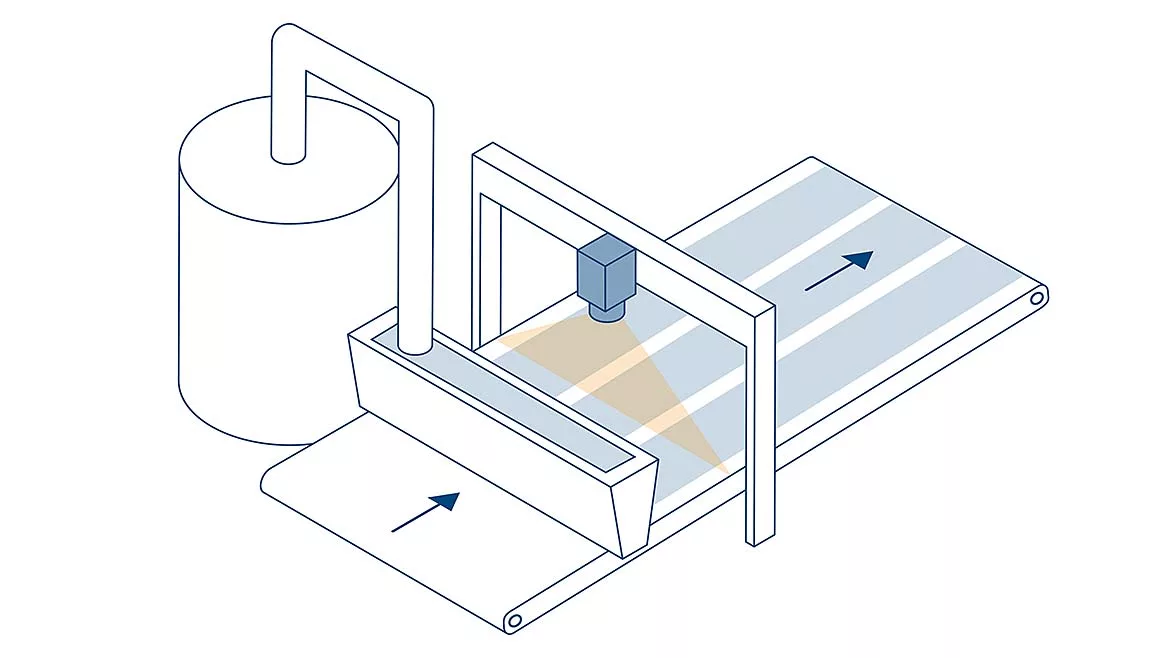
Coating the substrate foil with slurry is a critical production step. The surface quality must be uniform, free of voids and particles, and the thickness of the slurry must be precise and homogeneous. 

Electrode coating in detail

In electrode coating, the carrier or substrate foil is coated with the previously mixed slurry using an application tool such as a slot die, doctor blade, or anilox roller. The top and bottom sides of the foil can be coated in parallel or sequentially. This is followed by a drying process.

This process step is particularly critical because many parameters must be precisely coordinated: the slurry must have the required stability and be applied at the correct rate. The aim is to achieve perfect coating homogeneity, without cracks or agglomerates, as the electrode layer is particularly important for battery performance.

However, many defects can occur in both intermittent and continuous electrode coating. Typical defects include agglomerates, coating cracks, contamination from foreign bodies and micro-compressions that occur when the coating is applied too thinly. Mud cracks, pinholes and breakouts at the end of the coating web are also possible defects.

Screenshot VA ROI

Image Source: Basler

The challenge of large image data

Image processing during production presents a dual challenge. Very high production speeds generate large amounts of image data. At the same time, a high level of detail is required (which is achieved through high image resolution), generating even larger amounts of data. Conventional solutions generally do not have the processing power required to maintain the required production speeds.

Advanced image processing technology on the other hand ensures reliable quality control during electrode coating. Highly sensitive line scan cameras are suitable for continuous material and deliver the necessary throughput and the required image quality. But with the use of targeted image pre-processing, only a fraction of the data volume needs to be analyzed. A combination of software and a frame grabber pre-processes the image data and thus creates the necessary focusing for the actual image processing. By determining the ROI (region of interest), only the areas with irregularities are localized first. Only the image data of the ROI is then viewed and further processed.

This has the advantage that the CPU of the IPC can continue to be used for the actual system control without any additional load. In the next step, the irregularities within the ROIs can be further analyzed. Specialized software for image analysis can, for example, classify the type of defect or measure the size of the defect. Depending on the type and size of the defect, a decision is made as to whether it is within the tolerances or whether further measures are required. Defective areas can be precisely cut out thanks to exact localization and measurement. This improves the quality of the battery cell and minimizes material waste.


This article was originally posted on www.qualitymag.com.
KEYWORDS: battery manufacturing machine vision systems quality assurance

Share This Story

Looking for a reprint of this article?
From high-res PDFs to custom plaques, order your copy today!

Frank von Kittlitz, Editor – Digital & Communications - Market Communications, Basler. For more information, visit www.baslerweb.com.

Recommended Content

JOIN TODAY
To unlock your recommendations.

Already have an account? Sign In

  • Made in the U.S.A.

    Consumer Products Manufacturing: Made in the USA

    Supply chain lessons learned during the coronavirus...
    Automated Assembly Systems
    By: Austin Weber
  • Best Practices for Press-Fit Assembly

    Best Practices for Press-Fit Assembly

    In manufacturing, ironclad formulas for success are hard...
    Assembly Presses
    By: Jim Camillo
  • aem0523leader-tesla1.jpg

    Tesla Rethinks the Assembly Line

    Engineers at Tesla Inc. have developed a new process that...
    Industries
    By: Austin Weber
Manage My Account
  • eMagazine Subscription
  • Assembly Newsletters
  • Online Registration
  • Subscription Customer Service
  • Manage My Preferences

More Videos

Sponsored Content

Sponsored Content is a special paid section where industry companies provide high quality, objective, non-commercial content around topics of interest to the ASSEMBLY audience. All Sponsored Content is supplied by the advertising company and any opinions expressed in this article are those of the author and not necessarily reflect the views of ASSEMBLY or its parent company, BNP Media. Interested in participating in our Sponsored Content section? Contact your local rep!

close
  • ultrasonic welding
    Sponsored bySonobond Ultrasonics

    Engineering Efficiency in High-Performance Assembly: How Ultrasonic Welding Enhances Throughput, Reliability and Quality

  • UV curing system
    Sponsored byDymax

    Why UV Intensity Alone Doesn’t Define Curing Performance

  • wooden pallets
    Sponsored byLEAN Manufacturing Products

    Eliminating Waste on the Shop Floor: Applying Lean Principles to Improve Manufacturing Efficiency

Popular Stories

Ferrari

Ferrari Unveils Four-Door EV

ASSEMBLY News Now, episode-30: Volvo Redesigns EV Manufacturing

Volvo Redesigns EV Manufacturing

automated consumer goods assembly system

Best Practices for Cycle Time Optimization

Watch the latest episode of ANN now!

Events

July 24, 2025

From Shop Floor to CFO: How Manufacturers Are Closing the Loop Between Operations and Finance

On Demand Learn how manufacturers are bridging the gap between the shop floor and ERP systems to gain real-time visibility, streamline operations, and kick-start digital transformation—without waiting years.

Sponsored by:

PicoStratusGreen
July 30, 2025

Buffer Analysis and Design Fundamentals for Manufacturing Excellence

On Demand In this presentation, Dr. Herman Tang shares practical insights from his industry experience and research on buffer management in manufacturing operations.

View All Submit An Event

Poll

Difficult Assembly Processes

Which assembly process gives you the most difficulty?
View Results Poll Archive

Products

Manufacturing Cost Policy Deployment (MCPD) Profitability Scenarios: Systematic and Systemic Improvement of Manufacturing Costs

Manufacturing Cost Policy Deployment (MCPD) Profitability Scenarios: Systematic and Systemic Improvement of Manufacturing Costs

See More Products
Register for webinar - Modernizing Automotive Assembly: Why Upgrading Legacy MES is a Business Imperative

Related Articles

  • nordsen

    How To make a positive difference in battery cell manufacturing

    See More
  • Ultium Cells plant in Spring Hill

    GM and LG Energy Solution Announce Plans to Upgrade Battery Cell Manufacturing Facility in Tennessee

    See More
  • KORE Power 9-23

    KORE Power to Build Large-Scale Battery Cell Manufacturing Plant

    See More

Related Products

See More Products
  • cell manu.jpg

    The Cell Manufacturing Playbook

  • advanced.jpg

    Advanced Manufacturing and Processing Technology

  • history.jpg

    Faster, Better, Cheaper in the History of Manufacturing: From the Stone Age to Lean Manufacturing and Beyond

See More Products

Related Directories

  • Load Cell Central

    Load Cell Central is a leading load cell manufacturer, delivering cutting-edge custom solutions for electronic weighing systems and components, weighing assemblies, and load cell repairs. Our expertise spans a wide range of applications, including the development of custom electronic load cell-based weighing systems, interchangeable replacement load cells, and specialized load cells and weighing assemblies. Whether you're in need of industrial scales, a load cell, or solutions for force measurement, center of gravity, or process and batching control by weight, we are committed to providing innovative, economical solutions. Our approach is comprehensive, guiding clients from the initial concept through to completion, with ongoing support long after the sale. At Load Cell Central, we pride ourselves on our technical expertise, customer-centric approach, and unwavering commitment to quality in every aspect of our service.
×

Never miss the latest news and trends driving the manufacturing industry

Stay in the know on the latest assembly trends.

JOIN TODAY!
  • RESOURCES
    • Advertise
    • Contact Us
    • Directories
    • Manufacturing Division
    • Store
    • Want More?
  • SIGN UP TODAY
    • Create Account
    • eMagazine
    • Newsletters
    • Customer Service
    • Manage Preferences
  • SERVICES
    • Marketing Services
    • Reprints
    • Market Research
    • List Rental
    • Survey/Respondent Access
  • STAY CONNECTED
    • LinkedIn
    • Facebook
    • Instagram
    • YouTube
    • X (Twitter)
  • PRIVACY
    • PRIVACY POLICY
    • TERMS & CONDITIONS
    • DO NOT SELL MY PERSONAL INFORMATION
    • PRIVACY REQUEST
    • ACCESSIBILITY

Copyright ©2026. All Rights Reserved BNP Media, Inc. and BNP Media II, LLC.

Design, CMS, Hosting & Web Development :: ePublishing