Comparing Electric and Pneumatic Actuators

Pneumatic systems require numerous components, including a cylinder, a compressed air system, valves, filters, regulators, tubing and fittings.
Photo by Kynny, courtesy iStock / Getty Images Plus
As automation technology has advanced, application demands have increased for flexibility, precision, efficiency and reliability in linear motion. This has resulted in considerable debate about the best overall technology—pneumatic or electric linear actuators—for automation applications.
Pneumatic cylinders have long been popular for providing economical linear motion across a broad spectrum of manufacturing processes. Pneumatic systems are durable and fairly simple to install. They provide a low-cost method of meeting linear motion and force requirements.
Developments in electric linear actuators now make that technology a viable, economical alternative for machine builders to consider for linear motion applications. Electric actuators provide control and reliability advantages while meeting motion and force requirements.
Factors that affect performance and feasibility of each technology include:
- Motion control capabilities.
- Force capabilities.
- Velocity, acceleration and deceleration capabilities.
- System components and footprint.
- Reliability, life and maintenance of devices.
- Data collection.
- Efficiency, leaks and utility costs.
- Shock and side loads.
Motion Control Capabilities
Standard pneumatic cylinders easily accomplish basic end-to-end position applications. Mid-stroke positioning, however, is more complicated, requiring additional actuator and valve hardware to achieve a third position. This results in a process that is not very accurate or repeatable.
Servo-pneumatic products attempt to address this issue of positioning, but further complicate the system and add additional cost to the system. Their cost structure becomes similar to electric actuators.
In addition to the positional accuracy and flexibility challenges of pneumatic systems, speed control can also be a challenge and require fine tuning. Speed control in a pneumatic system is monitored through flow controls; an operator must manually dial in the acceptable speed for an application, which may make an exact speed setting difficult to achieve. Once the speed setting is adjusted, the pressure force output required from a pneumatic cylinder is regulated through the valve. Again, the operator must fine-tune the system to achieve the desired force.
Looking for quick answers on assembly and manufacturing topics? Try Ask ASM, our new smart AI search tool. Ask ASM
Finally, the repeatability of position, speed and force of a pneumatic cylinder are subject to worn seals, leaks, pressure drops and spikes from the compressed air system as well as other maintenance factors. These factors often make it difficult to achieve repeatable performance shift to shift, day to day or week to week in demanding industrial production environments.
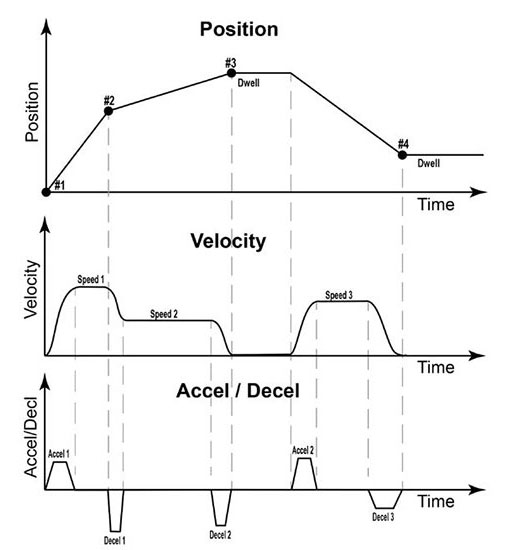
Electric linear actuators provide greater control over position, speed, acceleration and deceleration. This graph shows motion profiles at different velocities with varying acceleration and deceleration rates, all under full and precise control. Photo courtesy Tolomatic Inc.
One of the main reasons engineers select electric actuators over pneumatic cylinders is to increase the flexibility and motion control capabilities. This includes position control (multiple positions, accuracy, repeatability); velocity control; control of acceleration and deceleration; control of output force; and complex control of all these motion variables at any time during the motion.
Coupled with a servo drive and motor system, electric actuators offer infinite control over position, as well as increased position accuracy and repeatability, far beyond the capabilities of current pneumatic systems. Additionally, multiaxis servo controllers are readily available off the shelf for most control systems and can be easily integrated with multiple linear and rotary axes to create complete motion systems capable of running the most complex motion profiles. This improved motion control and flexibility is programmable into PLCs, HMIs and other controllers. Machine start-up and changeover times are fast and repeatable. With this improved capability, machine builders can easily optimize system performance, helping manufacturers improve their overall process.
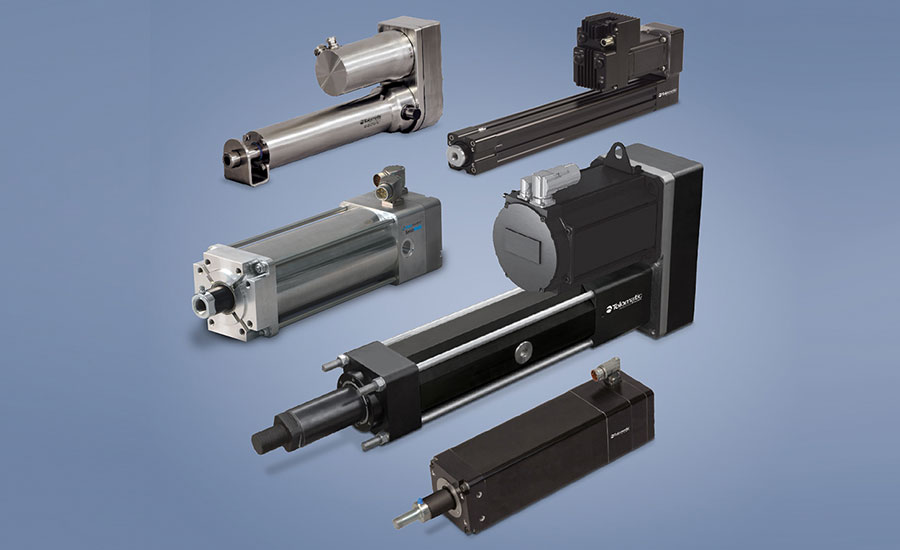
Electric actuator systems precisely regulate current through the servomotor to achieve accurate and repeatable force. Photo courtesy Tolomatic Inc.
Force Capabilities
Pneumatic systems typically operate on pressures from 80 to 100 psi. The output force of a pneumatic cylinder is easily calculated with the equation: force = pressure x area of the piston. For example, 1-inch and 3-inch bore cylinders at 80 psi could achieve approximately 63 pounds and 565 pounds, respectively.
However, pneumatic cylinders are typically not used to their full output force capability and are often oversized to improve control to ensure system operation. In pneumatic systems, where system rigidity is not optimized, the pneumatic cylinder may experience a delay in force generation due to the lag in time while system pressure is built up to complete the work. This phenomenon often makes it difficult for a pneumatic system to repeatedly produce the same force for each cycle in a repeating process.
Electric actuators precisely control current through the servomotor to produce torque, which drives the screw assembly and results in linear movement and force. This is a significant advantage, since force generation is almost instantaneous and essentially “on demand.”
Another advantage of electric systems is the servo controller’s precise closed-loop control of the current, which creates precise and repeatable force performance. This allows force limits to be programmed to achieve consistent force for each cycle or to prevent damage to the product or system in which the actuator is integrated.
Electric actuators typically can achieve much higher forces than pneumatic cylinders due to the large variety of servomotors combined with many screw lead and gearing ratios. When selecting an electric actuator system, it is important to consider the motor’s speed and torque capabilities, coupled with the screw lead in the electric actuator. Carefully match the servomotor speed and torque with the actuator’s screw lead and gearing. Although this step may appear to complicate the process, many actuator and servo component manufacturers provide easy-to-use sizing software packages that take all these variables into consideration.
Velocity, Acceleration and Deceleration
Pneumatic cylinders can achieve high velocities if compressed air volume and pressure are readily available. When sufficient volume and flow are available, pneumatic cylinders operate at high cycle rates in basic end-to-end positioning applications without the need for detailed sizing or thermal analysis.
A common challenge of pneumatic systems is that the velocity of commanded motion is difficult to control accurately and repeatedly, and engineers must factor acceleration and deceleration rates into their machine designs. Machine designers operating a pneumatic cylinder at high linear speeds or with high acceleration and deceleration rates must typically either consider shock absorbers or make additional design considerations to plan for shocks and impacts. If not factored into the machine design, these shocks and impacts can negatively affect the life of the cylinder and machine components.
Electric actuator systems can precisely and accurately control velocity, acceleration and deceleration throughout the motion profile, easily blending from one speed to another without stopping or over-running position. This capability creates opportunities for machine designers to optimize machine performance: minimizing move times, decreasing cycle times, and increasing overall machine productivity. Further improvements come with smooth motion throughout the motion cycle, eliminating the potential for shocks and impacts, which improves the overall reliability of the machine.
As with achieving high force, achieving high speed at force also presents a more involved sizing process with the combination of screw leads, gearing and the servomotor speed and torque possibilities. The combined limitations of the screw lead, gearing and servomotor may limit the maximum achievable velocity of the electric actuator system. In some cases, pneumatic systems may achieve higher overall linear velocities. However, overall motion cycle time can often be decreased when using an electric actuator operating at similar, but lower, velocities.
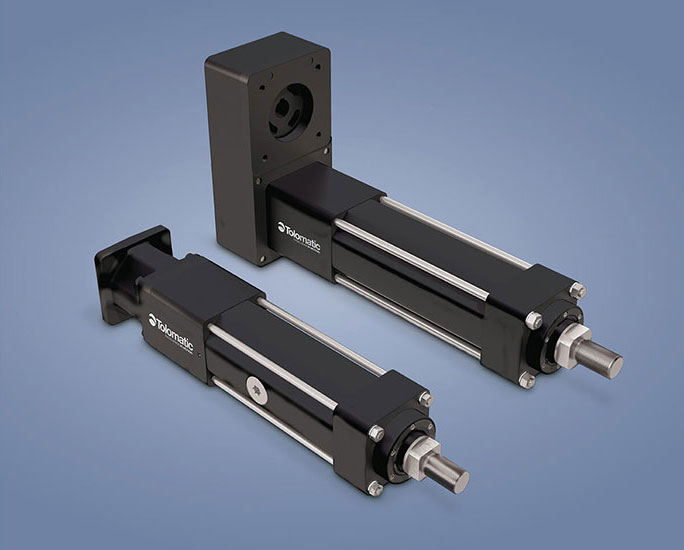
Electric motion systems consist of a mechanical actuator, a motor, an optional gearbox, cables, and a servo drive, which is usually mounted in a control cabinet. Photo courtesy Tolomatic Inc.
System Components and Footprint
A system’s total component count is an important consideration for engineers. Pneumatic systems require a cylinder; a compressed air system; valves; filters; regulators; tubing; fittings; and other components. In short, a pneumatic system typically has more components than an electric one.
Pneumatic cylinders offer a compact footprint at the work point (where the power density is required), but require a compressed air system, which takes up additional floor space. Factoring the compressor into the overall system footprint, the pneumatic system would have an overall larger footprint. Additionally, most compressed air systems require overhead air hoses and air drop lines to bring the compressed air to the workstation. These long lengths of air hose create additional volume of air to compress, increase the potential leakage points, and decrease overall system efficiency.
Electric actuators are physically larger than their pneumatic counterparts and are almost never drop-in replacements. They typically require additional space to accommodate increased length and width compared to a pneumatic cylinder.
However, electric motion systems have fewer components: a mechanical actuator, a motor, an optional gearbox, cables, and a servo drive, which is usually mounted in a control cabinet. The electric actuator—due to its integrated power screw assembly and bearing system—does require additional length over a pneumatic cylinder. However, when considering the overall system footprint, this additional length is more than compensated for by the much smaller footprint of the servo drive, the functional equivalent of the compressor. A servo drive is normally a fraction of the size of a compressed air system.
Reliability, Service Life and Maintenance
With proper maintenance and installation, pneumatic cylinders can offer rugged performance and provide a long service life. The key to achieving long service life is the integrity of the rod and piston seals. These sealing elements must achieve and maintain proper tolerances to contain the pressure required for motion and force.
As the cylinder cycles back and forth, seal wear is inevitable. The efficiency, force output, speed and responsiveness of a cylinder decrease as air leakage increases. Not only will the performance degrade, but the seal or the cylinder itself will require replacement. All of these factors reduce the probability of achieving consistent performance.
Predicting when the seals may fail, or anticipating the effect on cylinder performance to ensure proper and timely maintenance, can be almost impossible. As seals wear, operators must spend time manually adjusting air flow rates and pressures on individual devices to ensure proper operation of the machine. Additional labor hours are required when cylinders must be replaced or refurbished.
Many manufacturing facilities have developed dedicated preventive maintenance and replacement schedules for their pneumatic cylinders to avoid unexpected downtime. In doing so, they must also schedule additional time to test and tune systems on startup. While these maintenance plans offer increased machine and process reliability, they introduce additional costs in time, labor, replacement parts and managing the preventive maintenance schedule.
A final factor to reliability and service life with pneumatic cylinders and compressed air systems is maintaining a clean, dry air supply. Condensation in air lines can cause premature failure of pneumatic components through corrosion. It can also create an environmental risk through bacterial growth, which can contaminate the manufacturing process.
Electric actuators can be sized for the life requirements of an application. The main torque and force transmission elements of an electric actuator are the screw assembly and ball bearings. These components have a dynamic load rating specification that estimates the service life an electric actuator can achieve. Utilizing an industry standard L10 life estimation, electric actuators can be sized and selected to meet the machine life requirements. Their force and torque transmission elements are typically greased for life, but easy in-field greasing methods are available for demanding applications to extend service life.
A secondary wear element on an electric actuator is the rod seal, designed to keep water, dust and other contamination from entering the actuator and damaging the internal torque transmission components. Unlike pneumatic cylinder seals, the seals in electric actuators are not subjected to the precise sealing requirements necessary to contain the high pressures needed for motion. Even if the seal fails, the actuator will continue to operate.
Rod seals on most electric actuators can be easily and inexpensively replaced. Misuse is the primary reason that electric actuators fail. For example, exceeding the actuator’s performance specifications for extended periods of time and damage during commissioning or installation due to inadequate attention to control parameters are the most common misuse factors.
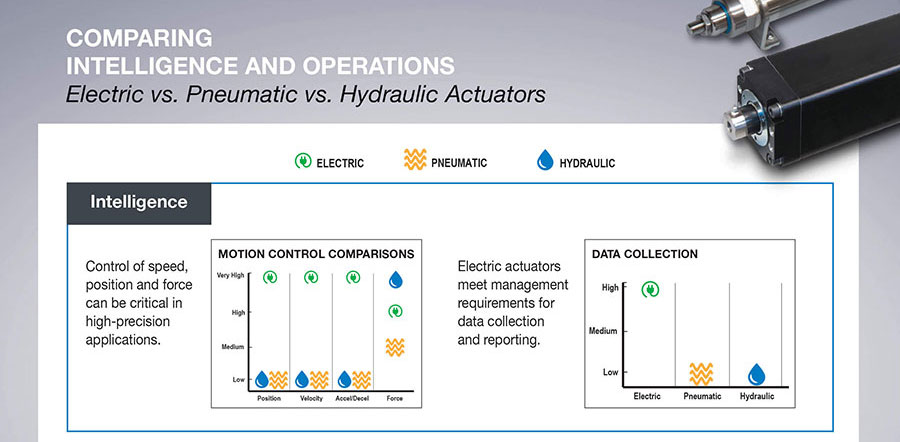
Compared with pneumatic actuators, electric actuators offer better data acquisition capabilities. Photo courtesy Tolomatic Inc.
Data Collection
In the never-ending quest to improve manufacturing processes and improve process control, data collection has become common in today’s manufacturing environment. Pneumatic cylinders may have proximity sensors connected to an IO Link or Ethernet valve bank, but without expensive linear transducers and other sensors to provide absolute positioning feedback, the information reported back to the controls system is often inadequate to tightly monitor and control a process in real time.
The fundamental design of electric actuators allows for increased in-process data collection. In an electric motion system, the servo drive regulates current and voltage to the motor. Most servo drives have features allowing users to monitor and export current and voltage parameters to data acquisition systems. The current supplied to the motor can be easily used to track force and repeatability. The feedback device on the motor registers accurate position, velocity, acceleration and deceleration during the entire motion cycle at any point in time.
The availability of this data for every cycle allows engineers to closely monitor the actuator’s operation and improve machine performance, reliability and process control.
Efficiency, Leaks and Electricity Costs
Pneumatic cylinders, the support components, and the compressed air system typically operate in the 10 to 20 percent efficiency range. Many factors can affect the efficiency of the entire system over time, including the number of components, leaks and quality of air. As efficiency changes, so can accurate and repeatable performance.
Additionally, pneumatic systems must stay pressurized at all times to ensure specified motion and force. When the system is active, the compressors must be running even though many of the cylinders may not be in operation, resulting in an inefficient use of power. This issue is further magnified if leaks are present in the compressed air system. The compressor will continue working, providing air pressure and volume flow to the system, while the air continues to escape through the leaks. Even an accumulation of several small leaks can result in significant air loss. Increased demand from the compressor unit adds to electricity costs. In large plants with complex compressed air systems, it can be difficult to locate and fix leaks.
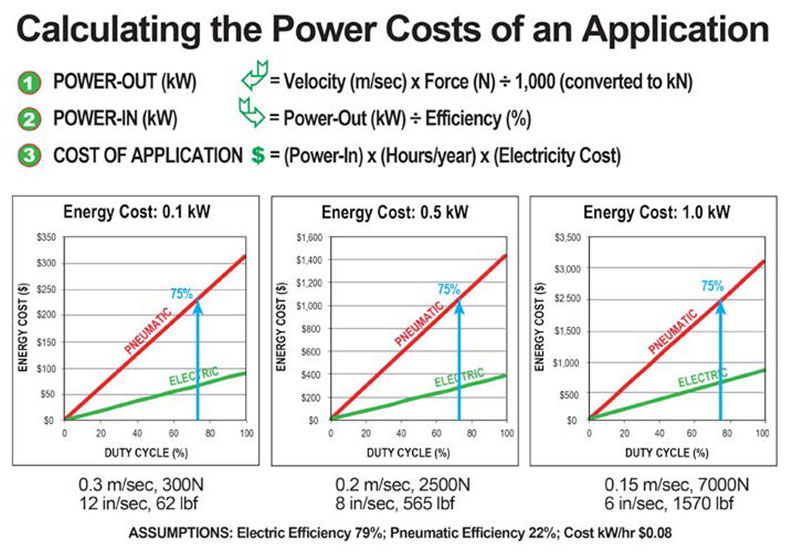
Electric actuators are more energy-efficient than pneumatic actuators. Photo courtesy Tolomatic Inc.
Electric actuator systems typically operate in the 75 to 80 percent efficiency range. Due to their mechanical construction and torque transmission components, this efficiency remains consistent over time.
An additional factor in the electricity cost equation is that electric actuators only demand current to the motor when torque is required for their operation. This means that when electric actuators are at rest, they require little to no current to hold their positions (unless force is required). An electric system allows for motion on demand and achieves a high efficiency range when operation is required. The use of holding brakes can further increase application efficiency, while holding large loads in place and allowing power to the actuator to be switched off.
As a result, electric actuators are often used to decrease electricity usage and meet green and energy-efficiency initiatives.
Shock and Side Loads
Pneumatic cylinders, with their construction containing a volume of compressed air, have an inherent air cushion and increased ability to withstand shock loads. A shock load in line with the rod would be absorbed in most cases by the piston against the compressed air inside the cylinder.
When using electric actuators, with their screw assembly and bearing system, engineers must consider shock loads with respect to the actuator life. Depending on shock load size and actuator construction, some applications may require the actuator to be oversized. The use of a roller screw, with its increased contact points, can increase the shock load capability of an actuator. Depending on the size of shock load, a shock absorber should also be used, or the design of the system should be re-evaluated.
Side loading—due to misalignment or pressure from a moment arm—places stress on both pneumatic and electric systems. When mounting either technology, the actuator must be aligned with the intended axis of motion.
A side load on the rod and piston seals of a pneumatic cylinder will cause premature wear or failure of the seals, resulting in poor performance with velocity and force, increased leaks and premature failure of the cylinder.
Electric actuators don’t perform well in side load scenarios either, but for different reasons. Side loading results in lateral forces on the actuator’s front rod seal and the screw assembly. Increased loading on the rod seal can often result in increased wear, allowing contaminants into the actuator and causing premature failure of the screw and bearing assemblies. Additionally, side loading the screw assembly can reduce the estimated life of the power screw.
However, unlike pneumatic cylinders, electric actuators typically contain an anti-rotation mechanism. This feature adds additional screw support, since it rides on the inside of the body tube, which allows it to absorb some side-loading.
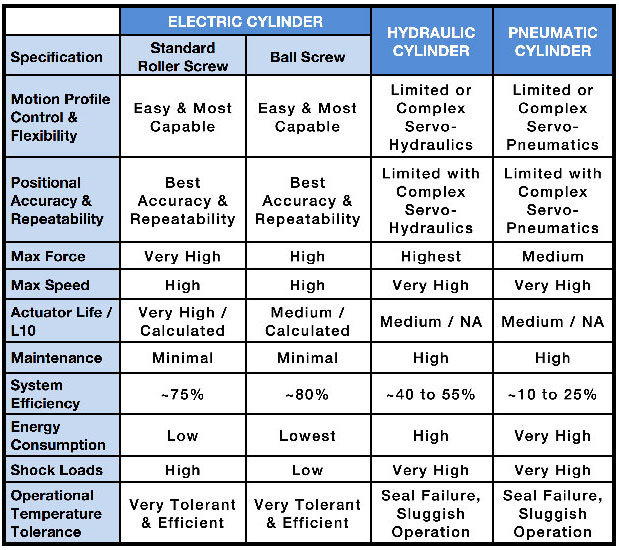
This table shows the application specifications affecting performance and selection for electric, hydraulic, and pneumatic cylinders. Photo courtesy Tolomatic Inc.
For more information on motion control technology, call 800-328-2174 or click www.tolomatic.com.
For more information on motion control technology,read these articles:
Actuators Help Sigma Integrale Simulate Drag Racing
How to Specify Pneumatic Cylinders
How to Choose Between Electric and Pneumatic Actuators and Grippers
Looking for a reprint of this article?
From high-res PDFs to custom plaques, order your copy today!