Robot Sets World Record as First Humanoid to Complete Half-Marathon
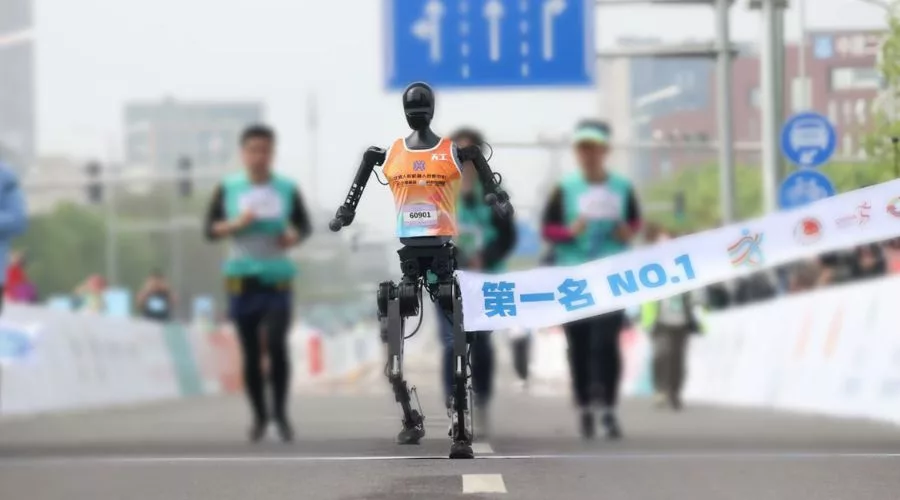
BEIJING, China—On April 19, 2025, twenty-one humanoid robots raced alongside 12,000 human runners for the first time during the Yizhuang Half-Marathon in Beijing. Robots from companies like DroidUP and Noetix Robotics competed, showcasing a range of designs and capabilities. Some robots needed human support, while others, like the winning runner "Tiangong Ultra," a full-size humanoid robot independently developed by the Beijing Humanoid Robot Innovation Center, completed the 21.0975 km course in 2 hours, 40 minutes and 42 seconds. It won the world's first humanoid robot half marathon championship, setting a record and establishing a new benchmark for humanoid robot athletic performance.
According to the Beijing Humanoid Robot Innovation Center, humanoid robots faced challenges such as long-duration running, complex terrains, and unexpected conditions during the half marathon. This demanded extremely high levels of technology in areas like high-energy-density integrated joints, robot body heat dissipation, robust motion control algorithms, and efficient energy systems. In 2021, the bipedal robot Cassie (an ostrich-like robot without an upper body) set a global record by completing 5 kilometers in about 53 minutes.
Unlike typical humanoid robots controlled by remote handles, "Tiangong Ultra" uses wireless navigation technology to follow and plan long-distance paths. It relied on its onboard motion control algorithms and multimodal sensors, combined with ultra-wideband wireless technology to guide the robot in target tracking, calculate its position, and autonomously adjust its running direction and speed in real-time from the start to the finish line. During the race, "Tiangong Ultra" utilized battery quick-swap technology to achieve long endurance for extended operation.
"Tiangong Ultra" stands about 180 cm tall and weighs about 55 kg. For humanoid robots, an increase in height and weight leads to exponentially greater technical challenges: the center of gravity rises, joint drive systems must provide greater torque and withstand higher impacts, motion control algorithms must handle larger inertia and balance dynamics, and energy consumption increases sharply with the load.
"Tiangong Ultra," with its high-power integrated joints and low-inertia leg design, demonstrated explosive speed. Through ongoing structural optimization, "Tiangong Ultra" found a balance between lightweight design and strength, incorporated clever buffering structures, and achieved a flexible-rigid coupled design for the legs and feet, enabling long-distance running without structural damage. Additionally, through optimized structure design, joint heat dissipation technology, and full-body thermal simulation, the joints reached thermal balance, allowing sustained long-duration running.
High coupling between software and hardware was also crucial for long-distance running. Empowered by the general-purpose embodied intelligence platform "Huisi Kaiwu," "Tiangong Ultra" leveraged the efficient coordination between its "large brain" and "small brain" to show clear advantages in long-distance running. On the "large brain" side, the robot used multimodal sensor fusion to perceive the environment in real-time and dynamically adjust speed and direction, even adapting to complex terrain and emergencies. On the "small brain" side, it employed Beijing Humanoid Robot’s "state memory-based predictive reinforcement imitation learning" motion control method, continuously optimizing its strategy and adaptation. This enabled high-precision control of coordinated joint movements, ensuring balance during prolonged running.
By adding disturbance training for turning, slopes, and rugged surfaces, the robot could adjust its gait and movements in real time, achieving more stable and generalized running. The "Huisi Kaiwu" platform completed the perception, decision-making, and execution loop, significantly improving the robot's stability and reliability during the half marathon.
Looking for quick answers on assembly and manufacturing topics? Try Ask ASM, our new smart AI search tool. Ask ASM
In the future, the upgraded "Tiangong," equipped with the "Huisi Kaiwu" platform, will have exceptional athletic capabilities, natural interaction, precise task planning, dexterous dual-arm operations, and multi-skill execution abilities. It will be widely applicable across industrial manufacturing, logistics sorting, specialized operations, and home services and elderly care, providing more support and convenience for social production and daily life.
At the post-race exhibition, the new generation "Tiangong 2.0" was unveiled. Compared with its predecessor, "Tiangong 2.0" received comprehensive upgrades in hardware, operational performance, and application capabilities. In terms of hardware, it features independently developed integrated joints with high precision and large torque, greatly improving athletic performance and adaptability to complex scenarios. Performance-wise, "Tiangong 2.0" boasts a self-developed dual-battery hot-swapping system that allows battery changes while powered on, achieving the first industrial-grade robot with perpetual operation capabilities. Combined with multi-condition energy control technology, it offers far superior endurance compared to its predecessor. It also features industrial-grade upper limb load capacity and a fully flexible lower limb system, laying a strong technical foundation for complex tasks. For operational application, "Tiangong 2.0" is equipped with a world-leading edge-intelligent computing platform, providing technical support for real-time intelligent decision-making.
Looking for a reprint of this article?
From high-res PDFs to custom plaques, order your copy today!