Assembly Lines
Robotic Swarms Will Assemble Large Aerospace Structures
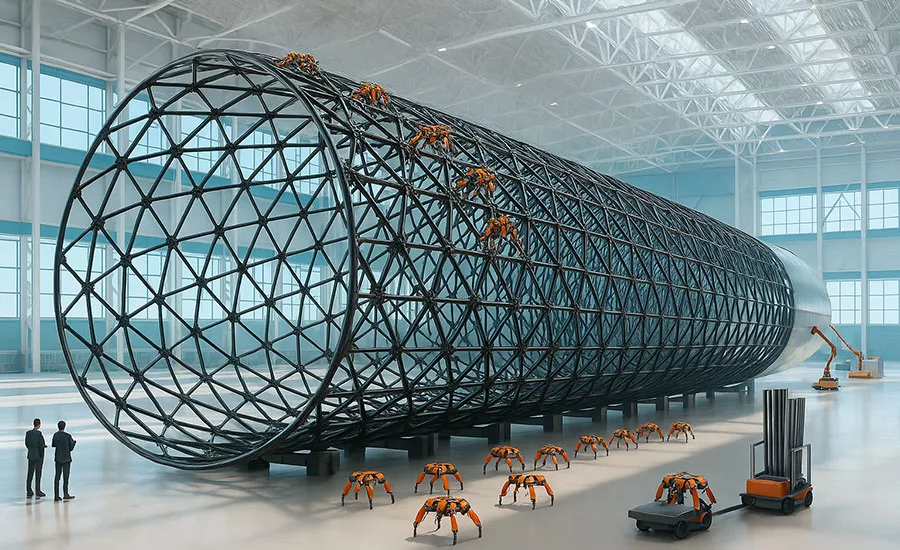
Robotic swarms will be deployed to assemble a large airship for cargo transport applications.
Illustration courtesy H2 Clipper Inc.
SANTA BARBARA, CA—Using automation in aerospace manufacturing applications has traditionally been difficult. But, a start-up company believes it has found an answer. H2 Clipper Inc. plans to deploy autonomous and semi-autonomous robotic swarms to assemble its rigid airship.
The 1,000-foot-long hydrogen-powered vehicle will be capable of economically transporting heavy payloads up to 340,000 pounds over long distances. The company claims that its airship will be 70 percent less expensive than traditional air freight.
The airship has an aerodynamic shape that gives it a top speed of 175 mph and a range of 6,000 miles. Electric motors will drive five propellers. A triangular-shaped exoskeleton hull made of lightweight carbon fiber composite materials gives the 150-foot diameter airship a rigid shape and eliminates the need for bulky internal braces and supports.
Separately fabricated nose and tail cones will attach to the exoskeleton. The airship’s external skin will be made from a fire-resistant and flame-retardant material.
H2 Clipper recently received a U.S. patent for the use of swarm robotics in large-scale aerospace manufacturing “to assist in assembling the frame, attaching the skin and performing other tasks in manufacturing an airship, and constructing other structures that are otherwise challenging, inefficient or unsuitable for humans to perform, or that traditionally require significant investments in capital intensive manufacturing facilities.”
“The issuance of this patent marks a pivotal moment in the evolution of aerospace and aviation manufacturing,” claims Rinaldo Brutoco, CEO of H2 Clipper. “By replacing traditional assembly lines with robotic swarms, this breakthrough enables aircraft and large aerospace assets to be built faster, at a significantly lower cost, and with far greater precision.
“Conservative estimates based on current aerospace production benchmarks suggest this approach can reduce total manufacturing costs by 40 percent or more, and cut production time by up to 60 percent, while simultaneously improving quality,” says Brutoco.
Looking for quick answers on assembly and manufacturing topics? Try Ask ASM, our new smart AI search tool. Ask ASM
According to Brutoco, the innovation enables “unparalleled precision and continuous round-the-clock autonomous production.” He says it offers numerous benefits, including:
- Automated manufacturing. Robots work in a coordinated swarm to assemble airframes, attach the exterior skin, install structural and internal components, perform bonding and fastening operations, conduct in-process quality inspections, and carry-out other complex, high-precision assembly tasks.
- AI-driven optimization. Machine learning and generative AI guide the robotic swarm to self-correct, improve manufacturing precision, reduce errors and optimize construction timelines.
- Scalability and safety. The system uses built-in sensors and AI-driven oversight to safely manage all operations, assuring collision-free operation and eliminating the need for people to operate at dangerous heights. With no fixed assembly line or gantries required, manufacturing can be supervised remotely and scaled across multiple locations.
- Heavy-lift robotics integration. The technology enables large-scale structures to be constructed entirely in place—horizontally or vertically—using autonomous robots capable of repositioning and aligning major components. This flexibility supports multiple assembly approaches, while reducing infrastructure requirements and improving safety.
“Whereas traditionally, aircraft must be moved through multiple stages, requiring massive facilities, complex scheduling and high logistical overhead, [our airships will be] built in place, eliminating costly movement, saving time, and reducing the need for assembly line infrastructure.
Brutoco believes that swarm robotics could be used to assemble other types of aerospace structures, such as aircraft fuselages. He plans to assemble a team of manufacturing experts to develop a technology roadmap that would support potential licensing to various OEMs.
“This patent represents a game-changing moment for aerospace manufacturing—a shift as significant as the invention of the assembly line itself,” claims Brutoco. “Swarm robotics gives OEMs the ability to build aircraft and spacecraft smarter, faster and more affordably than ever before, opening the door to a new era in aviation and the future of flight.”Looking for a reprint of this article?
From high-res PDFs to custom plaques, order your copy today!


