HOUSTON—
HD Korea Shipbuilding & Offshore Engineering and HD Hyundai Robotics are developing bipedal machines specifically designed for shipyard welding tasks.
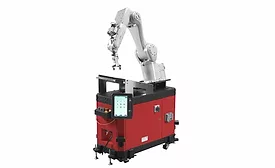
VERNON HILLS, IL—Mitsubishi Electric Automation Inc. has introduced the ARIA (Automated Robotic Industrial Assistant), its latest pre-engineered workcell.
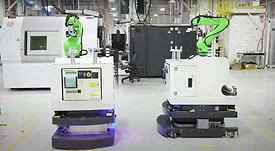
MILWAUKEE—OTTO Motors by Rockwell Automation plans to create next-generation autonomous mobile robots equipped with Nvidia artificial intelligence technology.
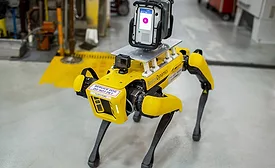
DEARBORN, MI—Ford Motor Co. has welcomed two new employees to its Van Dyke Transmission Plant in Sterling Heights, MI. Named Fluffy and Spot, they have four legs, and they can sit, shake hands, roll over and climb stairs.
In this RoboBusiness Direct session, you will learn about one of the biggest opportunities for providers of robotics technologies—retrofitting manually steered vehicles used in various industries to support autonomous navigation. The session will include data on shipments and revenues, as well as overviews of well-known providers of autonomous navigation systems, including Brain Corp., BlueBotics, Built Robotics and Outrider.
Robots are an important piece of the Industry 4.0 puzzle. Tomorrow's smart factories will depend on new types of machines, such as collaborative and mobile devices that are interconnected. Artificial intelligence (AI), cloud computing and data analytics will also make industrial robots more reliable than ever.
Developing new aircraft is always a challenge, but one that engineers at Gulfstream Aerospace Corp. (GAC) have successfully dealt with for more than 60 years. GAC produces state-of-the-art corporate jets for companies and governments all around the world, with hundreds of them currently in operation.
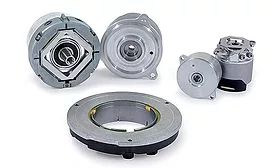
Speed, power and durability are key characteristics of industrial robots. These robots are typically used in applications such as welding or in lifting heavy components for vehicle assembly. Yet despite advanced calibration methods, the positional accuracy of industrial robots has been inadequate for certain tasks. This is now changing thanks in part to highly accurate, output-side encoders from Heidenhain and AMO.