New Lightweight EV Motor Uses Nano Technology
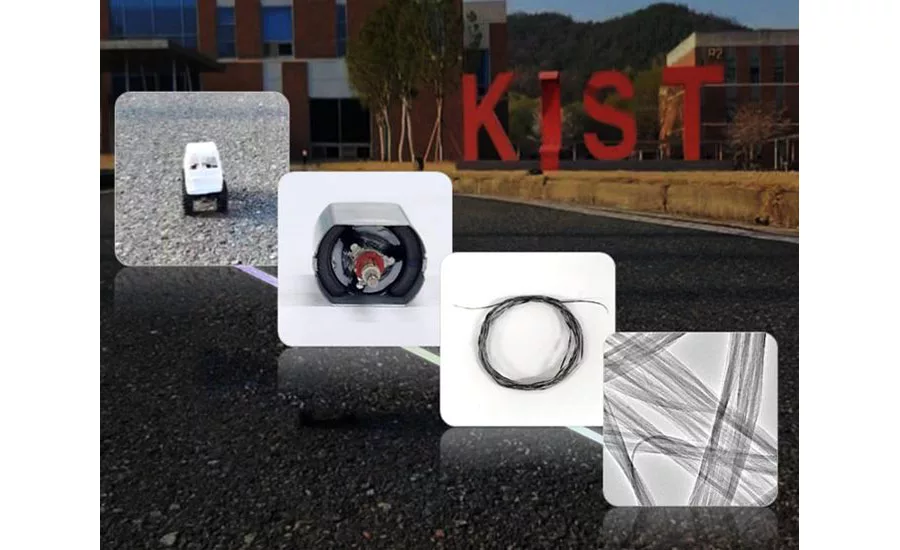
Engineers constructed the coil of an electric motor using only carbon nanotubes. Illustration courtesy Korea Institute of Science and Technology
SEOUL—Engineers at the Korea Institute of Science and Technology (KIST) have developed an electric motor that does not use traditional copper coils. Instead, it relies on carbon nanotube (CNT) technology to reduce weight.
CNTs are one-dimensional tube-shaped nanomaterials with carbon atoms arranged in a hexagonal honeycomb structure that are known to be much lighter than ordinary metals, while at the same time possessing excellent electrical conductivity, mechanical strength and thermal conductivity.
These properties have long attracted attention as a next-generation material, but CNTs have faced numerous barriers to real-world applications. One of the technical obstacles is the residue of catalyst metals used during the manufacturing process. These remain as metallic particles on the surface of CNTs, degrading their electrical properties.
To address the issue, KIST engineers developed a new CNT purification process that utilizes the alignment principle of liquid crystals.
“[It is a ‘fourth state of matter’ known as the intermediate state between liquid and solid,” says Dae-Yoon Kim, Ph.D., an engineer at the KIST Composite Materials Research Institute who is working on the project. “The process naturally resolves strong aggregation during the alignment of CNTs, effectively removing metallic particles that remain on the surface.
“The process is able to selectively remove impurities without damaging the nanostructure of the CNTs, making it distinctly different from existing liquid- and gas-phase-based purification methods,” explains Kim. “The purified CNTs show a significant improvement in conductivity, which can be brought to a level that can be applied to actual electric motors.”
According to Kim, coils account for a large proportion of the total weight of electric motors. Traditionally, metals such as copper have been used as the main material for coil,s due to their high electrical conductivity. However, copper is not ideal because of issues such as difficulty in securing resources, price volatility and weight problems due to high density.
Kim and his colleagues conducted experiments by applying a coil made of CNTs to a motor and found that the revolutions per minute could be stably controlled according to the input voltage. “This demonstrates that the basic operation of a motor…can be accomplished without metal,” he points out.
Looking for quick answers on assembly and manufacturing topics? Try Ask ASM, our new smart AI search tool. Ask ASM
Looking for a reprint of this article?
From high-res PDFs to custom plaques, order your copy today!