Automotive Industry
Zoox Opens California Factory to Assemble Robotaxis
At capacity, the factory will employ hundreds and be able to assemble more than 10,000 robotaxis annually.

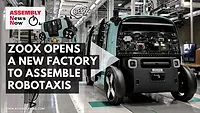
Zoox has opened a new assembly plant in Hayward, CA, to produce robotaxis. Photo courtesy Zoox Inc.
HAYWARD, CA—Amazon subsidiary Zoox Inc. has opened a new assembly plant here to produce robotaxis.
The company plans to introduce its robotaxi service in multiple locations throughout the United States, starting with Las Vegas this year. San Francisco, Austin and Miami are expected to follow in the next few years. (The company has been testing its robotaxis in Las Vegas, San Francisco and Foster City, CA, for the past two years.)
Spanning 220,000 square feet, the Hayward plant is the company’s second vehicle production facility in the Bay Area. The first assembly facility, located in Fremont, CA, has evolved into a dedicated facility for the company’s retrofitted testing fleet and for sensor pod configuration.
At full capacity, the Hayward factory will employ hundreds of people and be able to assemble more than 10,000 robotaxis annually. In addition to assembly, the factory will house myriad operations, including engineering; software and hardware integration; component storage; shipping and receiving; and end-of-line testing.
The factory is situated near Zoox’s Foster City headquarters, fostering collaboration between engineers and other teams.
The new factory blends automated and manual processes. Robots are used for specific tasks, such as dispensing adhesive for glass installation and transporting the robotaxi down the assembly line.
The factory was designed with sustainability in mind. For example, the company prioritized the use of logistics equipment to reduce noise and air pollution. Additionally, because Zoox does not perform energy-intensive processes like welding, cutting or painting on-site, the facility has a relatively low power draw compared with traditional car factories.
Looking for quick answers on assembly and manufacturing topics? Try Ask ASM, our new smart AI search tool. Ask ASM
Zoox also partners with suppliers to preassemble major components rather than managing every aspect of manufacturing in-house. This strategy streamlines the final assembly process and lessens the environmental impact of large-scale industrial operations.
Zoox has adopted a modular approach to robotaxi assembly, which is made possible by its symmetrical quadrant vehicle design.
An automated transport system moves vehicles from station to station. QR codes along a green line keep them on track along the routes. One of the final steps before the vehicle is moved into testing is the installation of the interior and sensors.
Once the robotaxi rolls off the production line, it is prepared for end-of-line testing. First, each robotaxi enters a calibration bay. The calibration bay ensures that all sensors are working in concert to produce an accurate understanding of the surrounding environment. The robotaxi rotates on a turntable, collecting data to calibrate the full suite of lidar, camera, long-wave infrared, and radar.
Next is wheel and headlight alignment. Each robotaxi arrives at an alignment station, where a subterranean operator adjusts each wheel to ensure the vehicle tracks and steers as intended. Headlights are also manually adjusted to ensure compliance with regulatory requirements.
The robotaxi is then loaded onto a dynamometer to stress the power train. The vehicle autonomously runs a series of tests at speeds of up to 75 mph to verify that the motors, brakes and thermal systems are functioning correctly.
At the next station, the robotaxi is subjected to a simulated rainstorm. This is to check for any leaks, ensuring riders and sensitive electronics stay dry in inclement weather.
The light tunnel acts as a final quality inspection point. Along with a visual check for scratches, fit issues or uneven gaps, various static functional tests are conducted. For instance, verifying that subway-style doors open and close properly, seatbelts work as intended, and the interior lighting, touch screens, and wireless charging units are functional.
Finally, each robotaxi is taken to an outdoor test track for an initial autonomy run to verify the proper operation of the ride-hailing, driving, and pickup and drop-off behaviors. The test track features elements that simulate a bumpy road, enabling operators to check for squeaks, rattles or loose connectors.Looking for a reprint of this article?
From high-res PDFs to custom plaques, order your copy today!