Manufacturing History
Historic Sites Preserve and Promote Industrial Heritage
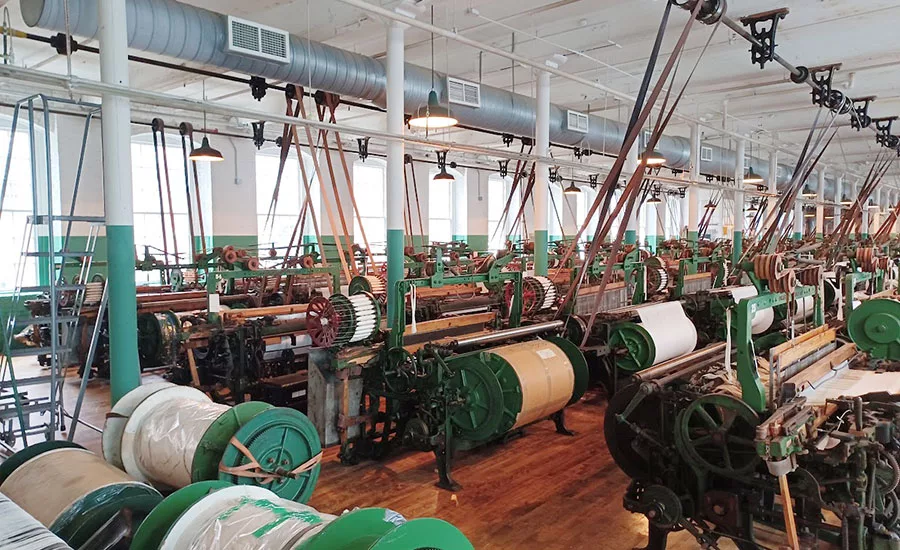
Photo by Austin Weber
The National Park System has been called “America’s Best Kept Secret.” Its network of natural wonders stretches from Arcadia in Maine to the Grand Canyon in Arizona and from Denali in Alaska to the Dry Tortugas in Florida.
But, along the way, the National Park Service also maintains an interesting assortment of historic sites, including several that celebrate America’s unique manufacturing heritage.
If you ever find yourself near Boston, Chicago or San Francisco, several small museums are worth visiting. The sites are located near popular attractions such as Cape Cod National Sea Shore, Indiana Dunes National Park and Redwood National Park. Each focuses on a different era, including the Industrial Revolution, the Gilded Age and World War II.
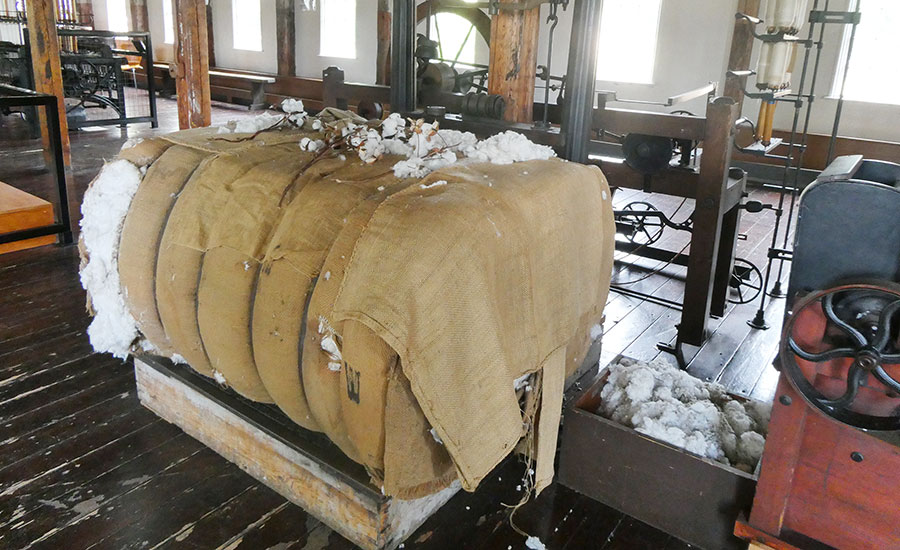
Old Slater Mill was the first American factory to successfully produce cotton yarn with water-powered machines. Photo by Austin Weber
Old Slater Mill
Blackstone River Valley National Historical Park is located between Providence, RI, and Cape Cod. It’s made up of six unique sites that tell the story of the American Industrial Revolution, including the Old Slater Mill National Historic Landmark.
The latter is a water-powered cotton-spinning mill that was built in 1793 by Samuel Slater. He used his photographic memory to successfully replicate textile machines he had seen in his native England.
At the time, the U.S. was still an agrarian nation and handicraft methods of textile production prevailed. No American inventor had yet been successful in building a textile spinning machine, and British law prohibited the export of such machines. In fact, to leave England, Slater had to disguise himself as a farmer.
Slater’s mill was the first American factory to successfully produce cotton yarn with water-powered machines. Water from the Blackstone River operated three carding machines and two spinning frames that were each equipped with 48 spindles.
Looking for quick answers on assembly and manufacturing topics? Try Ask ASM, our new smart AI search tool. Ask ASM
A series of overhead line shafts, pulleys and belts operated the machines at different speeds. However, most of the workers were children who toiled long hours in primitive conditions.
According to the National Park Service, Slater Mill is historically significant because it represents “the beginning of everything from machine-made goods and hourly wages, to planned communities and labor unions.”
By 1810, more than 60 cotton mills and 30,000 spindles were in operation in the U.S., primarily in Rhode Island and the Philadelphia area.
The three-story, wood-framed Slater Mill operated as a textile mill until 1895. Today, it contains working examples of various spinning and looming machines from different time periods.
One of Slater’s original spinning frames is also housed at the Smithsonian’s National Museum of American History in Washington.
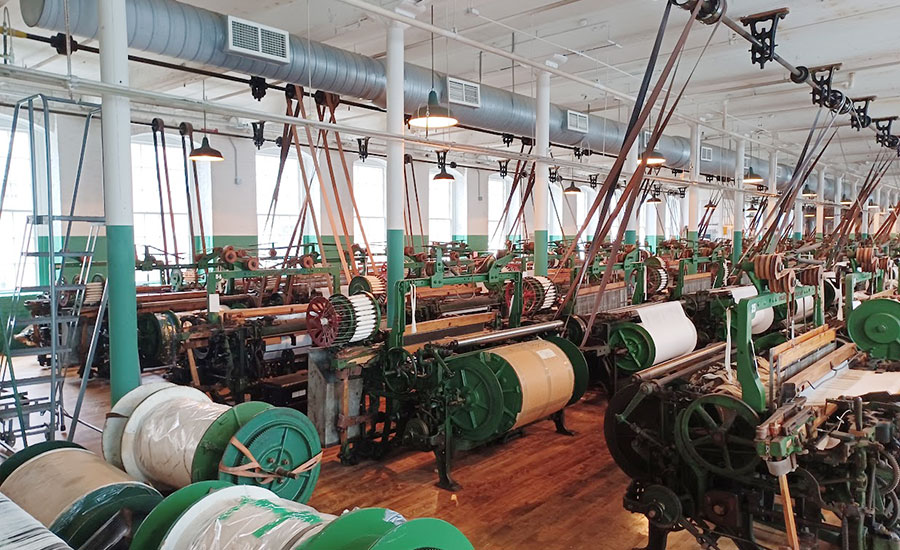
Textile mills in Lowell, MA, played an important role in the Industrial Revolution. Photo by Austin Weber
Lowell
Lowell is a small city in New England that’s located 30 miles northwest of Boston. As the first successful planned industrial town in the United States, it played an important role in the Industrial Revolution.
Beginning in the mid-1820s, textile entrepreneurs flocked to the city and built a 6-mile-long system of canals to harness water from the Merrimack River to power a large complex of mills.
Henry David Thoreau called Lowell the “Manchester of America, which sends its cotton cloth around the globe.” During the mid-1800s, 10 mills equipped with more than 300,000 spindles and 10,000 looms transformed cotton from the South into almost 1 million yards of cloth a week.
The mills employed more than 10,000 people and by 1850, Lowell was the second largest city in Massachusetts. At first, many workers were young, single women who came from farms and small rural villages throughout New England and lived in boardinghouses. But, after the Civil War, local textile companies began hiring European immigrants who were willing to work long hours in loud, dangerous conditions for low pay.
Virtually all steps in the production process were mechanized, from opening bales of cotton to bleaching or printing cloth. Stationary steam engines eventually replaced water power and the mills remained profitable until the 1920s, when the industry began shifting to southern states. By the mid-1950s, the last of the original mills shut down.
Today, Lowell National Historical Park includes several restored buildings and a variety of exhibits, in addition to canal boats and trolleys that transport visitors. The highlight is the Boott Cotton Mills Museum, which is housed in a red brick factory built in 1836.
It features a large weave room packed with more than 80 historic power looms from the 1920s that are still in operation. An extensive museum located nearby contains a variety of displays that explain the important role Lowell played and provide a glimpse of daily life inside the mills.
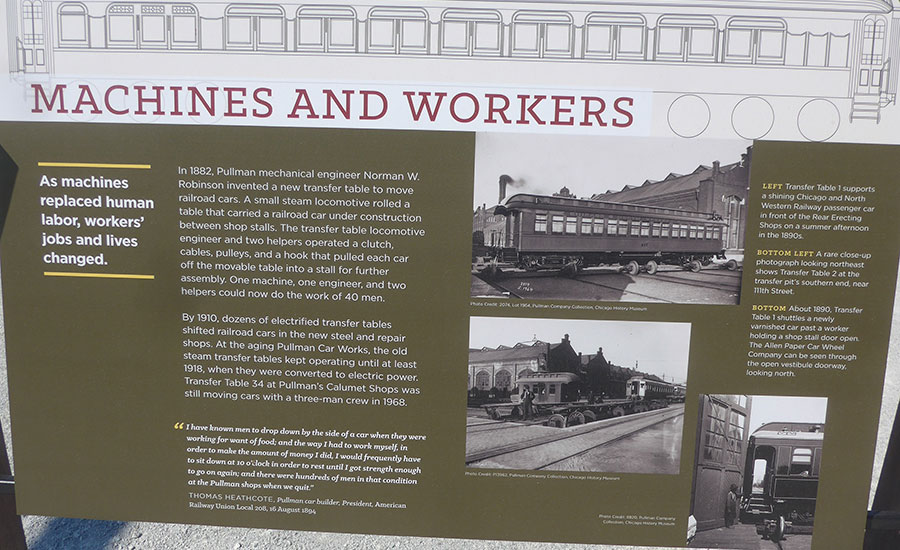
Pullman engineers developed innovative production processes and adopted new technology to remain competitive. Photo by Austin Weber
Pullman
The Pullman National Monument on the South Side of Chicago celebrates the unique history of a company that mass-produced freight and passenger rail cars at the site from 1881 to 1981. In addition to playing an important role in manufacturing, Pullman had a leading hand in both the organized labor and the civil rights movements.
All three achievements are celebrated at the visitor’s center, which is housed in a red brick Romanesque-style building that formerly housed managers and engineers at the vertically integrated production complex.
The Administration Clock Tower Building forms the centerpiece of the 12-acre national monument grounds, which features several historic Pullman buildings. Unfortunately, much of the manufacturing complex was destroyed by a fire several decades ago.
However, numerous brick duplexes and row houses remain standing nearby, and most are still inhabited. They were once part of a controversial “model town” that was built to house rail car workers and their families. The utopian community, which contained homes, churches, parks, shopping areas, a hotel and a library, plus an innovative sewage system, was once hailed as the “world’s most perfect town.”
The homes and factory complex were the brainchild of George Pullman, an entrepreneur who transformed the railroad industry by providing a method of long-distance, overnight travel that was clean, comfortable, reliable and safe.
Pullman engineers developed a variety of innovative production processes and adopted new technology to remain competitive. For instance, as railroad cars evolved from wood to steel in the early 1900s, new types of riveting and welding equipment were deployed on the factory floor. Displays at the visitor center explain how those manufacturing techniques were used to mass-produce rail cars.
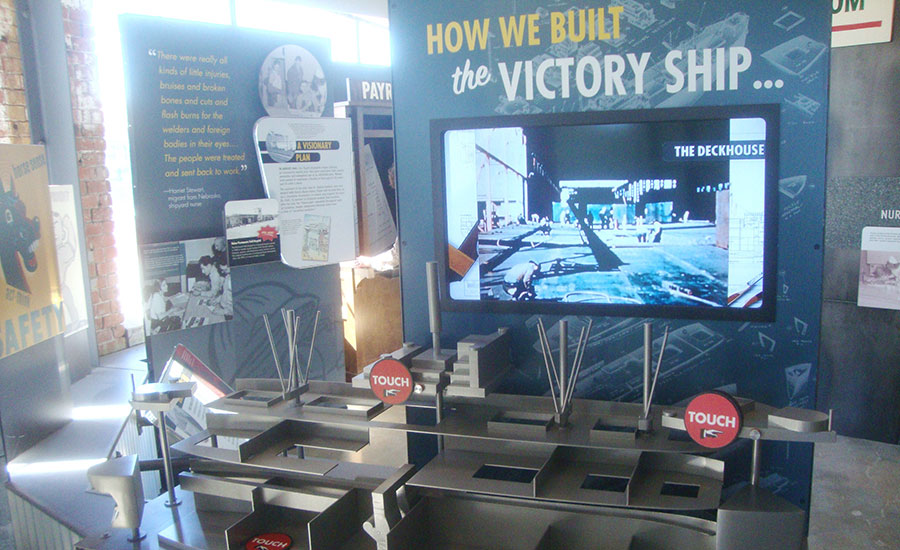
An interactive museum in Richmond, CA, celebrates women who worked in factories and shipyards during World War II. Photo by Austin Weber
Rosie the Riveter
Rosie the Riveter National Historical Park in Richmond, CA, overlooks scenic San Francisco Bay. Housed in a former Ford Motor Co. assembly plant, it celebrates life on the American home front during World War II by honoring all of the women who worked in factories.
“Rosie” refers to a famous illustration created for Westinghouse Electric Co. in 1942 by J. Howard Miller. The colorful image of a woman in a red polka-dot bandana raising her fist was turned into the ubiquitous “We Can Do It!” morale poster by the War Production Co-Ordinating Committee.
A different interpretation of Rosie painted by Norman Rockwell appeared on the cover of the May 29, 1943, issue of The Saturday Evening Post. It depicts a strong, confident woman eating lunch while wearing goggles on her head and holding a rivet gun in her lap, with an American flag in the background.
Rockwell based the pose on Michelangelo’s Sistine Chapel ceiling painting of the prophet Isaiah. The Post cover was so popular that the magazine loaned it to the U.S. Treasury Department for use in war bond drives.
In reality, numerous Rosie’s worked around the clock assembling aircraft, tanks, trucks and other vehicles in factories throughout the United States. At the same time, their counterparts, dubbed Wendy the Welder, toiled away in shipyards from New York City to San Francisco and Chicago to the Gulf of Mexico.
A museum and education center housed in part of the Ford factory contains interactive displays. In addition to honoring the unique role that women played in the war effort, the museum tells the story of the Bay Area’s contribution to the Arsenal of Democracy. Several local shipyards, such as Bethlehem Shipbuilding Corp., Moore Dry Dock Co. and Richmond Shipbuilding Corp., developed mass-production techniques that enabled them to find innovative ways to cuts costs and save time.
One technique was the widespread use of pre-assembled large components, such as deck houses. The shipyards also pioneered the use of arc welding, automatic seam-welding machines and other types of high-speed metal fabrication. That allowed them to produce more ships more quickly and efficiently than ever before.
According to the National Park Service, that unprecedented activity represented the “largest concentrated outpouring of ships in the history of the world. San Francisco Bay Area shipbuilders produced almost 45 percent of all the cargo shipping tonnage and 20 percent of warship tonnage built in the entire country during World War II.”
The Ford factory was built in the early 1930s to assemble Model A sedans, but during World War II, it produced Jeeps, tanks and other military vehicles destined for the Pacific Theater. After the war, the facility was retooled for civilian production and remained in operation until 1955.
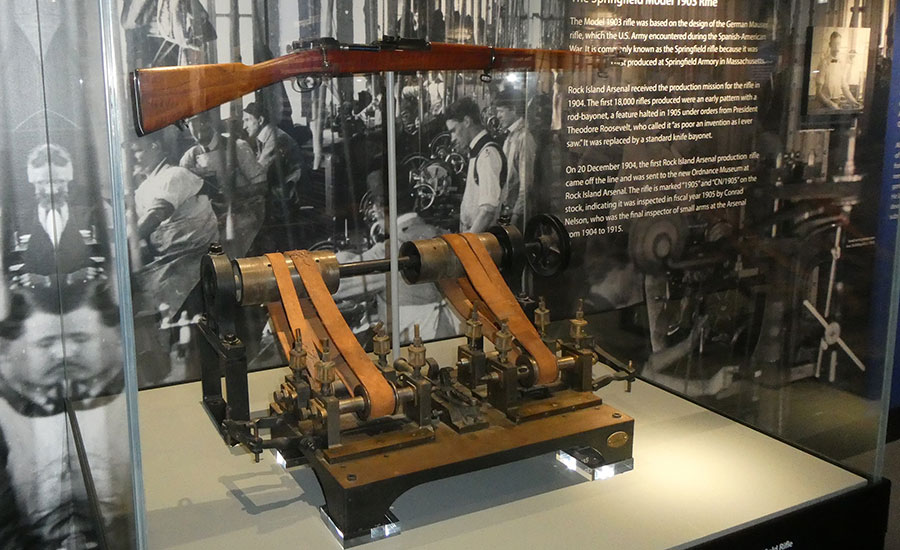
This stock boring machine was used to mass-produce Springfield rifles in the early 1900s. Photo by Austin Weber
Rock Island Arsenal
Although technically not a national park, the Rock Island Arsenal is a National Historic Landmark. It’s located on a 946-acre site that stretches three miles long in the Mississippi River between Davenport, IA, and Moline, IL.
Since 1862, the arsenal has served as an important manufacturing hub for the U.S. Army. During that time, the facility has made everything from mundane metal canteen cups and plates to lethal artillery shells and tanks.
The Rock Island Arsenal Museum features a variety of artifacts and interactive exhibits. Displays explain how the facility has mass-produced all sorts of infantry and artillery equipment, including camp stoves, cartridge boxes, haversacks, heaters and knives, in addition to gun carriages, howitzer canons, machine guns and rifles.
Besides producing many types of ordnance, the arsenal’s shops even made saddles, spurs and tack for horse-mounted cavalry troops during the Civil War, Spanish-American War and World War I. In fact, during the latter conflict, the Rock Island Arsenal produced 20,000 unique items and housed the largest harness manufacturing shop in the world. Museum displays explain how the arsenal also played a vital behind-the-scenes role during other major events, such as World War II, the Korean War and the Vietnam War.
The Rock Island Arsenal is still in operation today, housing vertically integrated facilities such as the Joint Manufacturing & Technology Center, which boasts 30 buildings and 3-million-square-feet of production space. A display in the museum explains how engineers continue to develop and produce advanced items for the military using additive manufacturing, laser welding and other state-of-the-art techniques.
Looking for a reprint of this article?
From high-res PDFs to custom plaques, order your copy today!