New Process Uses Ultrasound Technology to Test EV Batteries
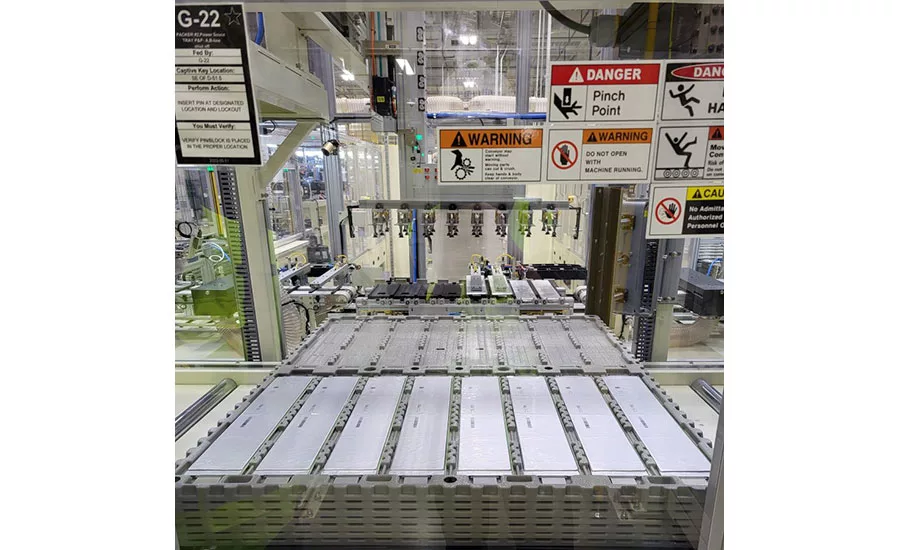
Ultrasound technology enables engineers to peer deep inside EV batteries.
PHILADELPHIA—Engineers at Drexel University have developed a benchtop tool that enables automakers and suppliers to get a better look at the electrochemical and mechanical functions of EV batteries. It uses ultrasound technology to reveal any damage or flaws that could lead to overheating or thermal runaway.
“While lithium-ion batteries have been studied for nearly half a century and commercialized for over 30 years, we have only recently developed tools that can see inside with high resolution,” explains Wes Chang, Ph.D., an assistant professor of mechanical engineering and primary investigator at Drexel’s Battery Dynamics Lab.
“In particular, ultrasound has been adapted from other fields, such as geophysics and biomedical sciences, for battery diagnostics only in the past decade,” Chang points out. “Because it is such a new technique in the EV industry, there is a need to teach battery engineers how it works and why it is useful.
“While the vast majority of lithium-ion batteries today are high performing and safe, defects are bound to exist when thousands of cells are used within electric vehicles and there are millions of electric vehicles being produced every year,” says Chang.
According to Chang, current safety and quality control processes rely heavily on visual inspection and performance testing of select battery cells after they come off the production line. Batteries may also be X-rayed to generate a high-resolution interior image, but this is slow and expensive.
“Manufacturers are required to follow these inspection and testing protocols, but with the scale at which batteries are being used, even a small design or manufacturing flaw that is missed can lead to a massive batch of defective batteries making their way into market,” warns Chang.
Chang claims that acoustic imaging—ultrasound—is faster and less expensive than X-rays and can easily provide complementary information about the mechanical properties of a battery. “The sensitivity of ultrasound makes it useful not just for detecting defects in manufacturing, but also for gauging how new battery chemistries fail in research and development labs,” he explains.
Looking for quick answers on assembly and manufacturing topics? Try Ask ASM, our new smart AI search tool. Ask ASM
The Drexel engineers used scanning acoustic microscopy technology to send low-energy sound waves through a commercial pouch cell battery.
Without affecting its internal operations or affecting its performance, the speed of the waves was altered as they passed through the various materials inside a battery. This allowed Chang and his colleagues to get a quick, detailed look at the chemical changes within battery materials as it was being used.
“By observing how the sound wave has changed upon interacting with the sample, we can deduce a number of structural and mechanical features,” notes Chang. “The process can help to detect structural defects or damage that could cause an electrical short and material deficiencies or imbalances that could hamper performance, as well as indications that problems are likely to occur.
“One substance the scan is particularly good at detecting is gas, which is important because the presence of [it] inside a battery is an indication of dry areas that could cause the cell to fail while it is being used,” claims Chang.
As part of the R&D project, Chang worked with engineers at SES AI, a lithium metal battery start-up. “We hope that by lowering the barrier to entry, ultrasonic testing can become a routine part of battery research and development,” he points out. “This adds to the existing collection of tools that [engineers] have on hand for measuring and diagnosing next-generation battery performance.”
Chang and his colleagues plan to continue improving the technology so that it can more easily scan battery electrodes, as well as cells, and produce more detailed three-dimensional images to better detect defects.
Looking for a reprint of this article?
From high-res PDFs to custom plaques, order your copy today!