Assembly Lines
New Center to Study Digital Twin Use in Manufacturing
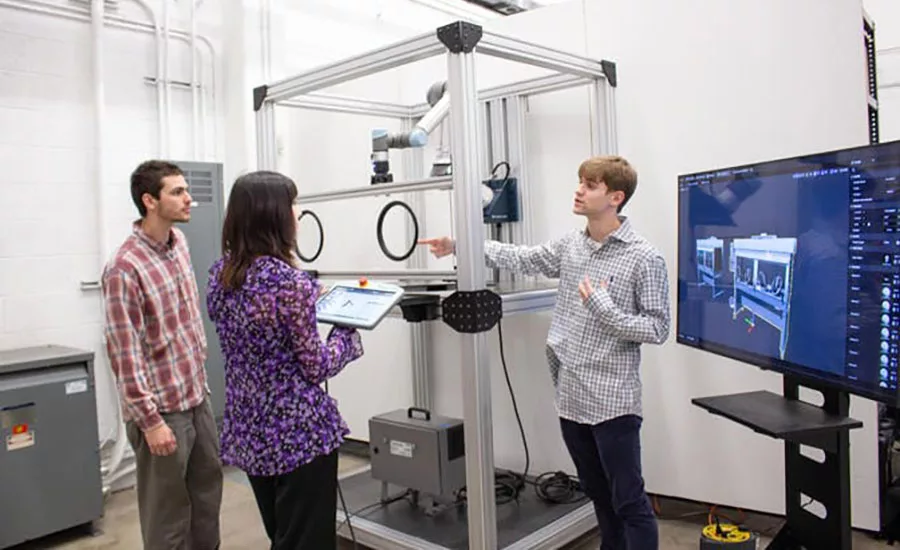
The new Center for Digital Twins in Manufacturing will study how to improve performance, quality and uptime.
Photo courtesy Arizona State University
ANN ARBOR, MI—Engineers at Arizona State University and the University of Michigan are establishing a Center for Digital Twins in Manufacturing. The goal of the organization is to address barriers that prevent digital twins from delivering on their promise to improve operational efficiency.
A digital twin is a computer model of a device that is in communication with the real device, updating itself so that it matches the state of the device it is modeling. For instance, a digital twin of a machine might represent the progress of a metal or plastic part, checking in every tenth of a second to make sure that its model is in lockstep with the real machine.
“The digital twin can make predictions about part quality, when maintenance will be needed and more,” says Dawn Tilbury, Ph.D., a mechanical engineering and robotics professor at the University of Michigan. “However, lack of standardization makes digital twins difficult to implement in manufacturing.”
Currently, Tilbury says most digital twins are for single devices. If a factory has a digital twin for an entire system or line, it is likely a custom piece of software that has to be rewritten if a part of the system changes. Meanwhile, many companies are providing digital twin software for individual machines.
According to Tilbury, linking them up with twins of the previous and next machines on the line would enable better coordination both up and down the line.
“Everyone’s building digital twins, but we’re trying to build the glue or connectivity that enables [the technology] to work together—to be composable, reusable and maintainable,” explains Tilbury. “[We] will work on issues that can bring broad benefits to everyone making and using digital twins, helping expand the use of these great technologies to improve manufacturing performance, quality and uptime.”
Tilbury and her colleagues also plan to focus on research aimed at quantifying and reducing uncertainty in digital twins, in addition to developing digital twins for human-robot collaboration.Looking for quick answers on assembly and manufacturing topics? Try Ask ASM, our new smart AI search tool. Ask ASM
Looking for a reprint of this article?
From high-res PDFs to custom plaques, order your copy today!


.webp?height=200&t=1774983900&width=200 "Manufacturing engineers using artificial intelligence software to analyze production data and optimize factory operations")