Assembly Lines
Humanoid Robots Are Moving From Hype to Reality
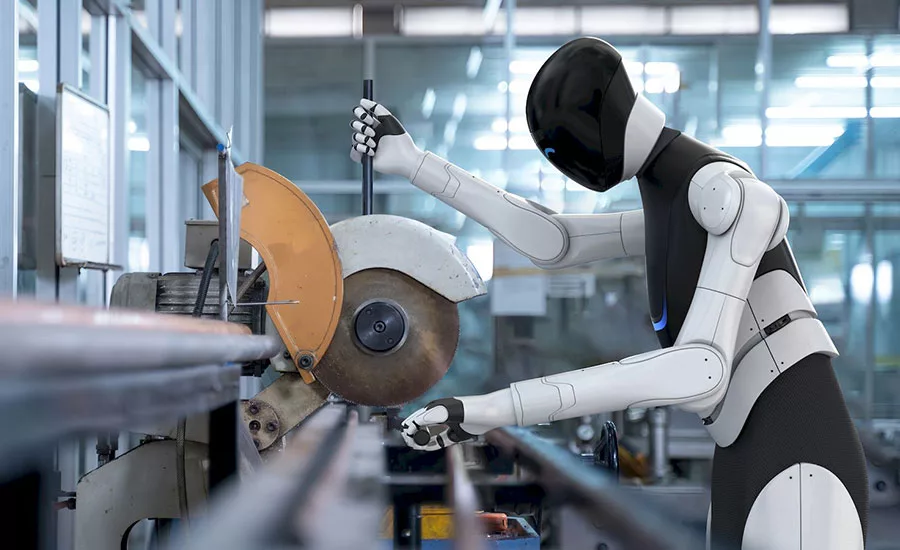
Many manufacturers are intrigued by potential applications for humanoid robots.
FRANKFURT, Germany—Human-sized machines equipped with two arms and two legs are slowly making their way into factories. They feature state-of-the-art actuators and sensors powered by artificial intelligence technology.
Humanoids are one of the hottest trends in robotics today. Start-ups in Asia, Europe and North America are scrambling to commercialize bipedal machines that can safely work alongside humans. The goal is to mass-produce general-purpose robots that help address severe worker shortages facing manufacturers.
“Futuristic humanoids working in homes, businesses and public spaces fuel people’s interest,” says Takayuki Ito, president of the International Federation of Robotics (IFR). “Since our environment is optimized for the human body, the demand for a quick, universal helper to maintain manufacturing and services is evident.
“If and when a mass adoption of humanoids will take place remains uncertain,” notes Ito, who also serves as chief technical advisor at Fanuc Corp. “In any case, humanoids are not expected to replace the types of robots currently on the market. Instead, they will complement and expand upon existing technology.”
Thanks to their human-like dexterity and adaptability, Ito believes that humanoids are well placed to automate complex tasks that traditional industrial robots struggle with. However, he says mass adoption as universal household helpers may not happen anytime soon.
IFR recently produced a report that provides valuable insights on humanoid technology. Among other things, it separates some of the hype from reality. It also examines how humanoid technology is being developed in different parts of the world.
“In the United States, tech companies like Amazon, Nvidia and Tesla are heavily developing advanced AI and robotics technologies,” says Ito. “Besides military funding, a lot of private investments [is supporting] this development. [There are] a large number of start-ups developing humanoid robots.
Looking for quick answers on assembly and manufacturing topics? Try Ask ASM, our new smart AI search tool. Ask ASM
“There is a strong interest in using humanoids in logistics and manufacturing,” claims Ito. “These machines are seen as tools for enhancing productivity and efficiency, rather than as social companions. The focus is more on practical applications and less on integrating robots into daily social life.”
China has put humanoids at the center of its national strategy. The government wants to showcase its competency and global competitiveness in this field of technology. According to Ito, one key element of the Chinese strategy is to establish a supply chain for key components that is scalable.
Japan has been a pioneer in the development of humanoid robots since Honda's Asimo machine debuted in 2000. Since then, a variety of machines designed as “social robots” have been deployed in educational settings, retail stores and elderly care facilities. The focus is on creating robots that can live harmoniously with humans and are accepted as part of society.
“Europe places a strong emphasis on the ethical implications of robotics and AI,” says Ito. “It has a significant focus on collaborative robots that work alongside humans in industrial settings. The [emphasis] is on enhancing safety, efficiency and human capabilities [Industry 5.0], rather than on replacing human workers.”Looking for a reprint of this article?
From high-res PDFs to custom plaques, order your copy today!