Assembly Audible
Despite Challenges U.S. Manufacturing Executives Are Increasingly Optimistic
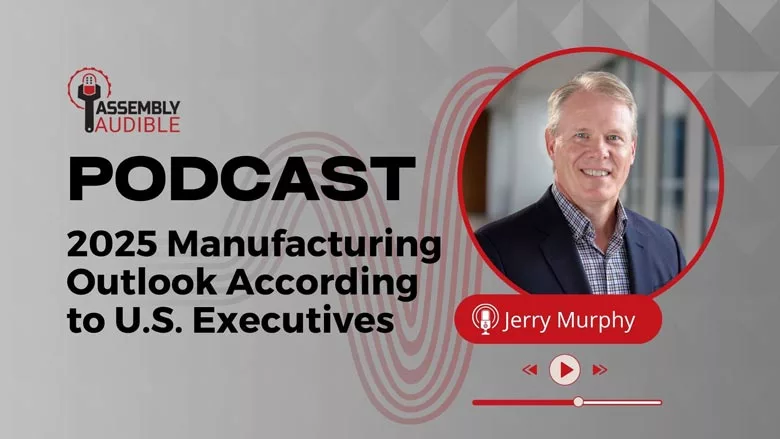
How are manufacturers adapting to inflation, supply chain challenges, and other economic headwinds? Where are manufacturers investing? We focus on top industry and macroeconomic trends based on new data from Sikich’s 2025 Manufacturing & Distribution Industry Pulse survey during our recent ASSEMBLY Audible interview with Jerry Murphy, Principal and Manufacturing Services Leader at Sikich.
Q: Tell our listeners about the Manufacturing & Distribution Pulse Survey.
Murphy: We've been conducting the survey for about 10 years now. The survey is designed to document what's at the top of mind for business executives. We can conduct the survey multiple times throughout the year to gather real-time insights from business executives across the entire country.
It covers a wide range of manufacturing and distribution sectors, as well as a broad spectrum of business sizes, from mid-market to enterprise-sized businesses. We're geared towards helping them understand their outlook for the future, the challenges they're facing, and their investment priorities for the next year or more.
We also wanted to track how manufacturers are responding to AI and where they're headed next with respect to AI.
Q: What was the general outlook or results revealed in the report?
Murphy: Fifty-six percent of the executives reported moderate optimism. Additionally, we track the optimism score, measured on a 1 to 10 scale, in each poll survey. The average confidence score was 6.85 out of 10.
There is a slight increase in optimism compared to last year at this time. And it's above the three-year average. Over the last three years, things have been improving. Some of the driving factors, I think, that are improving optimism are the supply chain situation, with many businesses having improved, whether they've moved their supply chain from one country to another or maybe even restored their supply chain to the United States, which has been a significant trend that we've noted in previous surveys.
They've also been reaping the benefits of all the operational efficiencies they've been working on over the last several years, particularly during and after the pandemic. There has been a significant amount of strategic investment in automation and robotics.
Looking for quick answers on assembly and manufacturing topics? Try Ask ASM, our new smart AI search tool. Ask ASM
Q: Those are good results. What are some common concerns or challenges shared among manufacturing executives?
Murphy: Given the timing of our latest survey, which took place in June and July of this year, tariffs were a significant concern for the survey respondents. Sixty-three percent of the respondents indicated that this is their top challenge, which was followed by rising material costs and inflation, labor shortages, and the possibility of hiring freezes.
The rising cost of materials and labor shortages have been a top concern for many years now.
Q: Let's talk about AI. It's certainly a big topic. What did this study show in terms of how AI is being incorporated into manufacturing operations?
Murphy: A lot of great data came out of the AI topics and questions that we posed in the recent survey. We asked our respondents to identify where they are on their implementation journey on a scale of phase zero, meaning they are not interested in AI at all, to phase five, which means they have fully integrated AI into their operations. And we found that about a quarter of the executives said that they're still in phase zero, meaning that they're not interested in AI at all right now, but 70 percent indicated that they're in phase one and two, meaning that they're probably starting to research AI, maybe doing some training, and implementing small-scale projects.
Many of the companies that I work with are still in phases one and two. And there's really only a small number of employees involved in those small-scale projects.
Through learning about the current state of businesses and their AI journey, we discovered that a relatively insignificant amount of training place with respect to AI. And only 9 percent of the respondents indicated that they've trained a quarter of their workforce in AI. As you can see, there's a lot of room for improvement.
Q: What are some of the barriers or concerns keeping manufacturers from adopting AI?
Murphy: Nearly a third of business executives indicated that they don't see a use case for AI. And many others then indicated that they lack support from their internal AI team, as well as from their executive team.
So that's really holding people back. There's also a lack of trust around AI. However, having said all that, it was interesting to find in the survey that 84 percent of the respondents believe AI will become the standard in manufacturing within the next five years. So there's a great deal of skepticism today. However, there's clearly confidence that it will be a significant tool in the future.
Q: What do you think it would take for companies to progress from level 0 to 2?
Murphy: I think the next phase would be training employees on how to use the tools. And, I would encourage businesses to assemble teams of management and employees to develop the business's AI strategy. They would then be instrumental in helping you implement that strategy.
Sixty-five percent of the respondents indicated that they're using AI in sales, marketing, and customer service-type applications. Thirty-five percent of them have found ways to utilize it in their financial administration within their business. And only 23 percent are using it for process automation.
Q: Where are manufacturers investing in 2025?
Murphy: Several areas have been stressed over the last several years. But in 2025, we're seeing a continuation of automation and robotics. We've mentioned the labor shortages that we've been plagued with for many years, and businesses are using automation or robotics to replace or augment the need for finding those people and taking good employees out of those routine processes, putting them in more advanced positions, and allowing automation and robotics to do those routine tasks.
Manufacturers are also spending time and money on data analytics to prepare themselves for AI. Many of us have a large amount of data in our CRM, accounting, and operational systems, but that data may not be very clean and may not be ready for use with predictive AI.
They're also beginning to consider how tariffs will impact or disrupt their supply chains and costs. As we mentioned, their primary concern is inflation, and tariffs may play a role in that. Continuation of supply chain diversification is something people will work on in the coming months, until the tariff situation is settled, which may result in some reshoring.
Previous surveys that we've conducted have indicated that many businesses are beginning to bring some of their manufacturing back to the United States. The two remaining investment opportunities are workforce development and training. The labor shortage…has forced us to take great employees and train them to perform more advanced tasks and responsibilities.
Many states…offer training grants and other funds to help cover the cost of training under specific circumstances. I encourage you to explore your state's grant opportunities for training. Lastly, we've seen many businesses investing in ERP systems. The major authors of those systems are incorporating data analytics and AI into cloud-based software platforms to help enterprises utilize their data and information more effectively.
It provides them with a significant competitive advantage over their competitors.
Q: Do you have any closing tips or predictions on how to stay ahead or what to look out for in terms of technological advancements?
Murphy: Embrace AI. As the leaders in the survey indicated, AI will be a major tool in the future. I encourage [manufacturers to provide software] to the appropriate employees and train them on how to use AI.
Create a team of management employees to develop your business's AI strategy. Encourage your employees to provide use cases on how to improve your business operations and customer experiences. And provide a means of sharing those use cases.
As a prediction, tech companies that experiment with AI, automate their processes, and invest in their people will be the ones that truly lead the next wave of growth in the experience and business sectors.
I'll be interested in seeing the results of future surveys. If the gap between early adopters and those waiting on the sidelines widens quickly, will everyone catch up?
Looking for a reprint of this article?
From high-res PDFs to custom plaques, order your copy today!