Sustainable Batteries Are Made From Wood
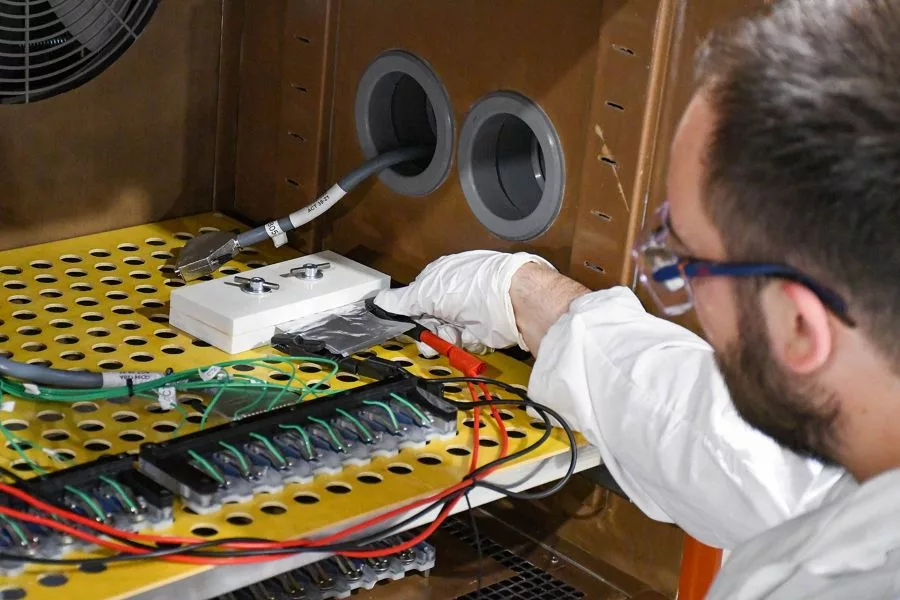
ARNSTADT, Germany—Engineers at the Fraunhofer Institute for Ceramic Technologies and Systems (IKTS) are developing a sodium-ion battery that uses lignin, a by-product of the wood and pulp industry, as an electrode.
The goal of the ThüNaBsE (Thuringia Sodium-Ion Battery for Scalable Energy Storage) project is to create an environmentally friendly device that is cheaper, safer and easier to recycle than traditional batteries. The engineers are using wood harvested from the nearby Thuringian Forest as a bio-based raw material for the negative electrode.
“We want to avoid critical metals such as lithium, cobalt and nickel in the battery value chain,” says Lukas Medenbach, a researcher working on the project at Fraunhofer IKTS. “We also aim to minimize the fluorine content in the electrodes and electrolytes, and we are testing to which degree we can eliminate it.
Under inert conditions, lignin is thermally converted into carbon, which is then further processed into electrodes. According to Medenbach, hard carbon boasts high electrochemical performance, good cycle stability and low acquisition costs, especially if obtained from sustainable raw materials.
“After 100 charging and discharging cycles, the lab cell shows no significant degradation,” explains Medenbach. “The aim is to demonstrate 200 charging and discharging cycles for the 1-ampere-hour full cell by the end of the project.”
Once fully developed, Medenbach says the battery could be used for stationary or mobile storage applications where fast charging is not required, such as forklifts, microcars or other small vehicles that require lower power requirements.
Looking for quick answers on assembly and manufacturing topics? Try Ask ASM, our new smart AI search tool. Ask ASM
Looking for a reprint of this article?
From high-res PDFs to custom plaques, order your copy today!