Next2OEM Project Explores Automated Wire Harness Production
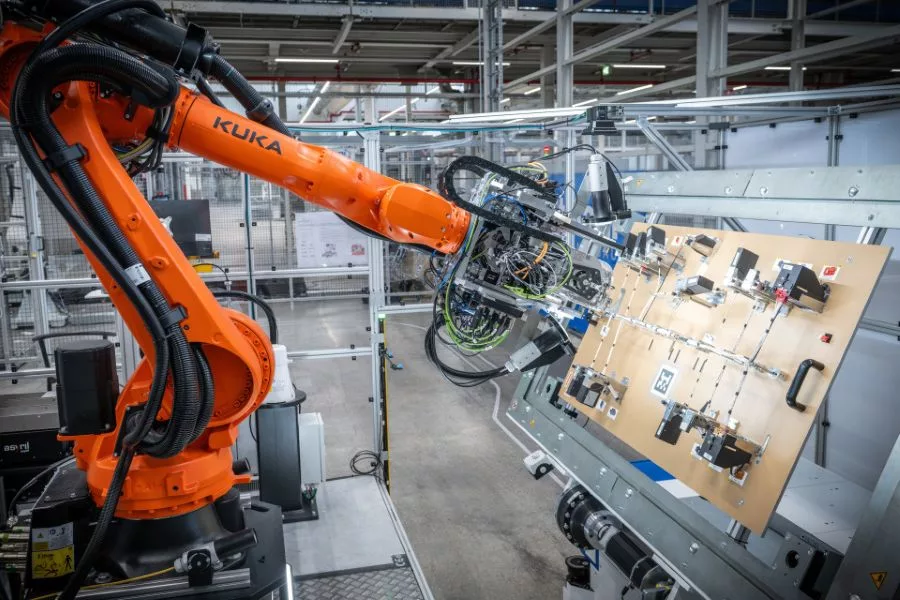
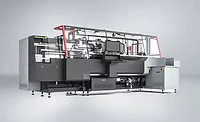
Audi recently concluded a three-year R&D project that focused on new ways to automate wire harness assembly. Photo courtesy Audi AG
Engineers at Audi AG recently concluded a three-year R&D project that focused on new ways to automate wire harness assembly applications in the automotive industry. Next2OEM was conducted with a handful of partners, including Komax Group and TE Connectivity.
The project demonstrated that even flexible components such as cable harnesses can be handled and assembled automatically using innovative design and process approaches.
The goal of the initiative was to show how digitalized, end-to-end automated wire harness production can succeed along the entire value chain—from development and production to final insertion into the center console of a vehicle. Potential benefits include less complex logistics, fewer manual tasks, error reduction and shorter response times for adjustments (minutes instead of weeks).
Komax provided Omega 850and Zeta 640 machines for the project. Other equipment included an ultrasonic welding station, an automatic twisting unit for the production of unshielded twisted pair wires in sequence, a forming board and integrated testing modules. In addition, Next2OEM used a six-axis Kuka robot for spiral and spot taping, and attaching clips, as well as an integrated inline vision inspection unit.
“It became clear that robust automation can only be achieved through the coordinated design of components, processes and systems engineering via clearly defined mechanical interfaces,” says Stefan Glaser, product management director at TE Connectivity. “In the Next2OEM project, we consistently developed our connection technology from the perspective of the automated process chain—not only in terms of electrical performance, but with a clear focus on robotic processing.
"The great interest from the market shows that automation-compatible wiring harness components are a decisive lever for future series processes,” notes Glaser. “They are becoming a strategic driver for future vehicle platforms and are now also technically feasible.”
“The results obtained in the Next2OEM project will be transferred to series production processes for future vehicle platforms at TE,” claims Glaser. “The findings will be incorporated into the further development of wiring harness components, such as contacts and connectors, to develop new products designed for automatic processing right from the start.
“At the same time, the project has shown that numerous technical and procedural challenges remain, particularly with complex wiring harnesses,” warns Glaser. “Additional automation will need to be developed for these applications in the coming years.”
Looking for quick answers on assembly and manufacturing topics? Try Ask ASM, our new smart AI search tool. Ask ASM
Looking for a reprint of this article?
From high-res PDFs to custom plaques, order your copy today!