Workstations and Ergonomics
Can Exoskeletons Enhance Ergonomics in Manufacturing?
A new study by researchers at the University of Santa Clara examines whether exoskeletons can help workers on the assembly line.
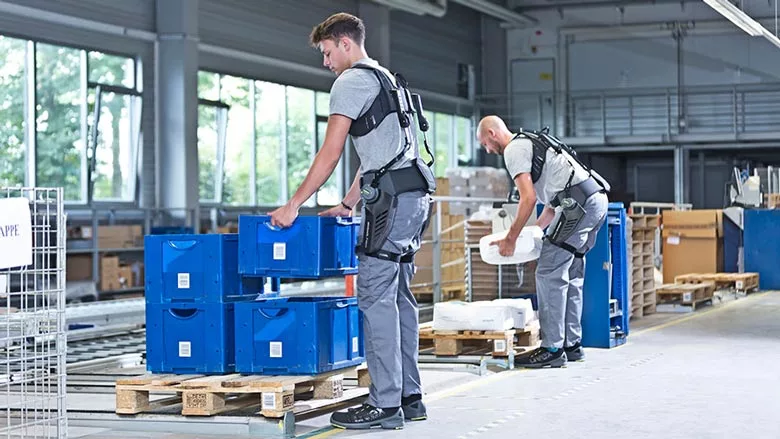
The exoskeleton decreased discomfort and physical exertion in critical areas such as the back, shoulders, and knees.
In manufacturing, where manual material handling and other physically demanding tasks are common, wearable assistive technologies, such as exoskeletons, can alleviate the burden on workers. By offering biomechanical support and reducing fatigue, exoskeletons can play a role in promoting occupational health and ergonomics.
Using exoskeletons for manual material handling tasks is particularly beneficial, since those tasks are usually associated with non-ergonomic postures that lead to physical discomfort and injuries.
Exoskeletons can be powered, passive or a hybrid of the two. Powered exoskeletons are mostly restricted to laboratory research, due to their higher costs and greater complexity. In contrast, passive exoskeletons are growing in popularity, because they are more affordable and user-friendly.
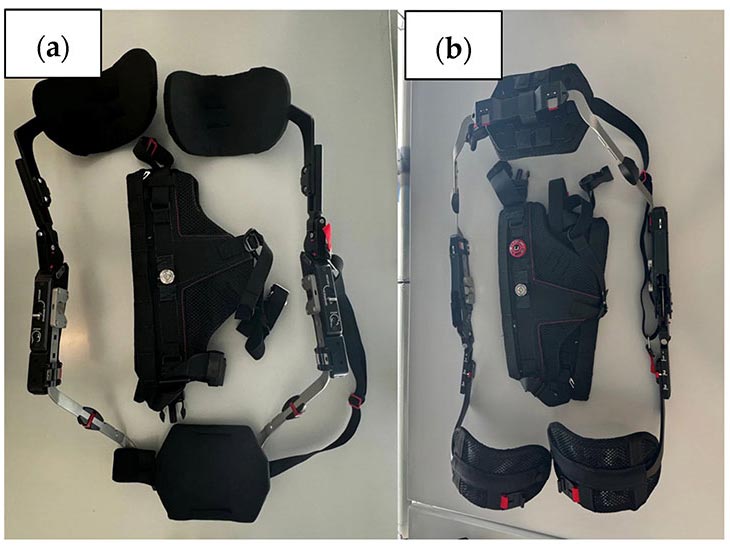
The researchers used the Ottobock BackX, a passive back-support exoskeleton for industrial applications. Photo courtesy Santa Clara University
A passive exoskeleton relies on springs and pulleys instead of motors to assist with movement. Often incorporating a belt or a buckle for attachment, this type of exoskeleton is both light and user-friendly, which makes it convenient to take on and off and enhances mobility and comfort for the user. Besides reducing physical strain, the exoskeleton may also lighten the cognitive load in tasks requiring prolonged posture, potentially improving balance and mental performance.
Despite their apparent benefits, adoption of exoskeletons remains limited. Greater adoption has been hindered by a lack of clarity on their effects and risks. Studies indicate that exoskeletons customized for individual needs may be more effective than generic models. However, thorough evaluations, weighing their advantages and disadvantages, are still needed to guide developers, ergonomists and users.
We set out to provide an analysis of users’ interactions with a passive back-supporting exoskeleton. Our study focuses on the advantages and difficulties encountered when users wear a back-support exoskeleton during manual material handling tasks. In addition, the research offers a statistical comparison of the participants’ physical exertion and the biomechanical effort they perceive while engaging in these tasks.
Our Study
We designed a set of manual handling tasks to be completed by participants in two sessions: one with the use of an exoskeleton, and one without. Each participant was in good health, without any physical discomfort, medical conditions or musculoskeletal disorders.
Looking for quick answers on assembly and manufacturing topics? Try Ask ASM, our new smart AI search tool. Ask ASM
Our study involved 22 college students—10 men and 12 women—who volunteered as participants. Their average age was 20.5 years. Their average weight was 146 pounds.
Our study tested the Ottobock BackX, a passive back-support exoskeleton for industrial applications. The device alleviates gravity-induced forces on the lower back. It reduces exertion during tasks involving stooping, lifting and reaching by providing supportive force to user’s chest and thighs.
Initially, each participant performed a sequence that included walking for two minutes and then carrying and lifting a box weighing 15.6 pounds. These tasks were completed without the aid of the exoskeleton. For the walking task, participants walked 8 feet, back and forth, at their preferred walking speed. The carrying task involved moving the box between two points 8 feet apart. Each task of carrying and lifting the box was repeated in two sets of three repetitions. The height at which the box was to be placed during the lifting tasks was fixed at 2 feet.
The tasks were then repeated while wearing the exoskeleton.
Breaks of three to five minutes were provided throughout the session to prevent fatigue and ensure the participants’ well-being.

Study participants were asked to complete three tasks: walking, lifting a box, and carrying a box. Photo courtesy Santa Clara University
Survey Components and Analysis
We used two types of assessment: one for testing the impact of the exoskeleton on perceived physical exertion and another to examine interaction between users and the exoskeleton.
To measure perceived physical exertion, we used the Borg scale of 0 to 10, with “0” representing no exertion and “10” representing maximum exertion. The Borg scale is designed to rate muscle exertion and pain. While subjective, it provides a clear and direct measure of exertion.
The participants rated their discomfort in various body parts, including neck, shoulders, upper body, chest, wrists, lower body, knees, ankles, feet and elbows.
In addition, the participants completed a survey assessing several dimensions of the exoskeleton’s usability and impact. The survey included questions about ease of use, practical utility, user attitudes, trust and overall experience. Each aspect was rated on a scale from 0 to 10.
For ease of use, the participants rated cognitive effort, freedom of movement, physical effort, and overall ease of use. For usability, the participants assessed posture improvement, fatigue, perceived inefficiency, movement constraint and overall helpfulness. To assess attitudes toward the product, the participants rated the exoskeleton’s trustworthiness, ergonomic impact, general sentiment, comfort and perceived innovation. Understanding these attitudes helps gauge user acceptance of the technology.
Finally, participants were asked to provide their ratings on usage likelihood, perceived power augmentation, training requirements and impact on autonomy.

Participants reported less perceived physical exertion while wearing an exoskeleton than they did without it. Photo courtesy Santa Clara University
Exertion Results
Our data indicate a significant reduction in perceived physical exertion when the tasks were performed with the exoskeleton. This highlights the potential of exoskeletons as an ergonomic tool in high-exertion settings such as manufacturing.
The exoskeleton reduced the perceived physical exertion for several body parts. For the lower back, the reduction was substantial, with a decrease of 22.67 points, indicating a major alleviation of exertion. The knee showed a notable reduction of 9.33 points, and the shoulder a significant drop of 10 points. The upper back experienced a reduction of 9 points, while the ankle and wrist showed decreases of 6.66 and 5.33 points, respectively. The feet and elbow also benefited from the exoskeleton, with reductions of 4 and 3.67 points, respectively.
In contrast, the chest experienced a slight increase in exertion with the exoskeleton, with a rise of 3 points, suggesting that the exoskeleton might add some load to this area. The neck showed a minimal reduction in PPE, with a decrease of only 1.34 points.
Overall, the exoskeleton appeared to be effective in reducing physical exertion in most body parts, particularly in the lower back, knees and shoulders.

The exoskeleton was particularly beneficial in relieving perceived physical exertion of the lower back. Photo courtesy Santa Clara University
Not surprisingly, the level of physical exertion varied by task. Walking was less demanding than lifting and carrying the box. The significant differences across tasks suggest that exoskeletons may provide varying degrees of support depending on the specific activities performed.
For the walking task, the mean difference in the exertion scores with the exoskeleton and without it was 3.8, indicating no statistically significant difference. However, for the lifting task, the test showed a significant mean difference of 8.15 in exertion scores, confirming that the exoskeleton reduces physical exertion in lifting. For the carrying task, the mean difference in exertion scores was 6.55, suggesting no statistically significant difference.
These results highlight the effectiveness of the exoskeleton in reducing physical exertion during lifting tasks, while its impact on walking and carrying tasks is less pronounced.

The exoskeleton reduced exertion during lifting tasks, while its impact on walking and carrying tasks was less pronounced. Photo courtesy Santa Clara University
Survey Results
Our survey about the exoskeleton yielded mixed results.
The exoskeleton received high scores for safety, trust and ergonomic assistance. However, it received moderate scores in empowerment and willingness to reuse. Addressing the feelings of constraint and intimidation would enhance user experience and acceptance of the device.
The exoskeleton received high average scores for helpfulness, ease of use, safety, trust and posture improvement. Users generally found that the exoskeleton was beneficial in enhancing their posture, was straightforward to operate, and instilled a sense of safety and reliability.
On the other hand, the exoskeleton received low average scores for perceived tiredness, perceived time wasted, perceived constraint, cognitive effort, level of freeness, and perceived physical effort.
Moderate scores for perceived constraint and physical effort point to some discomfort and physical exertion and restricted movement while wearing the device. Additionally, the middling score for freeness suggests that the users experienced a degree of movement limitation, which could affect task performance and overall satisfaction.
The participants also rated cognitive effort, movement freedom, physical effort, and overall ease of use. The cognitive effort required to use the exoskeleton was rated at 2.42 out of 10, suggesting that the mental demand of operating the device is relatively low. Movement freedom, or freeness, scored 5.09 out of 10, indicating a moderate level of autonomy in movement while using the exoskeleton. The physical effort required to operate the exoskeleton was rated 3.27 out of 10, reflecting that the physical exertion needed was manageable, but could be improved.
Overall, the exoskeleton’s ease of use was rated 6.32 out of 10, suggesting that while the device is generally user-friendly, there are opportunities to further reduce the cognitive and physical effort required to use it effectively.
Usability was assessed through several dimensions, including posture improvement, fatigue level, perceived inefficiency, movement constraint, and overall helpfulness. The exoskeleton received a posture improvement rating of 5.55 out of 10, highlighting its effectiveness in enhancing physical alignment. The participants reported a fatigue level of 2.64 out of 10, indicating that the exoskeleton helped to significantly reduce fatigue.
Perceived inefficiency, or time wasted, was rated very low at 1.86 out of 10, suggesting that the exoskeleton did not hinder productivity. However, movement constraint received a score of 3.09 out of 10, indicating that some users felt restricted in their movements while using the device. Overall, the helpfulness of the exoskeleton was rated 5.41 out of 10, reflecting a positive impact on task efficiency, but also highlighting areas for improvement in reducing movement constraints.
The participants provided ratings on various aspects of their attitudes towards the exoskeleton, including trustworthiness, ergonomic impact, general sentiment, comfort, and perceived innovation. Trustworthiness received a high rating of 6.59 out of 10, showing that the users felt confident about the device’s reliability and functionality. The ergonomic impact was rated 6.0 out of 10, indicating that the exoskeleton provided significant support in reducing physical strain. General sentiment, or how much the participants liked the exoskeleton, was rated 6.23 out of 10, reflecting a generally positive attitude towards the device. Comfort received a score of 5.86 out of 10, suggesting that while the exoskeleton is relatively comfortable, there is room for enhancement. Perceived innovation was rated 5.09 out of 10, indicating a moderate recognition of the exoskeleton’s technological advancement.
Finally, the participants were asked to provide their ratings on usage likelihood, perceived power augmentation, training requirements, and impact on autonomy. Usage likelihood, or the intention to reuse the exoskeleton, was rated 4.44 out of 10, suggesting that while the overall experience was positive, there is room for improvement. Perceived empowerment received a rating of 4.82 out of 10, indicating that the exoskeleton moderately enhanced the user’s sense of strength and capability.
The training requirements were rated very low at 2.41 out of 10, reflecting that minimal training was needed to use the exoskeleton effectively. Impact on autonomy was also rated low at 2.45 out of 10, suggesting that the exoskeleton did not hinder the user’s sense of control and independence.
Our results suggest that while the exoskeleton had a positive impact on reducing physical exertion and supporting safer lifting practices, further refinement in its design could improve flexibility, comfort and broader utility.

The exoskeleton decreased discomfort and physical exertion in critical areas such as the back, shoulders, and knees. Photo courtesy Ottobock
Conclusions
Our findings show that the exoskeleton decreased discomfort and physical exertion in critical areas such as the back, shoulders and knees, which are prone to injury in industrial environments. By enhancing ergonomic postures, the exoskeleton alleviates immediate physical strain and contributes to the long-term prevention of musculoskeletal disorders.
Despite these positive outcomes, the survey also highlighted areas for improvement, particularly in reducing feelings of constraint and improving overall comfort.
Our study was limited by its sample size and demographic. Young, healthy college students may not fully represent the diverse workforce in manufacturing. Future research should aim to include a larger and more diverse sample to enhance the robustness and applicability of the findings.
Furthermore, the study relied solely on subjective survey methods and did not use biophysical measures, such as electromyography. Additionally, the laboratory environment does not entirely mimic the complexities and variations of real-world manufacturing. These factors highlight the importance of conducting further research involving real-world settings.
It is crucial to also explore the long-term effects of exoskeleton use on worker health and productivity, including potential negative outcomes, such as dependency or over-reliance on the technology.
Since several passive exoskeletons are available on the market, and only one type was tested in this trial, future studies should consider testing a range of exoskeletons to determine the best fits for various tasks and users.
The deployment of passive exoskeletons in manufacturing could lead to improvements in worker safety, comfort and productivity. However, to fully realize these benefits, ongoing refinement of the design and personalized training programs will be essential.
Editor’s note: This article is a summary of a research paper co-authored by Armin Moghadam, Ph.D., assistant professor of engineering at San Jose State University; and Arnold Nieto and Hardik Vora, research assistants at Santa Clara University. To read the entire paper, click here.
For more information on exoskeletons, read these articles:
Exoskeletons Lend a Lift at Ford
Exoskeletons Aid Assemblers at Truck Plant
Exosuits Ease Back Strain
Looking for a reprint of this article?
From high-res PDFs to custom plaques, order your copy today!