Manufacturers Plan to Double Down on Automation
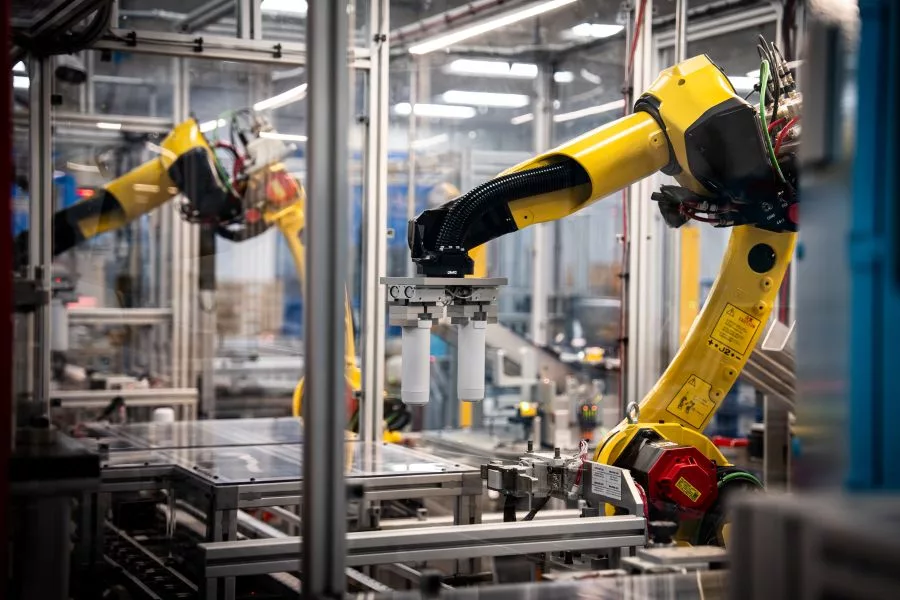
Manufacturers are planning to invest more in robots and other types of automation. Photo courtesy GE Appliances
LONDON—The number of manufacturers that expect to automate key production processes by 2030 will more than double, from 18 percent to 50 percent, according to a recent survey conducted by PwC. The Global Industrial Manufacturing Sector Outlook study claims that “future-fit” industrial manufacturing companies—the fastest, most agile and most innovative 20 percent of companies identified in the survey—will have a clear edge.
Currently, 29 percent of these companies have highly automated processes, compared with 15 percent of other companies. By 2030, that share is expected to rise to 65 percent for future-fit companies vs. 45 percent for others.
“As tech adoption and automation accelerate, advantage will shift from who has tools to who can adopt them and orchestrate them the fastest,” says Ryan Hawk, global industrials and services leader at PwC US. “Agile, tech-enabled and future-fit manufacturers already have an edge.
“The divide between those who are tech-enabled and those still operating with patched up systems [will] widen even further,” warns Hawk. “The question for manufacturers is do they know what to adopt and [what is] their level of readiness?
“In terms of the overall deployment of advanced technology within value chain steps, two areas—first, production and operations, and second, product design and development—will lead the way, with heavy use reaching 76 percent (from 29 percent) and 72 percent (from 37 percent), respectively,” explains Hawk.
“While the goals behind this investment boom vary by technology, they center on growth and productivity,” claims Hawk. “AI is equally expected to deliver both (47 percent and 46 percent respectively), while robotics is seen as less about growth (13 percent) and more about productivity (78 percent).
“Tech enablement and automation will surge across the sector, yet the most meaningful performance differentiation will come from how coherently those technologies, including AI and automation, work together,” says Hawk. “If manufacturers are to unlock the growth and productivity opportunities afforded by new and emerging technologies, they must treat AI and other advanced technologies as a system, not a set of projects and advanced tools in isolation.”
Looking for quick answers on assembly and manufacturing topics? Try Ask ASM, our new smart AI search tool. Ask ASM
Looking for a reprint of this article?
From high-res PDFs to custom plaques, order your copy today!